Ontario / Practical guides
Stop guessing whether they read your quote
An evening on a price, then silence, and no way to tell whether it landed in spam or was read and rejected. Send the proposal as a page instead of an attachment and it reports back: what they read, for how long, and what they skipped.
Browse all Ontario guidesPut this into practice
Build the offer
Connect the scope, price, assumptions, and client response in one working proposal.
You spend an evening on a price. You send it. Then nothing. A week later you still do not know whether it landed in spam, whether they opened it and hated the number, or whether it is sitting unread under two hundred other emails.
That not-knowing is the expensive part. It decides whether you phone tomorrow or leave it another week. Calling into silence feels like begging, so the week wins.
What it sounds like
"I spent hours working on this quote for this customer and essentially got ghosted after delivering the price, even coming up with multiple cost saving options, as well as a few upgrade options."
"My old process was: talk to lead, spend hours on diagram and estimate, get ghosted."
Both of them changed how they qualify, which is right. The other half of the fix is refusing to send work into a black hole in the first place.
Send it as a page, not an attachment
A PDF in an email tells you nothing after it leaves. The same documents sent as a page the client opens can tell you everything, because opening a page is an event and opening an attachment is not.
Same content. Cover letter, scope and exclusions, the price, your recent work, your insurance certificate. The difference is that this one reports back.
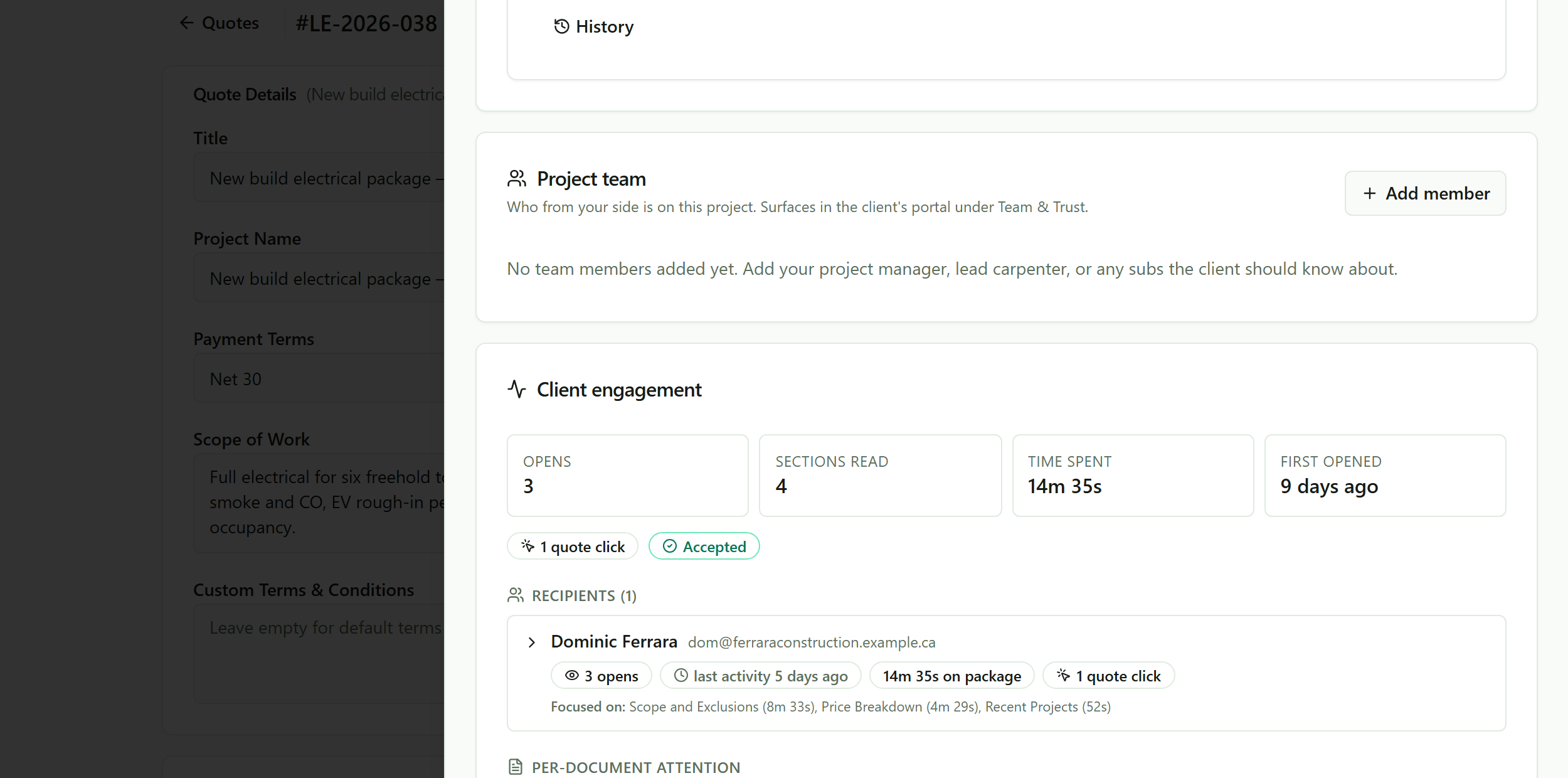 Not whether it was delivered. What they read, for how long, and in what order.
Three opens. Fourteen and a half minutes. First opened nine days ago, last activity five days ago. And the line that changes what you do next: Focused on: Scope and Exclusions (8m 33s), Price Breakdown (4m 29s), Recent Projects (52s).
Somebody who spends eight minutes in your scope is not ignoring you. They are working out whether the price covers what they think it covers. That is a phone call you can make with an opening line.
What they skipped tells you more
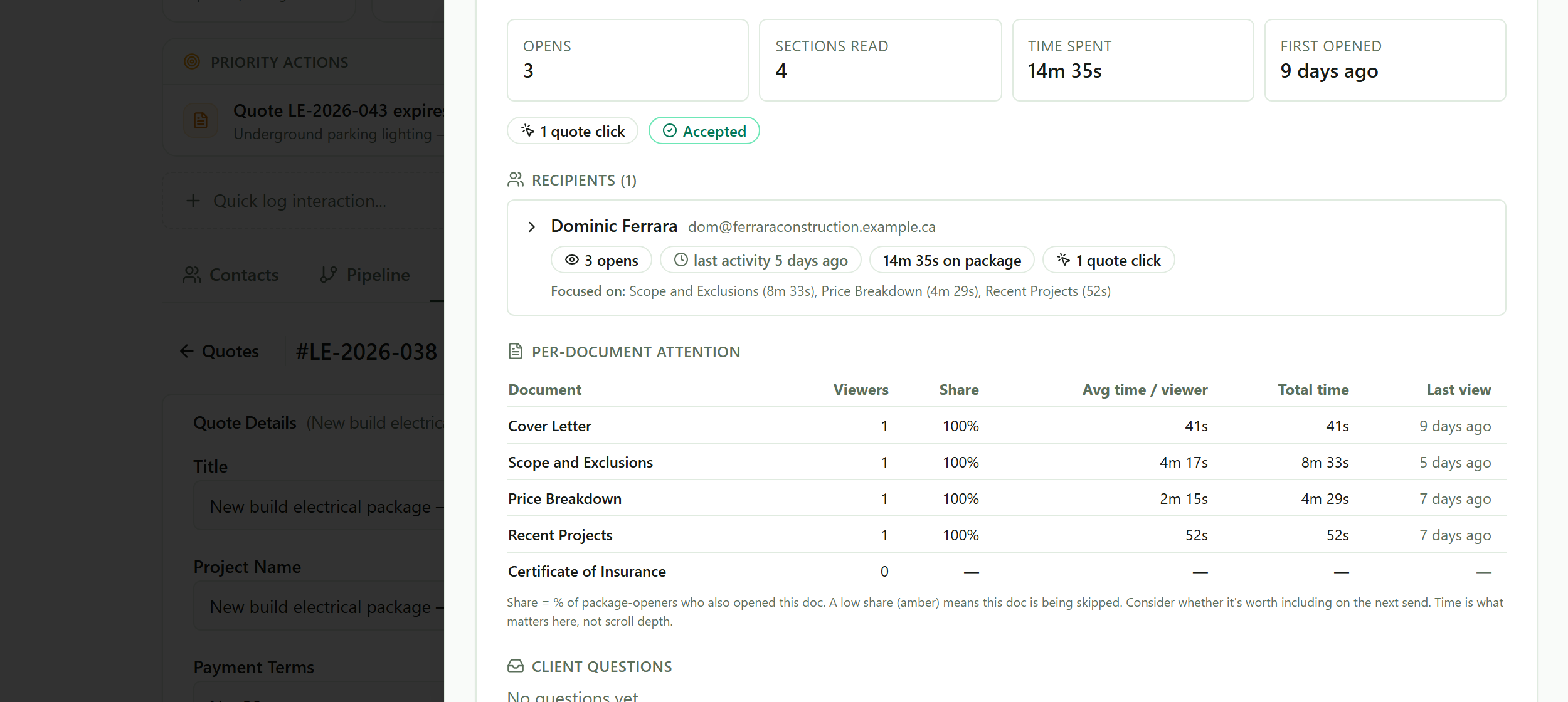 The row with nothing in it is the useful one.
Cover letter: forty-one seconds, a glance. Scope: eight and a half minutes. Certificate of insurance: never opened.
That last row is a read on who you are dealing with. A general contractor's coordinator opens the insurance certificate first, because compliance is their job. An owner building their own kitchen has no reason to. Knowing which of the two you are looking at changes what you lead with next time.
It also tells you what to stop sending. A document that goes unopened package after package is making yours longer for no reason.
What to actually do with it
Opened, no reply, five days. Call. You are not chasing, you are following up on something they read. "I saw you had a look at the scope, did you want me to walk through the exclusions?" is a normal sentence.
Never opened, three days. The problem is delivery, not the price. Resend, or text them, or check the address. Do not rewrite the quote.
Opened once, thirty seconds, nothing since. The number was wrong for them and they stopped reading. Worth one call to find out whether it was the number or the scope, and worth remembering when you price the next one for that client.
Opened repeatedly by more than one person. It is being circulated internally. Something is being decided. That is the moment to be available rather than patient.
Long time in the scope. They are comparing you to somebody else's scope. This is where written exclusions win or lose the job.
The part that is not tracking
None of this makes a bad price good. If you are consistently opened, read carefully and then not chosen, the answer is in what an hour costs you and how you price, not in the follow-up.
What tracking fixes is the other failure, which is more common and completely avoidable: a job you would have won, lost to silence because nobody called.
What the client gets out of it
The client's side of this is better than a PDF, which is why they open it. It is a page that works on a phone, sections they can jump between, the price laid out rather than buried on page four, and a button to accept or ask a question without composing an email.
Your side is opens, time on each section, and clicks, tied to the address you sent it to. The same standard reporting any emailed document gives you, on a document the client actually prefers.
What it costs
Commercial terms depend on the workflow. Review the relevant AEC Stack product page before you start.
On AEC Stack: the board that holds the ones still open is every job on one board. What goes in the package is pricing a job and scope and exclusions.
Open the last quote you sent and look at whether it was opened. If it was, and you have not called, that is today's call. The demo business has a sent package with its tracking already on it.
Take this guide with you
The full write-up, every screenshot and clip, captions, and a machine-readable manifest in one zip. Share it with your office or hand it to whoever runs your socials.
Download the kitContinue reading