Ontario / Practical guides
Your first public bid, without the paperwork stopping you
Public work is not harder work, it is work with a filing cabinet attached. See what is actually open with closing dates, then find you already hold a controlled document library with the company profile and prequalification package in it.
Browse all Ontario guidesPut this into practice
Find relevant work
Explore opportunities and carry the right one into a pursuit.
The work is not the hard part. Fifteen years in and a municipal watermain job is a Tuesday. What stops people is a bid package that assumes you have done this before: bonds, prequalification schedules, a document register, a company profile with a control number on it.
"Anyone know a website or something that has an idiots guide to bid with on a state government job? I'm trying to bid on a concrete job (the job itself is a joke and not a problem) but all the different types of the bonds and when needed are confusing. We're a legit business with 15 years in residential and commercial but I'm wanting to dip my toe in the government work pool to see if it's worth the headache."
The job itself is a joke and not a problem. That is the whole thing. Public work is not harder work, it is work with a filing cabinet attached, and the filing cabinet is what decides whether you find out if it is worth the headache.
Start by seeing what is actually open
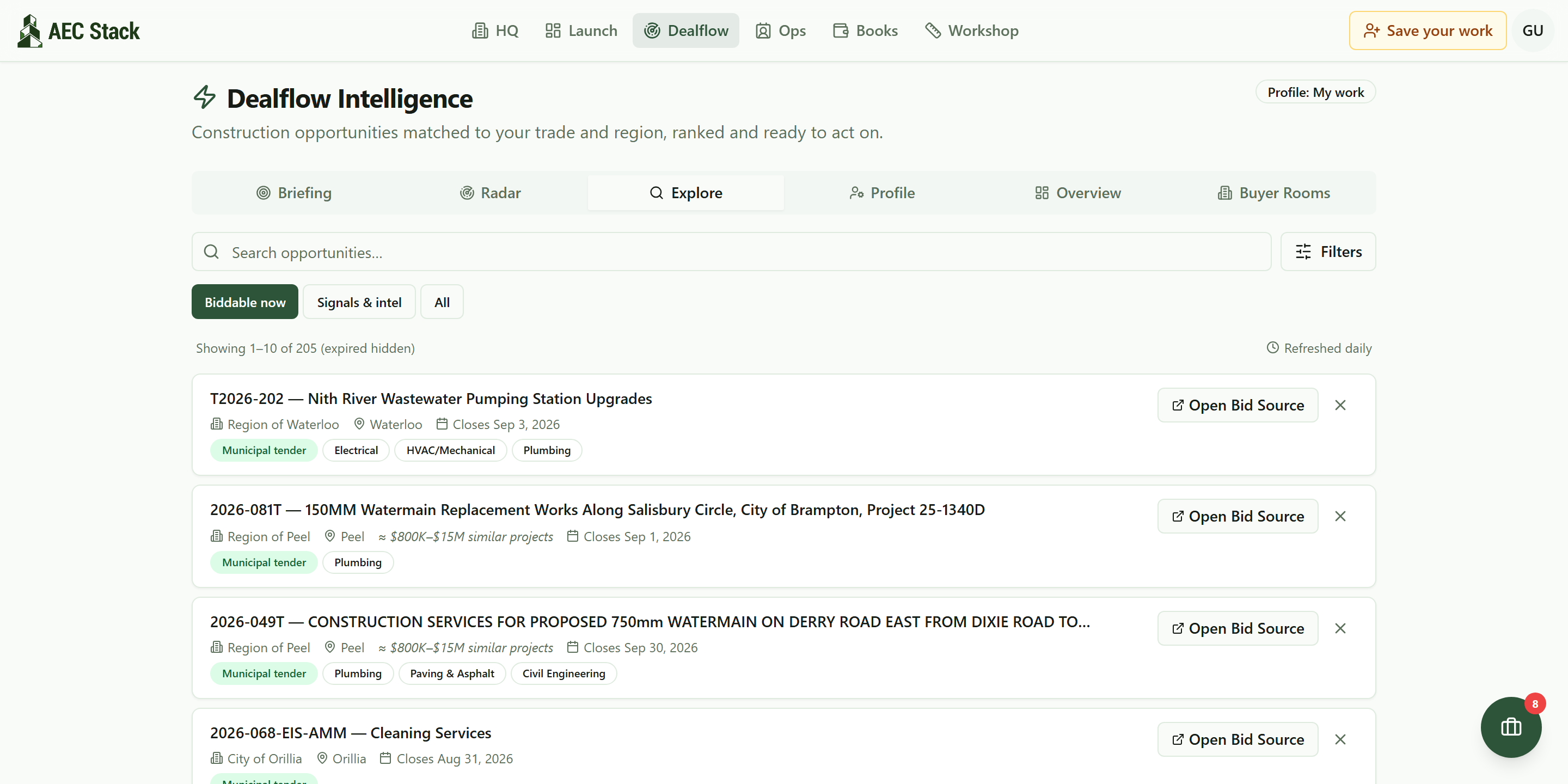 What is actually open, with the closing date on the row and a button that takes you to the buyer's own portal to download the documents.
Biddable now is the filter that matters on a first attempt, because it hides the expired ones and separates real closings from the standing-offer rosters and vendor-of-record lists that look identical in a search result and are a completely different thing to apply for.
Two hundred and five open, each row carrying the tender number, the buyer, the city, the closing date and the trades. Some carry a band like $800K to $15M similar projects, drawn from comparable work that has settled, which on a job with no published budget is the difference between a guess and a range.
Open Bid Source takes you to the buyer's own portal to download the actual documents. Nobody is between you and the tender.
Pick one that closes far enough out that the paperwork is not a panic. Read the submission requirements page first, before the drawings. That page is the real spec on a public job.
Then find out you already have most of the filing cabinet
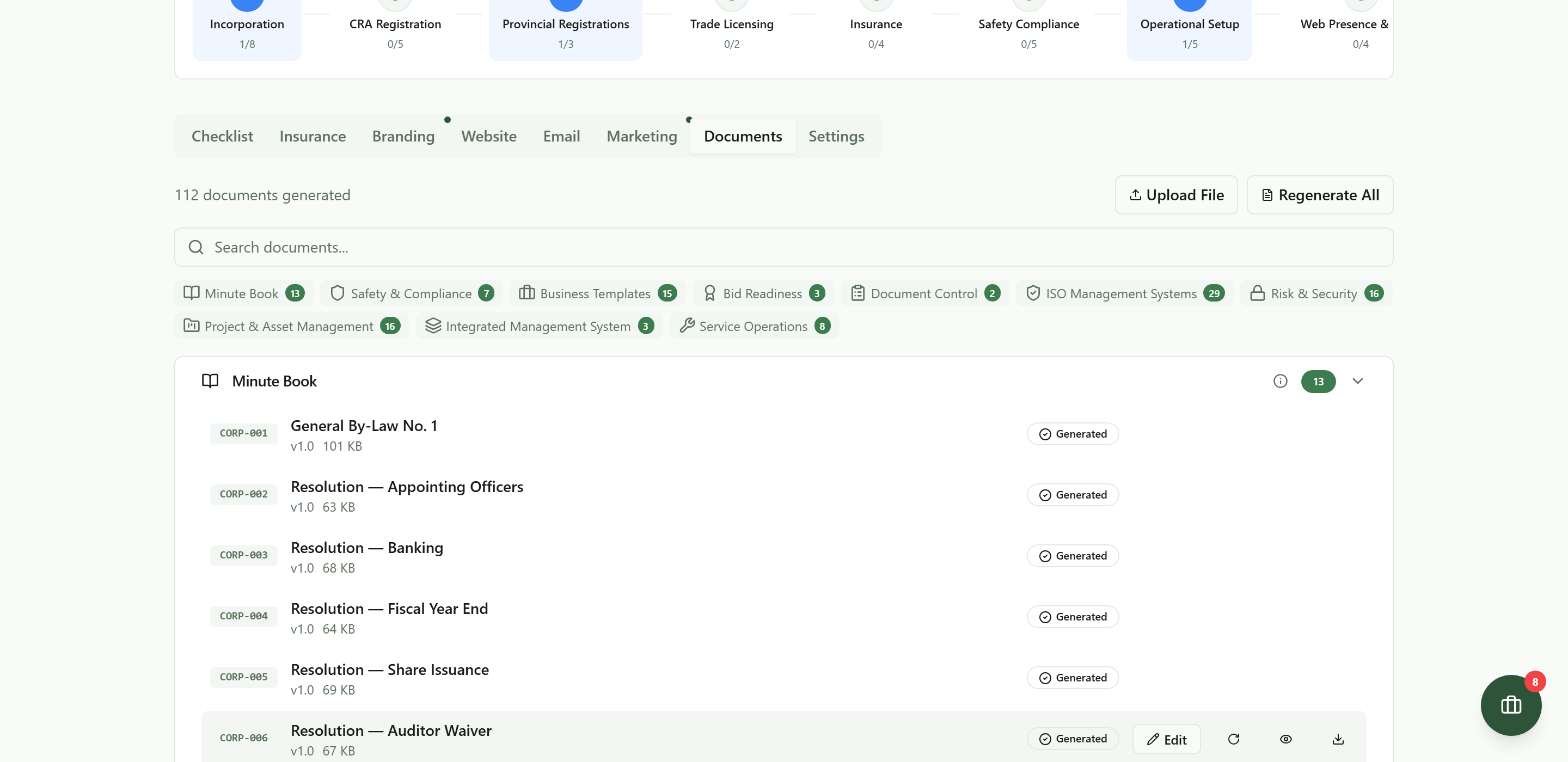 A hundred and twelve documents, already made, each with a control number and a version. That is what a reviewer means by a controlled document.
A hundred and twelve documents, generated for the business rather than downloaded off a template site. Minute book, safety and compliance, ISO management systems, risk and security, project and asset management.
Look at what is beside each one. CORP-001, v1.0. A control number and a version, which is precisely what a prequalification schedule means when it asks for controlled documents and what a reviewer is checking when they open the file. A health and safety policy in a Word document somebody edited last March reads as one thing. The same policy carrying a number, a version and a register entry reads as a company that has a system.
That difference is most of what separates a bidder who gets scored from one who gets returned.
And the three a buyer asks for first
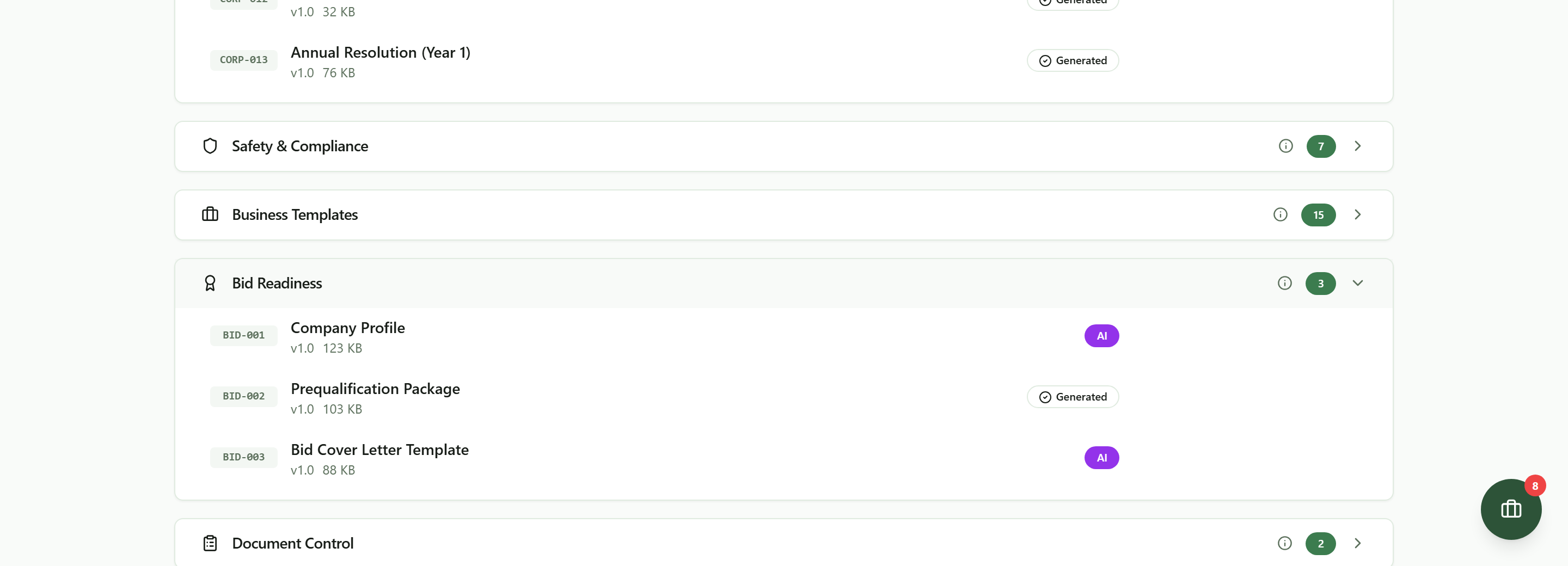 The three a public buyer asks for first, numbered and versioned like everything else in the library.
Company profile, prequalification package, bid cover letter. Numbered BID-001 to BID-003, in your branding, filed as PDFs.
These are the three that get asked for on nearly every public submission and the three most likely to be written at 11pm the night before. Having them already made turns the first bid from a week of assembly into an afternoon of filling in what is specific to the job.
The order that makes a first one survivable
Read the submission requirements before the scope. Public bids are refused on form far more often than on price. Find the checklist page, then work backwards.
Register on the buyer's portal the day you decide, not the day it closes. Some take a day to approve an account. That is the single most common way a first bid dies.
Sort the bond conversation early. Bid, performance and labour-and-material bonds come from a surety, and a surety underwrites the company, not the job. They will ask for financial statements, your incorporation documents and your safety record, which is the same filing cabinet above. Ring a broker the week you decide to bid, not the week it is due.
Record your C of Q and master licence numbers once. They land in the prequalification packet automatically after that, and a missing licence number is a returned submission.
Ask what a step means, out loud. A tender is written in procurement language on purpose. The advisor will translate a clause in ordinary terms, and there is a person behind it when the answer is not good enough.
Then run the readiness check before you send. It looks for placeholders left in, missing scope and missing numbers, and it blocks the send on the critical ones. A bid with a bracket in it is not a near miss, it is non-compliant.
And the fee only lands after you are paid
Commercial terms depend on the workflow. Review the relevant AEC Stack product page before you start.
On AEC Stack: the readiness side is the bid-ready checklist and what a prequalification asks for. Every document in that library is covered in brand, website and documents in one click.
Pick one tender closing four weeks out and register on the buyer's portal today. You will learn more about whether public work is worth it from one real submission than from any amount of reading about it. The live Ontario tender list is free and needs no account, so picking that one tender takes a couple of minutes.
Take this guide with you
The full write-up, every screenshot and clip, captions, and a machine-readable manifest in one zip. Share it with your office or hand it to whoever runs your socials.
Download the kitContinue reading