Ontario / Practical guides
Look like a real company on the day you decide to be one
The decision takes a sentence. The admin that follows takes a fortnight: a logo, a colour picked in a hurry, a website that never gets finished, and documents written the night before a builder asks for them. One press produces all three, in one brand.
Browse all Ontario guidesPut this into practice
Build your next client relationship
Keep contacts, follow-ups and the next opportunity in one place.
The decision is the hard part, and people make it in a single sentence. What follows is a fortnight of admin that has nothing to do with the trade: a logo, a colour somebody picked in a hurry, a website that never quite gets finished, and a folder of documents you write the night before a builder asks for them.
That gap is where the momentum goes.
The moment itself
"I've realized through my time as a super especially working for the company I work for that I might as well own my own company and deal with the bullshit I deal with but for myself and my own paycheck. I held off for a year dealing with doubts and telling myself not to bother... But fuck it. Starting my own trim carpentry company and taking it to the builders."
"I've been building homes for 5 years and I'm tired of doing shit backwards... I'm going after my own clients for small jobs and will work to build homes on my own."
Both of them have the skill and the client instinct. Neither wants to spend the next two weeks choosing fonts.
A brand, not a colour picker
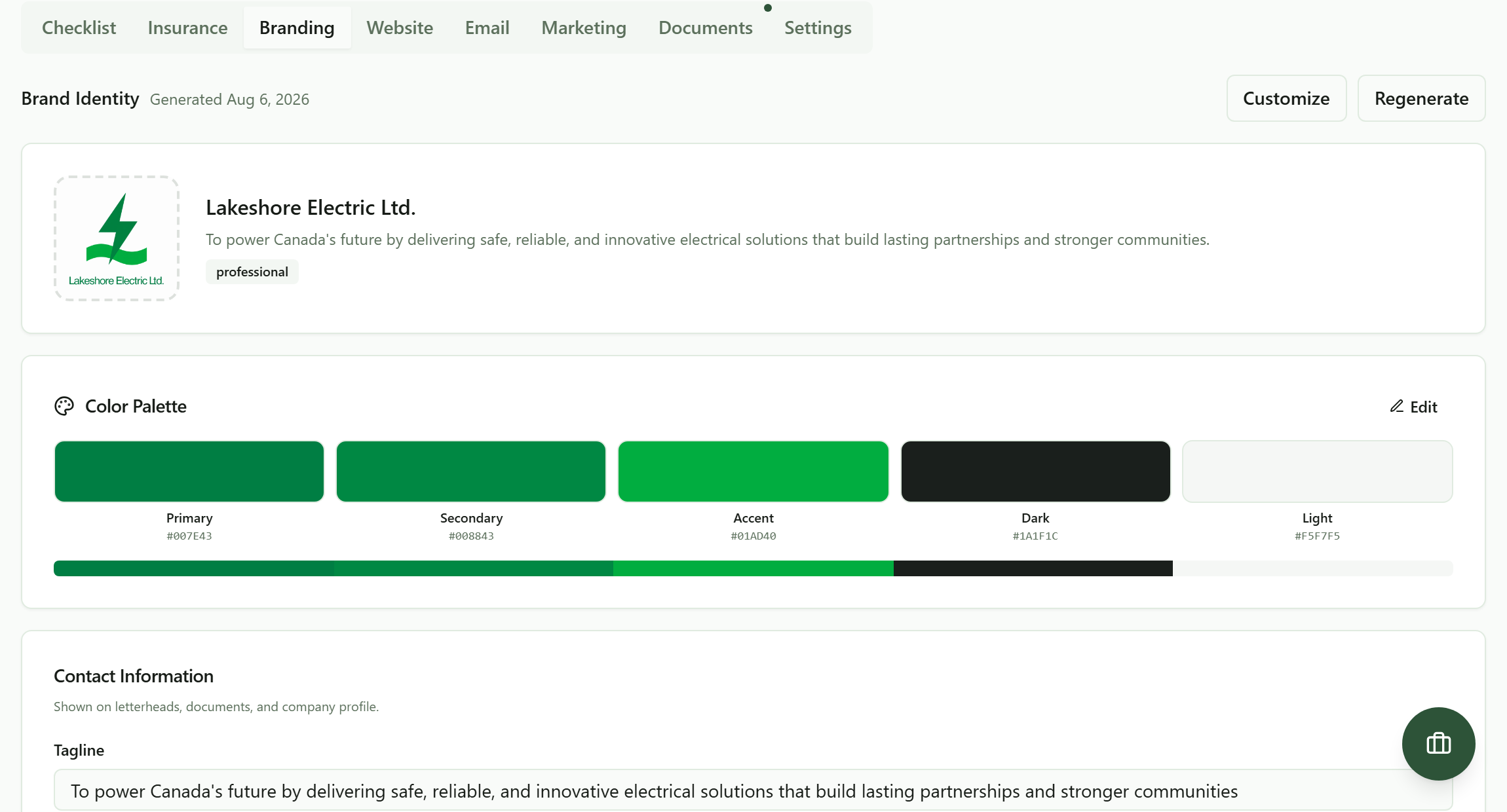 Colours, type, a mission line and a tone of voice. Generated from the trade, and built around the logo rather than beside it.
Five colours with the proportions they are meant to be used in, a heading and body typeface that go together, a mission line, and a written tone of voice.
The part that matters is that it is one system. A colour you like is not a brand; a brand is the same five values turning up on the quote, the invoice, the proposal the client opens, the business card and the website without you re-deciding each time. That is what stops a one-person company looking like a different company on every document.
If you already have a logo, upload it and the palette is built around it. If you do not, one is generated and you can ask for another with a note about what was wrong with the first.
The website is a switch list, not a project
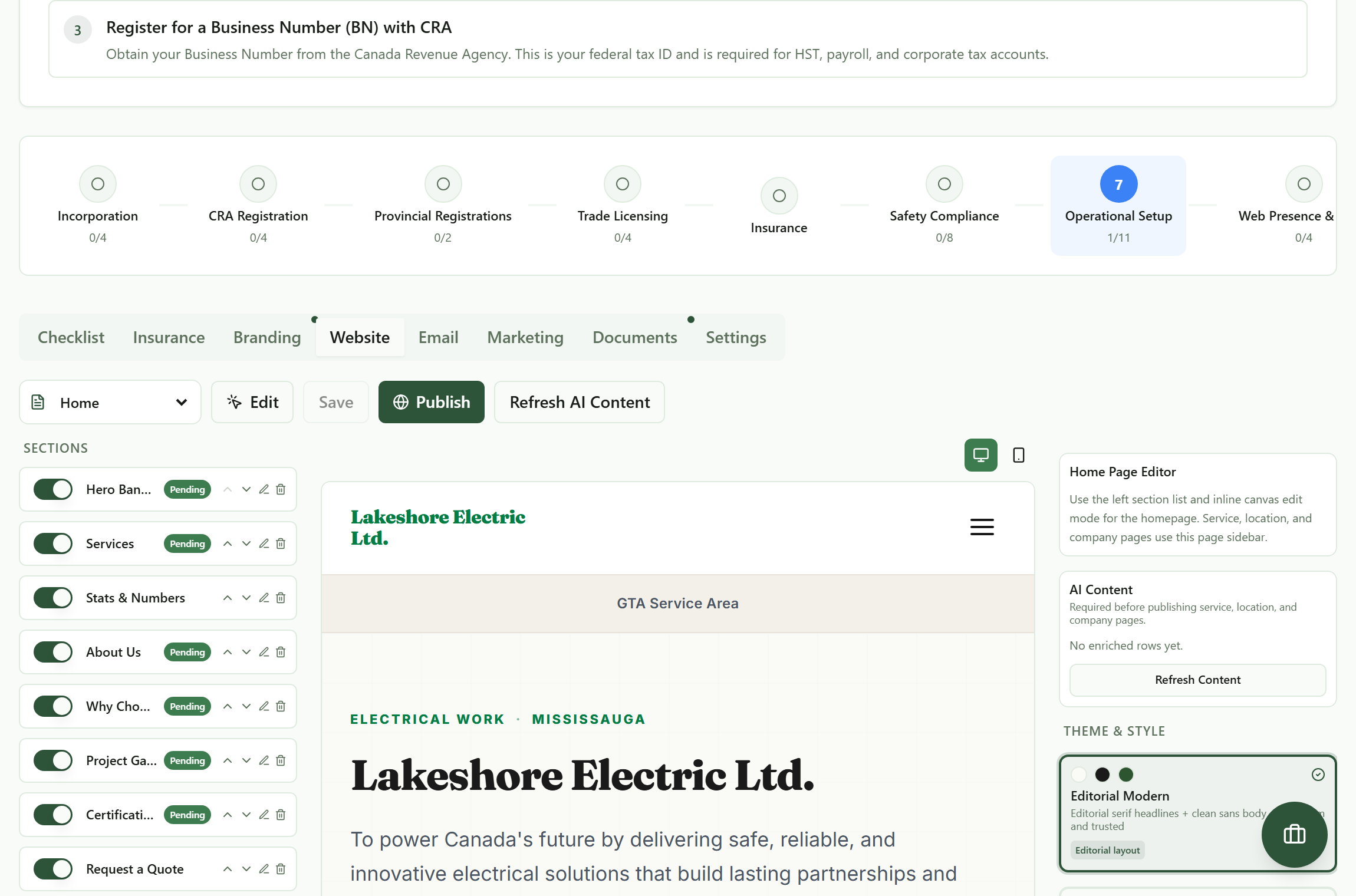 One press. The site is already in the brand, and every section is a switch rather than a build.
Fourteen sections, each a toggle: hero, services, stats, about, why choose us, project gallery, certifications, request a quote, testimonials, before and after, service areas, owner story, FAQ. Turn off the ones you cannot back up yet. A project gallery with no projects is worse than no gallery.
The preview is already in your colours and already says what you do and where. The photography is stock construction imagery, which is the honest trade: it is better than an empty box and worse than photos of your own work, so replace it as you finish jobs.
Nothing is public until you press Publish. The site lives at yourname.aecstack.com, and you can point a domain you own at it or buy one without going near a registrar.
The part worth knowing: the contact and quote forms on that site are wired to your CRM. A lead who fills in the form on a Sunday is a contact and a deal on Monday, not an email you have to re-type.
The paperwork arrives with it
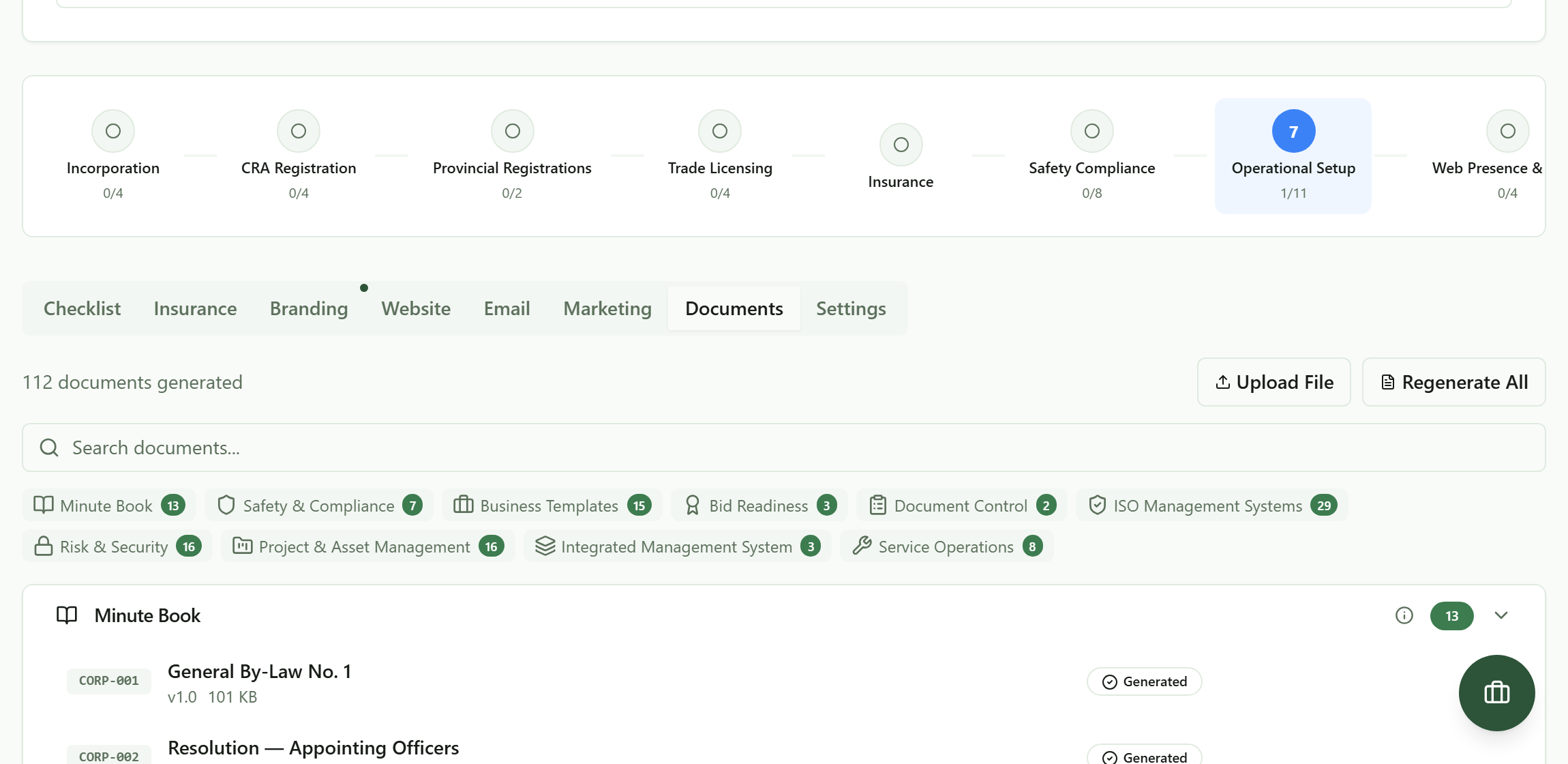 The same press produced the paperwork: 112 numbered, versioned documents, grouped the way a reviewer asks for them.
This is the part neither of them mentions. A builder does not ask for your website; they ask for a health and safety policy, a WHMIS program, a company profile, proof you have a document system.
Every one of these carries a control number and a version, written about your business rather than a blank template with your name pasted in. What a prequalification package asks for is getting on a builder's bid list.
What to do first, and what to leave
Do the brand before anything client-facing. Everything downstream inherits it, and changing it later means reissuing documents you have already sent.
Turn off the website sections you cannot support. Testimonials with no testimonials reads as a template, and builders recognise templates.
Do not publish the site the same hour you generate it. Read the About and Services text once. It is written from what you told the wizard, so it is right about your trade and guessing about your emphasis.
Leave the ISO documents alone until somebody asks. They are there so you are not caught out. They are not a thing to work through.
Read the safety policy before the first time you send it. It is written about your business and it is a commitment you are making, so it is worth five minutes and a nod. The first time a builder asks for one at 8am on a Monday, you find out what it is worth to already have it.
Without it, this is the part that gets written the night before, because it is boring and there is always a job on. Getting the paperwork to exist, in one brand, before anybody asks for it is most of what "looking like a real company" actually means.
What it costs
Commercial terms depend on the workflow. Review the relevant AEC Stack product page before you start.
On AEC Stack: what the whole setup costs is what going out on your own costs. Where the work comes from once you look the part is where work is starting.
Open your branding and look at the mission line. If it does not sound like you, change that one sentence: it is the line the website, the proposals and the company profile all quote.
Take this guide with you
The full write-up, every screenshot and clip, captions, and a machine-readable manifest in one zip. Share it with your office or hand it to whoever runs your socials.
Download the kitContinue reading