Ontario / Practical guides
What going out on your own costs, and how long until money comes back
Two numbers decide this and only one gets discussed. The setup fees are hundreds. The gap between doing the work and being paid for it is thousands, and it is the one that closes businesses.
Browse all Ontario guidesPut this into practice
Start with your business
Organize formation, standing, and the records that let the business operate.
Two numbers decide this and only one of them gets discussed.
The first is what it costs to set up: incorporation, licence, insurance, clearance. People ask about this constantly and it is the smaller number by an order of magnitude.
The second is how long you go on paying for materials, payroll and yourself before a client's money lands in your account. That is the number that closes businesses, and it is the one the tradesperson below is circling without naming: what have I totally not considered.
What people ask, and what they get told
The question, in full:
"Do I need to get WSIB, if so what is cost. I need to incorporate can I just upgrade my sole prop/HST number. Can a software like Quickbooks make payroll seamless? What kind of profit would make the added responsibility worth it? What have I totally not considered?"
The answer that keeps coming back:
"Plan on not having any income for minimum 6 months to start"
True, and no working shown. Here is the working.
The first number: setting up
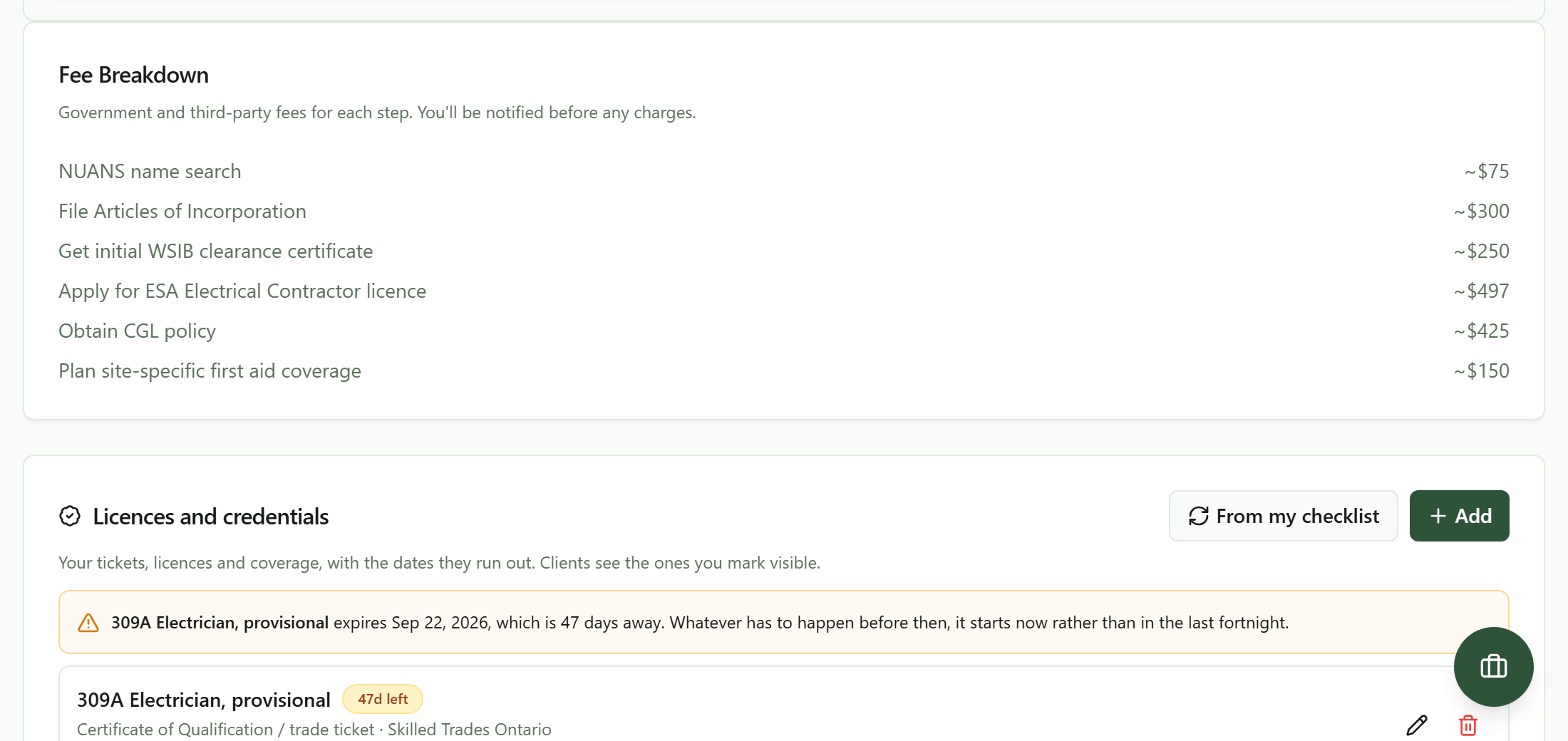 The government and third-party fees for your trade, per step, so you can see which ones are coming rather than one number that makes you close the tab.
These are the estimates on that business's own checklist, generated for an electrical contractor incorporating in Ontario. A landscaper's list is shorter and a home builder's is longer, because the licensing is different.
Read it per line rather than as a total. The reason it is presented that way is that a single scary number makes people stop, when the truth is that these arrive over weeks and several are optional at the start.
What is not in that list and should be in your arithmetic: insurance premiums beyond the first policy, WSIB premiums once you have workers, a vehicle, tools, a phone plan, an accountant, and the deposit your supplier will want before extending you terms. The licence fees are knowable. Those are not, and they are bigger.
Nobody can quote your premium from a page. It depends on your class, your revenue and your broker, which is why this page gives you the fee lines and not a number for insurance.
The second number: the gap
Now the part that decides it.
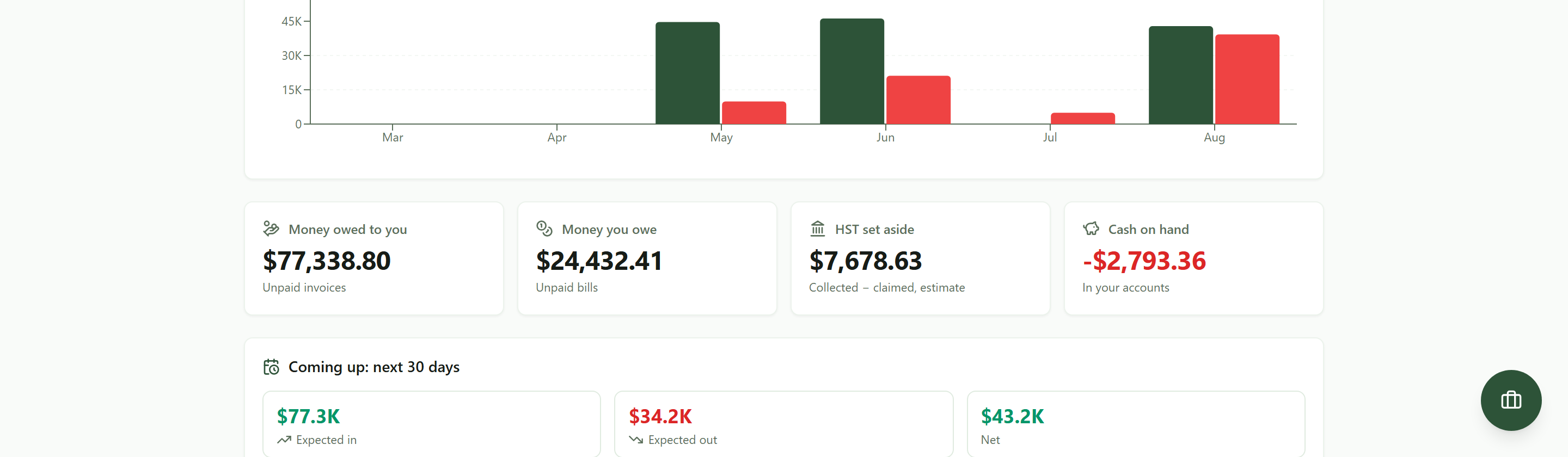 And this is the same trade a year in. The setup fees are the small number; the gap between doing work and being paid for it is the big one.
That is a real shape for a working contractor: seventy-seven thousand dollars invoiced and not paid, twenty-four owed to suppliers, and an overdrawn account. The business is profitable. The bank balance is negative. Both at once.
Work out your own version before you go:
How long from starting a job to being paid for it? Material goes out on day one. The invoice goes at the end or at a milestone. Terms are net 30 to net 60, and net 60 means sixty days at the earliest. On a two month job with net 60, money for work done in week one arrives around month four.
What goes out in the meantime? Materials, subs, fuel, your own living costs. Multiply by the number of months above. That is the float you need, and it is the answer to "how much do I need behind me".
What does the first invoice actually pay for? Not the work you are doing when it arrives. It pays for work you did months earlier, which is why growing fast makes it worse rather than better.
The people quoting six months are describing exactly this, and they are usually right for a business that starts without deposits.
What moves the number in your favour
Deposits. Nothing shortens the gap like being paid before the material is bought.
Bill as you go, not at the end. A four month job invoiced at the end is a four month loan. Billing monthly against a schedule of values is the single biggest lever you control: surviving net 60.
Price the job properly. Underpricing shows up as a cash problem months later and gets blamed on slow payers. What an hour of your crew actually costs is here.
Do not spend the HST. It sits in the same account and it is not yours: HST without the surprise.
Making the decision
Add the fee lines for your trade. Add the float from the second calculation. Compare that to what you have plus what you can borrow at a rate you would say out loud.
If the answer is close, the fix is usually not more capital. It is deposits and faster billing, both of which are free.
What it costs to use this
Commercial terms depend on the workflow. Review the relevant AEC Stack product page before you start.
The arithmetic above is the part people skip, and it is the part that decides whether the first six months are survivable. Run it with your own numbers before you hand in your notice.
On AEC Stack: the full setup list for your trade is the bid-ready checklist, and the structure question underneath it is sole proprietor versus incorporating.
Open your dashboard and look at the fee breakdown for your own trade. Then do the float calculation on paper. It takes ten minutes and it is the only part of this that actually decides.
Take this guide with you
The full write-up, every screenshot and clip, captions, and a machine-readable manifest in one zip. Share it with your office or hand it to whoever runs your socials.
Download the kitContinue reading