Ontario / Practical guides
Charge HST right, set enough aside, and fix it if you started late
Nobody writes to tell you that you crossed the threshold. Register on time, charge it on the whole invoice, keep the collected money separate, and read your return on the CRA's own line numbers before you sit down with your accountant.
Browse all Ontario guidesPut this into practice
Open Books
See the receipt, transaction, job, and tax record in the same financial picture.
HST is the tax most likely to hurt a contractor, and not because it is complicated. It hurts because it is somebody else's money that arrives in your account, mixed with yours, months before anyone asks for it back.
The three ways it goes wrong are always the same. You did not know you had to register. You registered but charged it inconsistently. Or you charged it correctly, spent it, and then the filing came due.
This page is what the numbers look like when they are being kept as you go, and what to do about each of those three. It is not tax advice, and the screen it describes says so itself: these are estimates to review with your accountant, and nobody here files anything on your behalf.
How contractors describe the problem
The one nobody sees coming:
"my tax preparer never mentioned anything to me when I crossed the $30,000 gross income threshold that would require me to get an HST number. This year I'm working with a new accountant and she has pointed out this problem and has me in a panic that the CRA is going to ask for all this money that I never collected, plus penalties and interest."
Charging it inconsistently, which reads as a small thing and is not:
"My friend started up as a sole proprietor contractor and he didn't charge HST on the materials portion of his invoices to clients for all of 2024. He only charged HST on the labour portion. Is there any situation where this should be done? Does he now have to pay the HST that the customer did not pay?"
a poster helping a contractor clean up on r/PersonalFinanceCanada
And where it ends up when nothing is kept:
"Haven't paid taxes. Ran out of extensions. Just bought Xero software. Bringing in money. Lots of expenses. Specialty construction company. Maybe 100k gross receipts per year. Need to rectify accounts and pay back taxes, future taxes, etc."
That post's title mentions a shoebox full of receipts and it ends with the word HELP.
Charging it right: two rules and one phone call
Register when you have to, and know which of the two tests catches you. The threshold is $30,000 and there are two ways past it. The familiar one looks back over the four calendar quarters before the current one: cross it there and you stop being a small supplier at the end of the month after the quarter you crossed in. The one that catches contractors is the other. Cross $30,000 inside a single calendar quarter and you are out from that moment, the invoice that takes you over is itself taxable, and there is no grace month. One good job can do it. Either way you have 29 days to register.
Note the word calendar. Those quarters are fixed to January, April, July and October, so they do not follow your fiscal year and they do not roll forward day by day. And the number is not quite revenue: it counts your worldwide taxable sales including anything zero-rated and anything billed by a business associated with you, measured from when the money became due rather than when it arrived, and it leaves out sales of capital property. Selling a truck does not push you over. A $50,000 invoice still sitting unpaid does.
Charge it on the whole invoice, not the labour half. A contractor's supply to a client is normally one supply, and splitting it so materials go out untaxed is the mistake in that second quote. If you did that for a year, the money the client never paid is generally still owed by you, which is why that thread ends with a recommendation to get professional help.
The phone call: whether a specific supply on a specific job is taxable, zero-rated, or something else is a question for your accountant. Nothing here answers it, and no software can, because the answer depends on facts about the work.
On AEC Stack, tax on a quote or invoice comes off the province you are working in rather than a hardcoded 13%, and the amount stays editable, because a zero-rated line is a real thing and a tool that will not let you say so is a tool you will fight.
The return, on the CRA's own lines
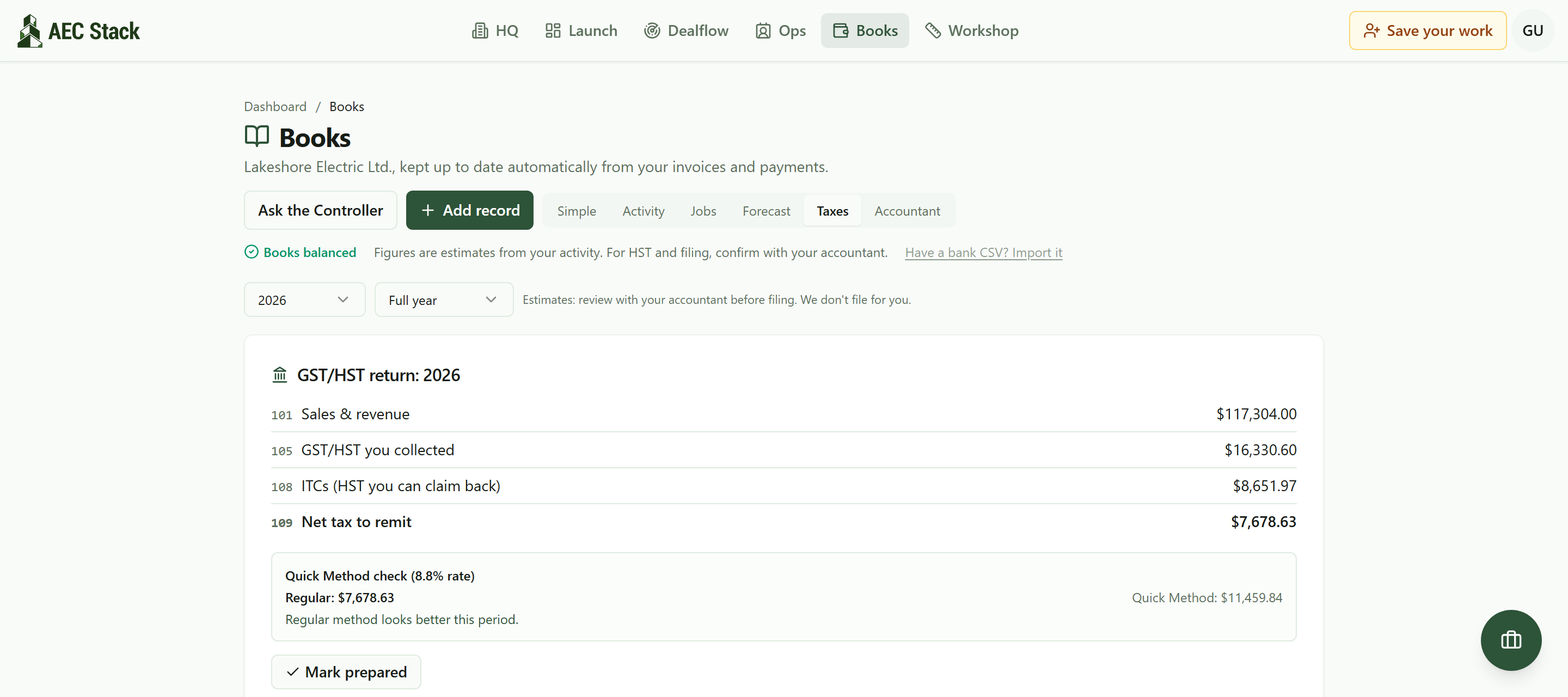 Your return, on the CRA's line numbers, from invoices and expenses already entered. The Quick Method line checks the other way of doing it against yours.
Four figures, on the lines the CRA numbers them by, built from the invoices you raised and the expenses you entered.
101 Sales and revenue. What you billed, before tax.
105 GST/HST you collected. What your clients paid you on top. This is the number to internalise: $16,330.60 of that year's deposits was never yours.
108 Input tax credits. The HST you paid on your own materials, tools, fuel and subcontractors, which comes back off what you owe. This line is worth exactly as much as your record keeping. Every receipt that never got entered is HST you paid and will not claim.
109 Net tax to remit. What actually goes to the CRA: collected minus claimed.
The Quick Method box underneath is the useful extra. The Quick Method is an alternative where you remit a flat percentage of your tax-included sales and mostly stop claiming ITCs, which suits some businesses and not others. Here it is shown as a comparison, at the rate stated, against your regular figure, and on this business the regular method comes out $3,781 better. Whether you are eligible and whether electing it is a good idea are questions with conditions attached, and they belong with your accountant. All the screen does is stop you guessing.
Every figure on it is derived from your own activity, which is what makes it defensible and what your accountant will file from.
Set it aside on the way past
The single behavioural fix that prevents the third quote is this: treat collected HST as not-yours from the moment it lands.
The books summary carries an HST set aside tile for exactly this reason. It shows what has been collected less what you can claim back, so the figure you are looking at is the real exposure rather than the gross. If that number is bigger than what is in the bank, you already know what next quarter looks like.
A separate account for it is old advice and it is old advice because it works. The version of this that fails is the one where the money stays in the operating account and you promise yourself you will remember.
If you pay subcontractors, T5018 is already counting
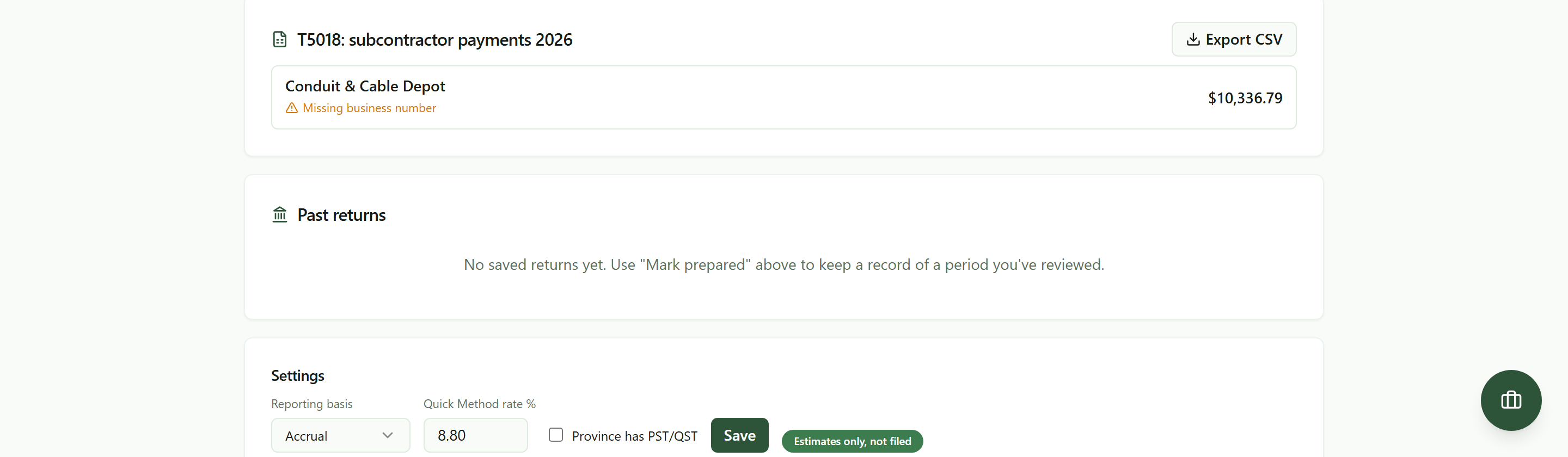 If you pay subcontractors, the T5018 total is built as you go. The amber line is the piece only you can supply.
Construction has a reporting obligation most trades meet late: payments to subcontractors get reported to the CRA on a T5018 information return. The totals here accumulate as you record the bills, and the export gives your accountant the list.
The amber warning is the part worth acting on today. A subcontractor with no business number on file is a slip you cannot complete in January without chasing somebody who may not answer. Getting it when you first pay them takes one message.
If you already got it wrong
None of these are reasons to avoid looking. All of them get worse with time and interest.
Never registered and should have been. Voluntary disclosure exists, back-registration is possible, and the numbers are usually smaller than the panic. That is an accountant conversation this week, not a forum thread.
Charged it wrong for a period. Get the exposure quantified before deciding anything. Some of it may be recoverable from clients, most of it usually is not, and the ITCs you never claimed cut the other way.
Collected it and spent it. This is a cash flow problem wearing a tax costume. Read surviving net 60, and get on a payment arrangement early rather than late.
What it costs
Commercial terms depend on the workflow. Review the relevant AEC Stack product page before you start.
This is your own activity, added up correctly and laid out on the lines your accountant already reads. That is the difference between a thirty minute meeting and an evening, and between a year end built from records and one built from memory.
On AEC Stack: the HST that waits on holdback is its own trap, and it is covered in the holdback guide. Whether the month made money at all is did I make money this month.
Open your books and switch to Taxes. If line 108 looks low for a year of your buying, the gap is receipts you never entered.
Take this guide with you
The full write-up, every screenshot and clip, captions, and a machine-readable manifest in one zip. Share it with your office or hand it to whoever runs your socials.
Download the kitContinue reading