Ontario / Practical guides
Know whether you actually made money this month, and on which jobs
The bank balance is a mix of last month's invoices, next month's HST and a deposit on a job that has not started. Read the month, split it by job, and learn the difference between a job losing money and a job you have not invoiced yet.
Browse all Ontario guidesPut this into practice
Open Books
See the receipt, transaction, job, and tax record in the same financial picture.
Most contractors answer this by looking at the bank balance, which is a bit like checking the weather by looking at your shoes. It tells you something, it tells you late, and it is mostly about what happened somewhere else.
The balance is a mix of last month's invoices, next month's HST, a deposit on a job that has not started and whatever the supplier took on the 30th. Whether the work you did in the last four weeks made money is a different question, and the reason nobody answers it is that answering it usually means an evening with a shoebox.
This page is the version where you already have the answer, because it comes off the invoices and payments already in the system.
How contractors describe the problem
The gap between what you think you are making and what turns up:
"After years of quoting jobs and wondering why my bank account never matched what I thought I was making, I finally figured out what I was missing. ... Most guys would quote this at $1,150 and wonder why they're tired and broke."
Why the question is unanswerable for a lot of people:
"I never really paid much attention to how I was tracking my expenses, receipts, and such. I know now that's a big mistake, but I've never created a separate business account. All my earnings go into my personal account, and I just spend as needed."
And the price of doing it the manual way:
"I swear I'm spending like 5+ hours just on the most mind-numbing stuff ,copying transactions from my bank, hunting down receipts in my email, matching invoices to payments. It's 2025 and I'm still doing ctrl+c ctrl+v like it's my full-time job."
The month, in one line
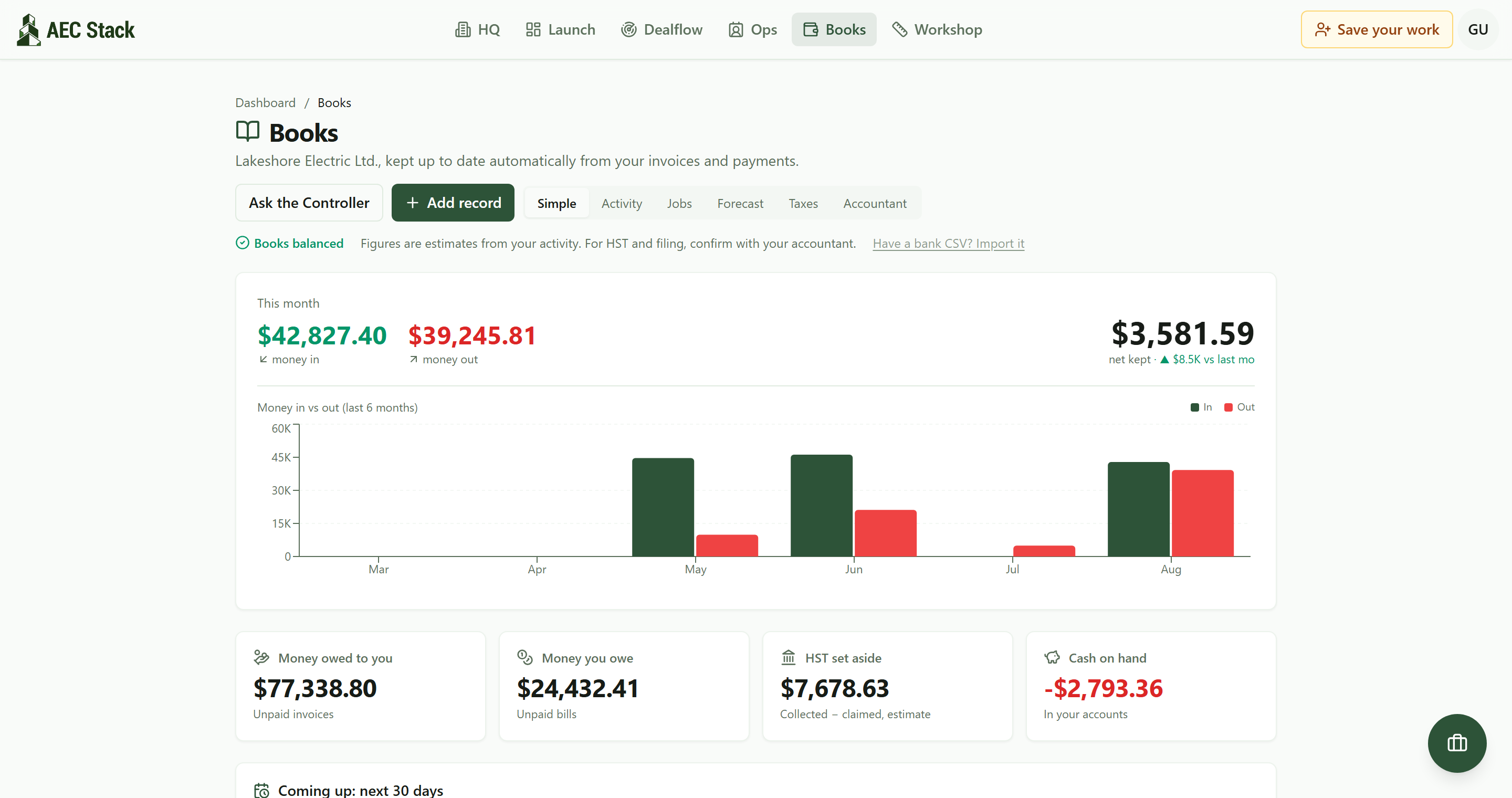 One line for the month: what came in, what went out, what is left. The six months behind it are the context that stops a good month reading as a trend.
Money in, money out, and what is left. In this month that is $3,581.59 kept on $42,827.40 billed, which is a bit over 8%, and the arrow says it is $3.6K better than last month.
None of that was typed in. It is derived from the invoices raised, the payments recorded and the expenses entered, which is the whole point: the number exists whether or not anyone sits down to work it out.
The six months behind it matter more than the month itself. One good month is not a business and one bad month is not a crisis. What you are looking for in that chart is whether the red bar is creeping up on the green one, and that is only visible over a run.
Profit and cash are different questions
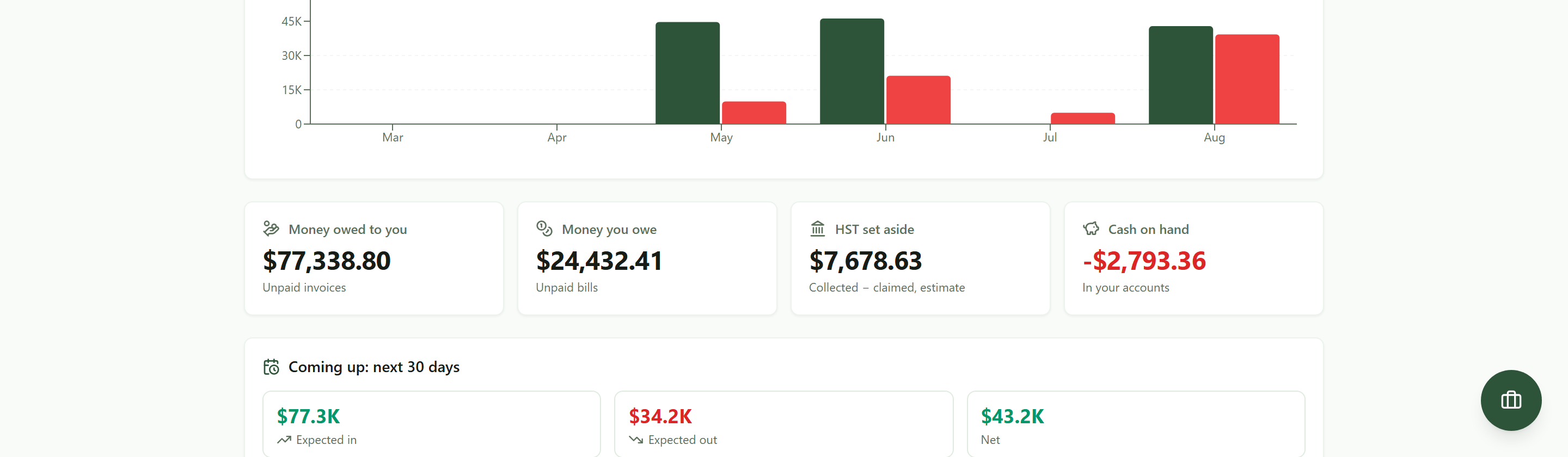 Profit and cash are different questions. A month that kept $3,581.59 is sitting at minus $2,793.36 in the bank, and the HST tile is money that was never yours.
Look at this next to the month above it, because between them they describe the thing that confuses everybody. The month kept $3,581.59. The account is overdrawn by $2,793.36.
Both are true. $77,338.80 has been invoiced and not paid, and $24,432.41 is owed to suppliers who did not wait. Profit is what the work earned. Cash is what has actually arrived and not yet left. A business can be profitable and broke at the same time for months, and most contractors who go under are in exactly that position rather than in an unprofitable one.
The HST tile is the one to read twice. $7,678.63 has been collected on the CRA's behalf and not yet remitted. It sits in the same bank account as everything else, it is not yours, and spending it is the single most common way a decent year turns into a bad quarter. Charging it, setting it aside and filing it is the HST guide.
If the money owed to you column is what is keeping you awake, that is surviving net 60, and the chasing order is in what to do when a client will not pay.
Which job, not just which month
A monthly figure tells you the business is fine. It does not tell you that one job is quietly funding the others.
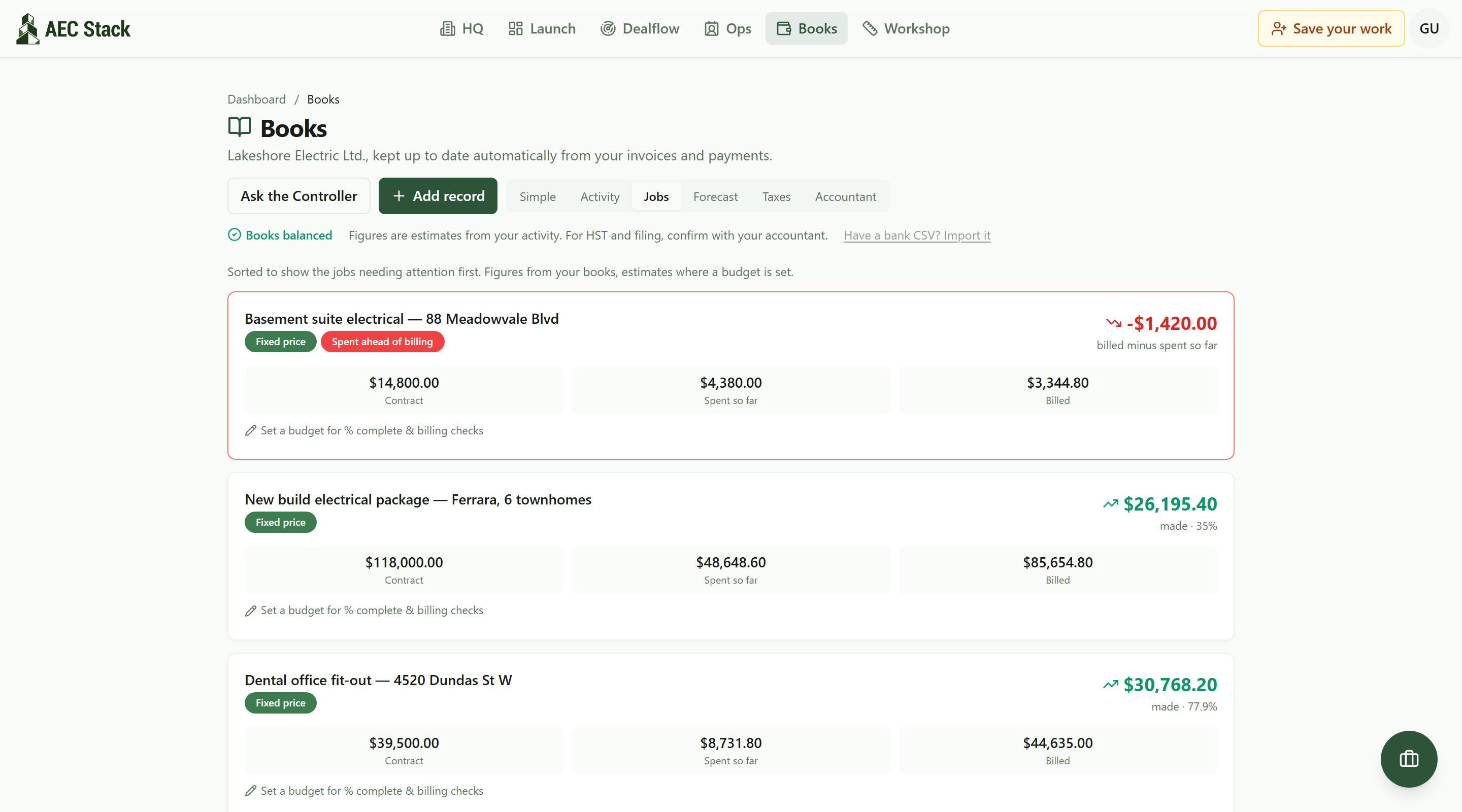 The same month split by job. The one at the top is not necessarily a bad job, it is a job you have spent more on than you have invoiced.
Same money, split by job, sorted so the ones needing attention come first.
Read the top one carefully, because this is where people scare themselves for no reason. Spent ahead of billing is not the same as losing money. $4,380 has gone out on that job and $3,344.80 has been invoiced. It might be a job that is going to lose money. It might just be a job where you bought the material up front and the next invoice has not gone out yet. The figure tells you which question to ask, not the answer.
The way to turn it into an answer is the small link under each job: set a budget for the total cost. Once the software knows what the job was supposed to cost, it can work out percent complete from your actual spend and tell you whether you are over-billed or behind on billing against it. Until then it is comparing two real numbers and saying nothing more than what they are.
The 35% on the townhome package is the honest kind of number. The 77.9% on the dental fit-out is high because not every cost on that job was tagged to it, which is the one thing this screen needs from you.
The one habit that makes all of it work
Tag expenses to a job.
That is it. Everything above is derived automatically except this. An invoice already knows which job it belongs to, so revenue lands in the right place on its own. A receipt for $600 of wire does not know anything, and if it goes in as a general expense it lands in the monthly total and disappears from the job.
Two minutes a week of putting costs against jobs is what turns "we did alright" into "the townhomes are at 35% and the basement suite needs an invoice out this week". There is no clever version of this. There is only doing it or not doing it.
Numbers you get while you can still use them
They are built from your own activity, and the page says so at the top of itself. That is the whole advantage. You get a read on the fifteenth, while the townhomes are still open and the basement suite invoice can still go out this week, instead of a perfect one in March about a year you can no longer change.
Good enough to price the next job on. Good enough to decide which invoice to chase on Monday. And good enough to put in front of an accountant, who otherwise spends the first billable hours of your year end rebuilding all of this out of a shoebox. Year end and HST are still their conversation. Walking in with this is what makes it a short one.
Commercial terms depend on the workflow. Review the relevant AEC Stack product page before you start.
On AEC Stack: what an hour of your crew costs, which is the input that decides whether these jobs were priced right in the first place, is what an hour actually costs you.
Open your books, switch to Jobs, and look at the one at the top. Then decide whether it is a job to worry about or an invoice to send.
Take this guide with you
The full write-up, every screenshot and clip, captions, and a machine-readable manifest in one zip. Share it with your office or hand it to whoever runs your socials.
Download the kitContinue reading