Ontario / Practical guides
Get a silent client to pay, in order, without a lawyer
Five steps in the order that costs least: check whether they ever opened it, send the reminder from your business, read the statutory dates, put it in writing, then pick the remedy that matches the amount.
Browse all Ontario guidesPut this into practice
Create the invoice
Follow the work into billing, payment status, and the next collection step.
There is a particular kind of quiet that follows an unpaid invoice. No dispute, no complaint about the work, no reply. Just nothing, and a growing suspicion that you are going to have to become somebody you do not want to be about it.
This page is the order to do things in. Every step below costs less than the one after it, and each one is worth doing properly before you move on, because the step after that will ask you what you already tried.
None of this is legal advice. It is the sequence contractors actually use, and where AEC Stack does part of it for you, it says so.
How contractors describe the problem
"A client I did a lot of work for already owes me $1100 and has claimed she doesn't want to pay because she doesn't like how the vinyl tile she chose looks. I installed it, she told me she thinks it doesn't look good so I go back pull it all out and reinstall it and now she is just ghosting me."
The top reply on that thread, with 379 people agreeing, was three words long: put a lien on the house. That is the whole ladder skipped in one jump, and it is what people reach for when nothing before it was set up.
Where it ends if it keeps happening:
"I was constantly chasing people for money...a lot of people think their brand new HVAC system is over priced and decide not to pay. It became such a headache having to deal with delinquent customers and lawyers to go after them that I just shut it down."
And the amount that causes the most trouble, because it is too small for anything formal:
"Fast forward and I finished the job, handed her the bill and she's refusing to pay the additional fee. ... Is there anything I can actually do here? $500 feels too small for a lien or a claim but it doesn't feel right to me."
Step 1. Find out whether they ever saw it
Before deciding somebody is ignoring you, rule out the ordinary explanation. Invoices go to spam, to an old address, to a project manager who left, to an accounts inbox nobody reads on Fridays.
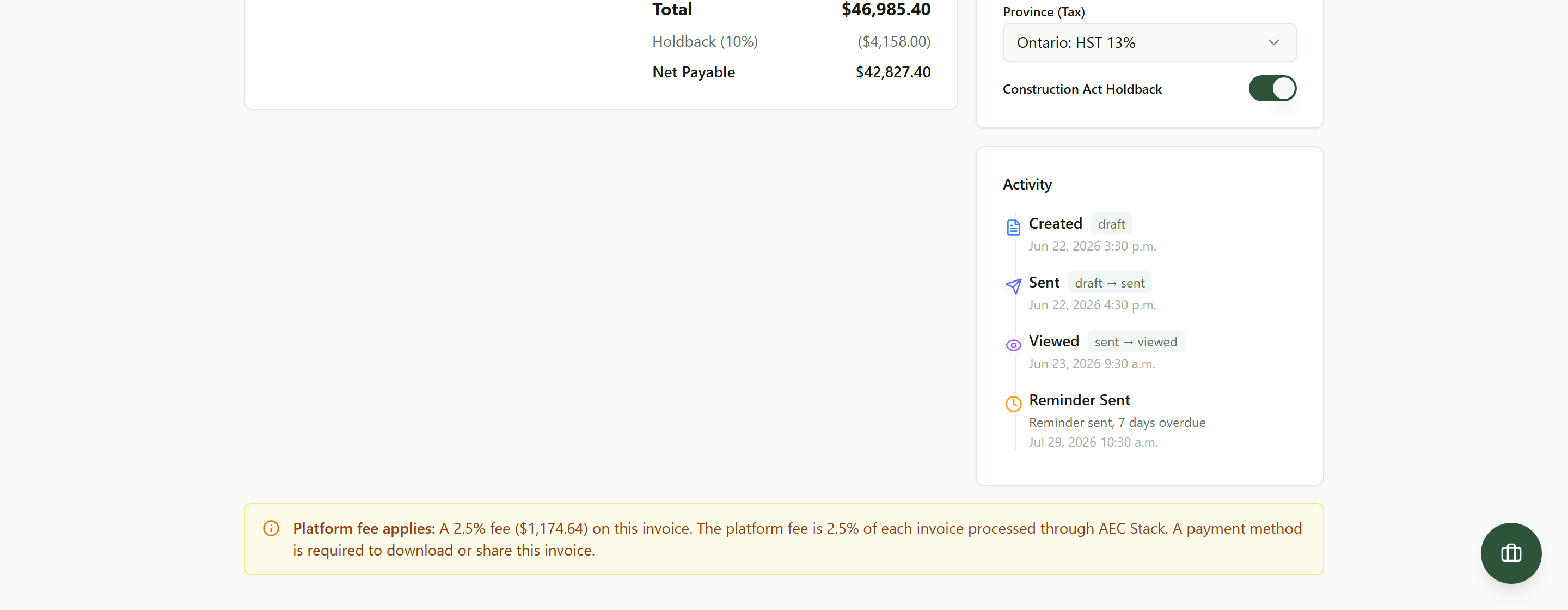 Created, sent, opened by them, reminded. The difference between a client who never saw it and a client who is not paying.
Every invoice carries its own history. Created, sent, and viewed when somebody opened the link, with the date and the time. On this one the client opened it the morning after it went out and has been quiet ever since, which settles the question. This is a payment problem, not a delivery problem.
Read it the other way round too. If there is no viewed event three weeks in, your next move is a phone call to check the address, not a demand for money.
Viewed means the link was opened. It is good evidence that the invoice reached them and it is not proof of who read it, so do not lean on it harder than that.
Step 2. Send the reminder, and send it from the business
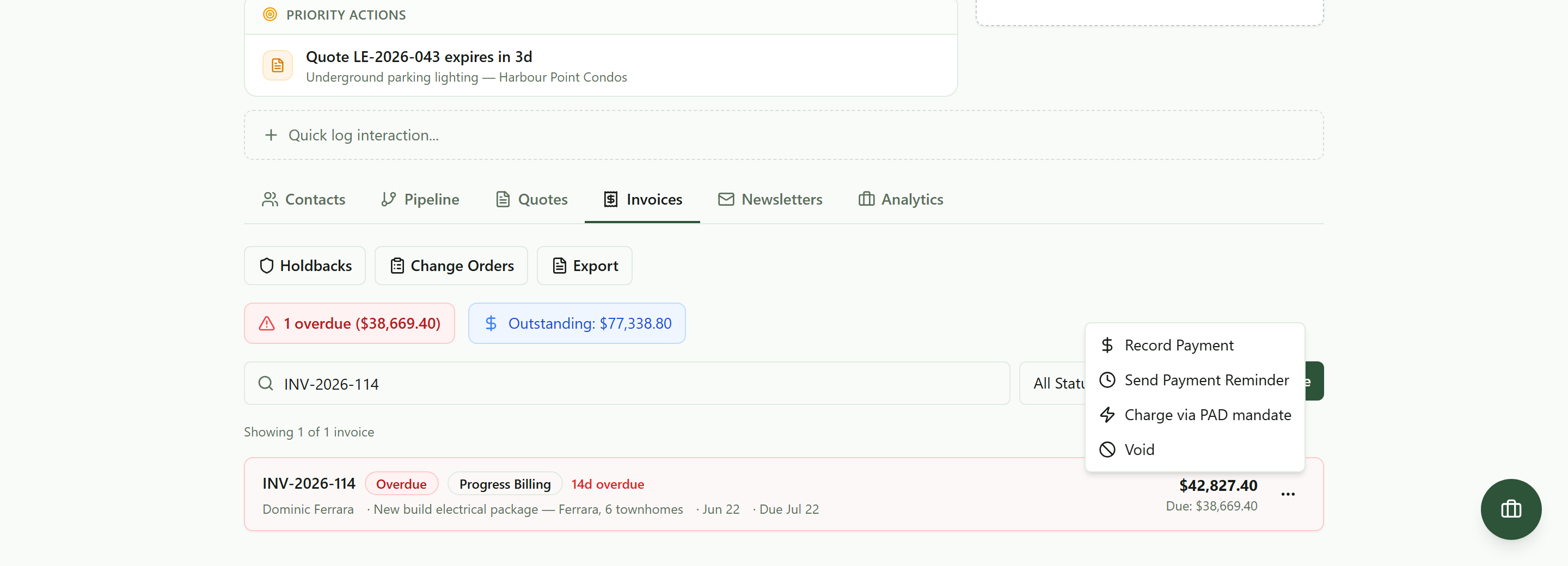 One click sends the reminder, from your business, naming the amount and the date it was due.
Send Payment Reminder emails the client the amount, the date it was due, how many days ago that was, and one link to pay. It comes from your business, not from us, and it lands on the invoice's history so the next conversation has a date attached to it.
It is deliberately plain. No threat, no legal language, no mention of interest or liens. You still have to work with these people, and an email that opens with consequences turns a forgotten invoice into a position they have to defend.
It goes when you click it. Nothing here chases anybody automatically, and there is no sequence running behind your back, because the third reminder in a fortnight is a decision about a relationship and not a setting.
If a fortnight of reminders produces nothing, stop sending them. Two is information. Five is a habit that both of you have settled into.
Step 3. Find out where you actually stand
This is the step almost everybody skips, and it is the one that changes the tone of everything after it.
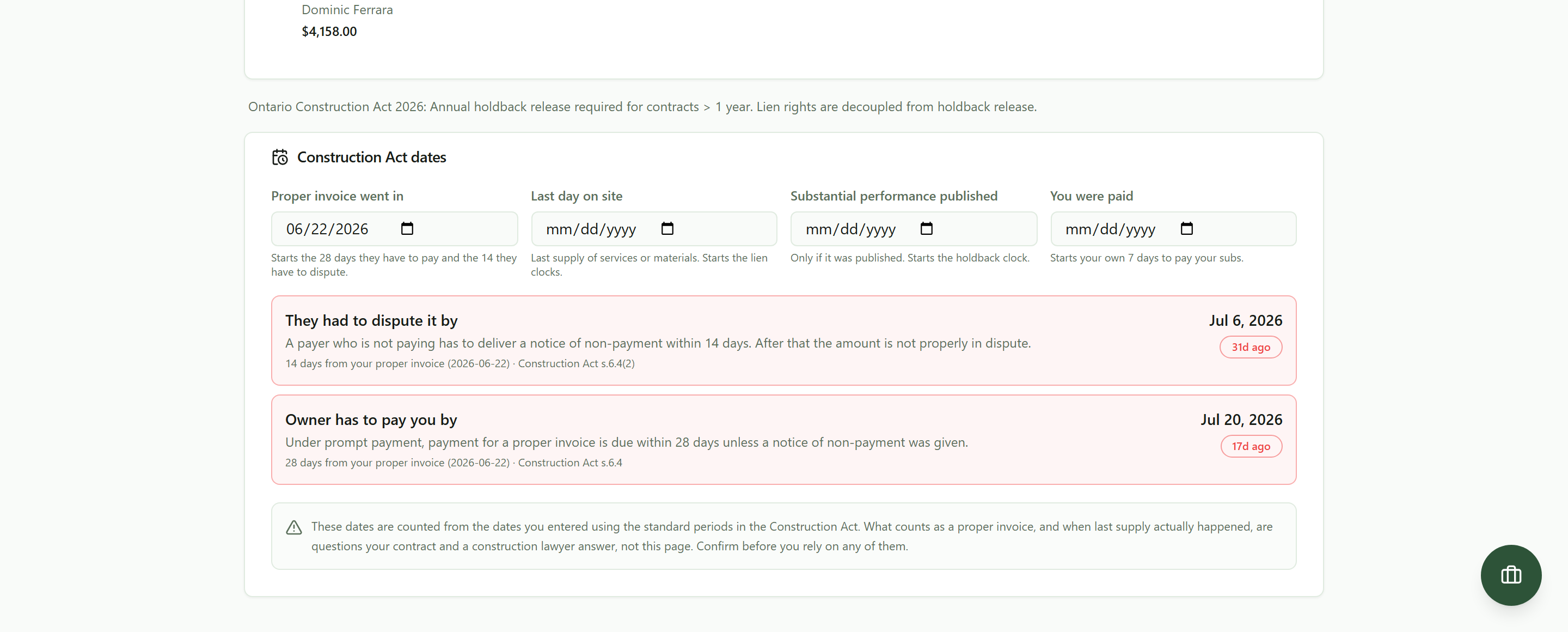 The same invoice, read as the Act reads it. Both of their deadlines went by before you started wondering whether to chase it.
Put the date the invoice went in and read what comes back. On a proper invoice, Ontario's prompt payment rules give the payer 28 days to pay it (section 6.4) and 14 days to deliver a notice of non-payment on Form 1.1 if they are disputing it (section 6.4(2)). Since 1 January 2026 an owner who wants to argue the invoice was not proper has seven days to say so in writing, or it counts as proper and the 28 days have been running. Both of those had already gone by on this invoice.
That matters because of what it tells you. A payer who never disputed anything within their 14 days and then did not pay within their 28 is not negotiating. Now you know which conversation you are in, and you know it from the Act rather than from a feeling.
What counts as a proper invoice, and whether these particular periods apply to your contract, is a question for your contract and a construction lawyer. The dates are counted for you; the interpretation is not. The full set of clocks is here.
Step 4. Put it in writing yourself
Not from the software. This one is yours, and it is short.
State the invoice number, the amount, the date it was due, that no notice of non-payment was delivered within the period the Act gives, and the date by which you expect payment. Say what you will do after that date, and only say it if you will actually do it. Send it by email and by anything that produces a receipt.
That letter does two things. It gives a reasonable payer a clean way to fix it, and it becomes the first exhibit in anything that follows. Judges, adjudicators and the other side's lawyer all read a calm dated letter differently than a text message thread.
Step 5. Pick the remedy that matches the amount
By here you are choosing, and the amount decides.
Under a thousand dollars. The honest answer is that formal recovery costs more than the debt. That does not make it fair. What it makes it is a decision about your time, and the useful move is to stop the same thing happening again: deposit up front, extras written down before the work (change orders), and no more work for that client.
Small Claims Court. Ontario's Small Claims Court is built for exactly the amounts in the quotes above, you do not need a lawyer, and the filing fees are modest. Its monetary ceiling is set by regulation and does change, so check the current figure on the Ontario courts site before you count on it.
A construction lien. This is the one everybody reaches for first and it is genuinely powerful, because it attaches to the property. It also has deadlines that cannot be extended, and they do not run from your invoice. What starts them depends on whether you hold the head contract or a subcontract, and it is a milestone on the job rather than the last day you were on it. If it is on the table at all, read when and how a lien works now rather than later, because the mistake is almost never filing the wrong thing. It is finding out about the date after it has gone.
Interest. If your contract sets a rate for late payment, say so in the letter at step 4. If it does not, the Act and the Courts of Justice Act have their own provisions, and that is a question worth one phone call to a lawyer before you invoice interest to somebody.
You decide, it remembers
Every rung of this ladder is a decision about a relationship, and those stay yours. What you get is the thing that makes each one easy to take: the record.
When the invoice was raised, sent, opened and reminded. The statutory dates counted from the dates you entered, each one showing the section of the Act it comes from. The reminder sent the moment you decide to send it.
That is what turns "I think it is about two months overdue" into "the invoice was delivered on the 3rd, opened on the 4th, and the 28 days ran out on the 31st." Same client, same money, completely different phone call.
Commercial terms depend on the workflow. Review the relevant AEC Stack product page before you start.
On AEC Stack: the ladder is shorter when the invoice was right in the first place. Terms, HST and same-day sending are in getting paid on time, and the gap this whole page exists inside is surviving net 60.
Open your invoices, find the oldest overdue one, and check whether it was ever opened. That answer decides which of the five steps above you are actually on.
Take this guide with you
The full write-up, every screenshot and clip, captions, and a machine-readable manifest in one zip. Share it with your office or hand it to whoever runs your socials.
Download the kitContinue reading