Ontario / Practical guides
Get every extra priced, approved and paid instead of eating it
The extra was agreed in a hallway and refused three months later. Raise it in a minute, send it to the client from your own business, and let them approve it where they read it, so the yes has a time stamp on it.
Browse all Ontario guidesPut this into practice
Build the offer
Connect the scope, price, assumptions, and client response in one working proposal.
The extras are not where contractors lose money because the extras are hard. They are where contractors lose money because the extra gets agreed standing in a hallway with the drill still in your hand, and three months later the only two people who remember it disagree about what was said.
This page is about turning that yes into something you can point at: written down, priced, sent to the person who has to pay for it, and answered by them in a way that leaves a time stamp. Not paperwork for the sake of it. The one piece of paper that decides whether the extra is revenue or a donation.
How contractors describe the problem
The clearest version of the leak, with a number on it:
"I was talking to a GC buddy of mine, and he mentioned he eats about $3k–$5k a year in "handshake deals" (client asks for small extras, he says yes, forgets to bill it, or they dispute it later). He told me it's too much hassle to stop working, wash hands, and type up a formal change order for a $200 item, so he just risks it."
Read that again, because the reasoning is correct. Stopping work, cleaning up, finding a laptop and typing a document for a $200 item is genuinely not worth it. The mistake is not laziness. It is that raising an extra costs more than the extra is worth, so the whole thing gets skipped, and the small ones add up to five figures a year.
The other end of it, once the work is already built:
"I went for a change order but the GC said nah dog."
And from the GC's side of the table, said out loud:
"So now we make the subs be the bank which means they just don't do our work, jack up their price and/or make every little extra a fight."
Nobody in any of those quotes is confused about the work. They are all describing the same gap between the moment the extra is agreed and the moment it has to be paid for.
One job, three extras, three different states
Change orders live under Invoices, on the job they belong to.
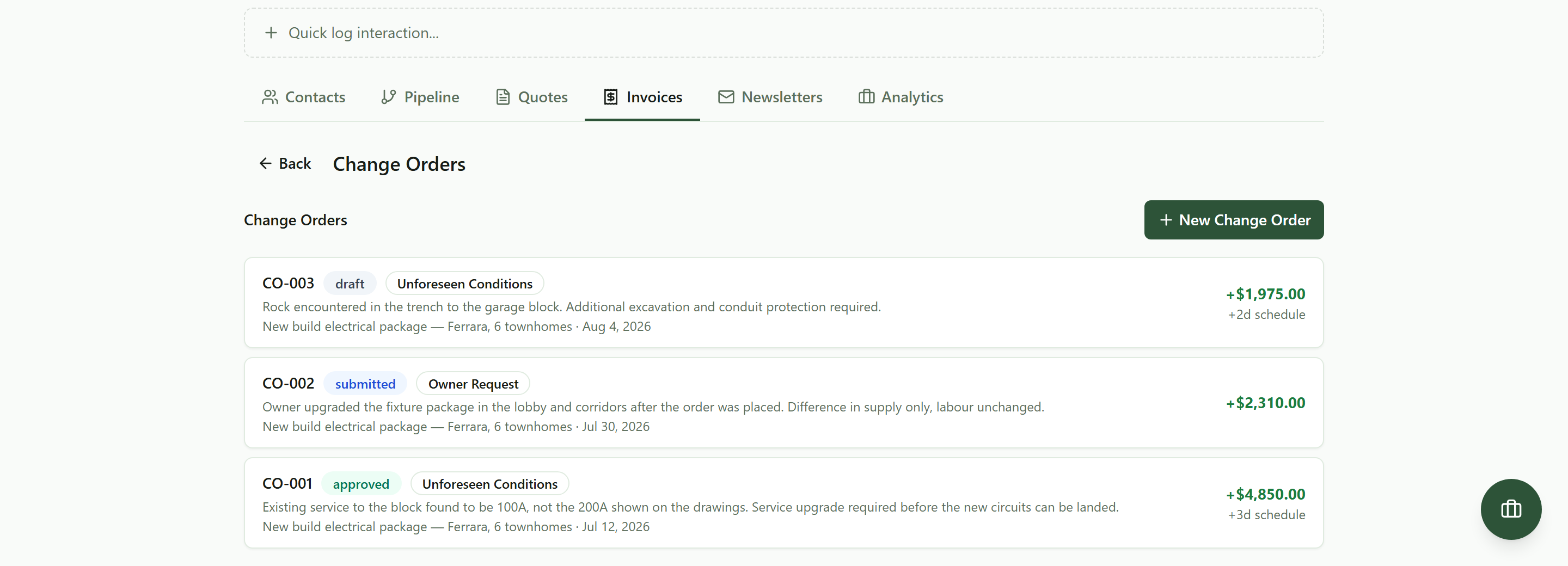 Three extras on one job, in the three states an extra can be in. The money and the days are on the same line as the status.
Three things are worth noticing on that screen.
Every extra carries its reason. Unforeseen conditions on the rock in the trench and the undersized service, owner request on the fixture upgrade. That word is the whole argument in miniature: rock is not your fault and the fixture upgrade was not your idea, and the reason is on the record before anyone starts negotiating.
The schedule is priced alongside the money. Two days here, three days there. Extras that add time and get billed as if they did not are how a job ends up late and cheap at the same time.
The state is visible without opening anything. Draft means you have written it and not sent it. Submitted means it is with the client. Approved means it is owed to you. A contractor who cannot answer "which extras am I waiting on" in five seconds is carrying the answer in their head, and heads are where the $3k to $5k goes.
Raise it in the time the extra deserves
A change order here is a reason, a description, a number and the days it costs. That is it. There is no form to design and no template to pick, which matters most for exactly the $200 item the quote above describes: the point is that it takes a minute, because the hassle is what the GC above weighed against $200 and decided to risk.
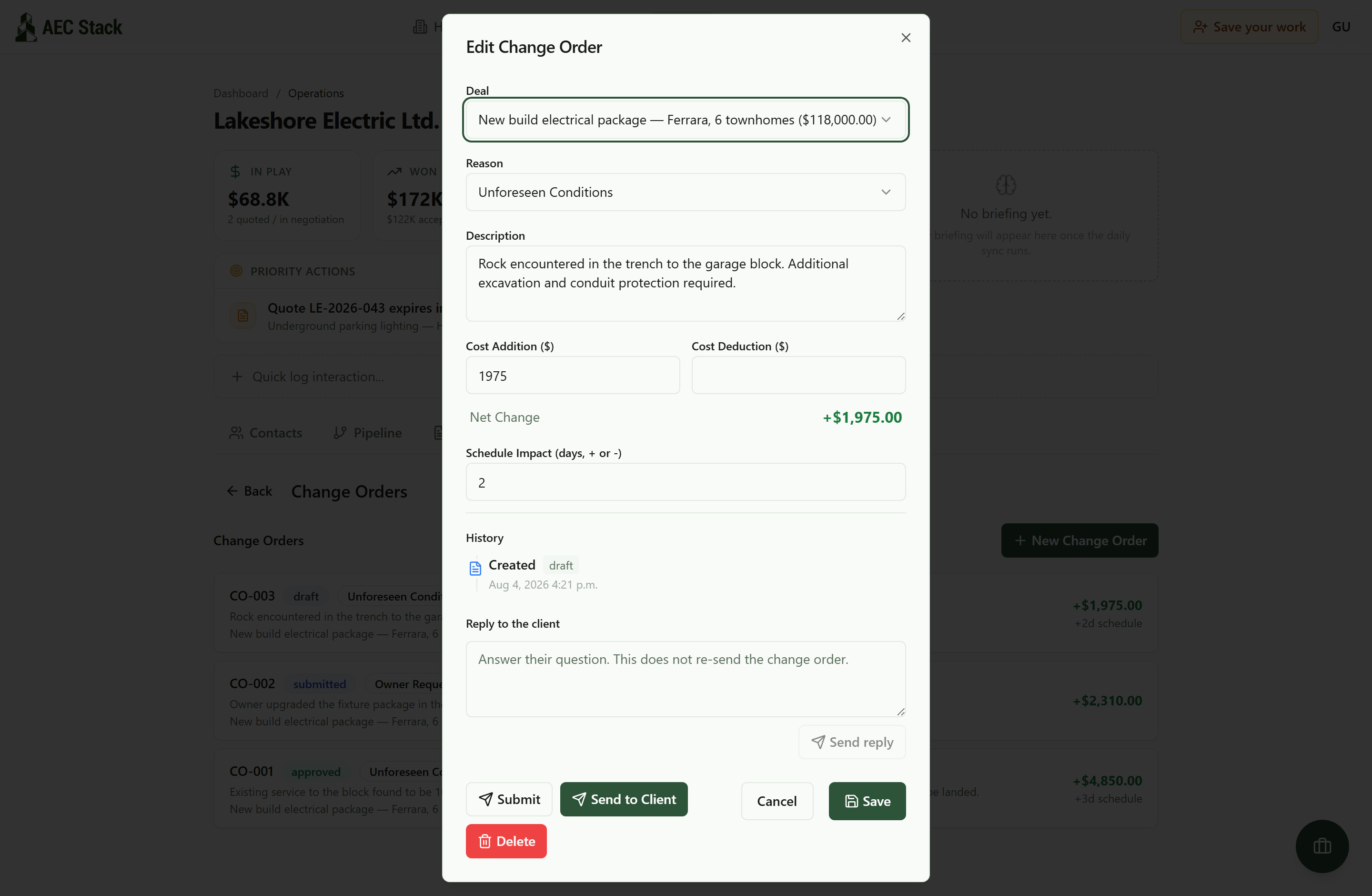 A draft has two ways out. Submit moves it along internally. Send to Client puts it in front of the person who has to pay for it.
Two buttons, and the difference between them is the difference between a note to yourself and a change order.
Submit moves it along on your side. Useful when the extra is agreed but you want the paperwork straight before it goes out.
Send to Client emails it to the contact on the job, from you, leading with the money and the days and carrying one link to review it. It goes direct rather than asking you to forward it, because the whole value of the record is that it is a record of the client being told, not of you being reminded to tell them.
The link points at your own published site, so it will ask you to publish your website before it sends the first one. That is deliberate: a client-facing document should not arrive pointing at somebody else's domain.
Pricing the extra is the same arithmetic as pricing the job, and it is worth being just as careful. Two days of a crew is not two days of wages: what an hour of your crew actually costs is usually about double what you pay them, and extras are exactly where contractors quote the wage by reflex.
The client gets three answers, not two
The link in that email opens the change order in your client portal, on the project it belongs to, and the answer happens right there.
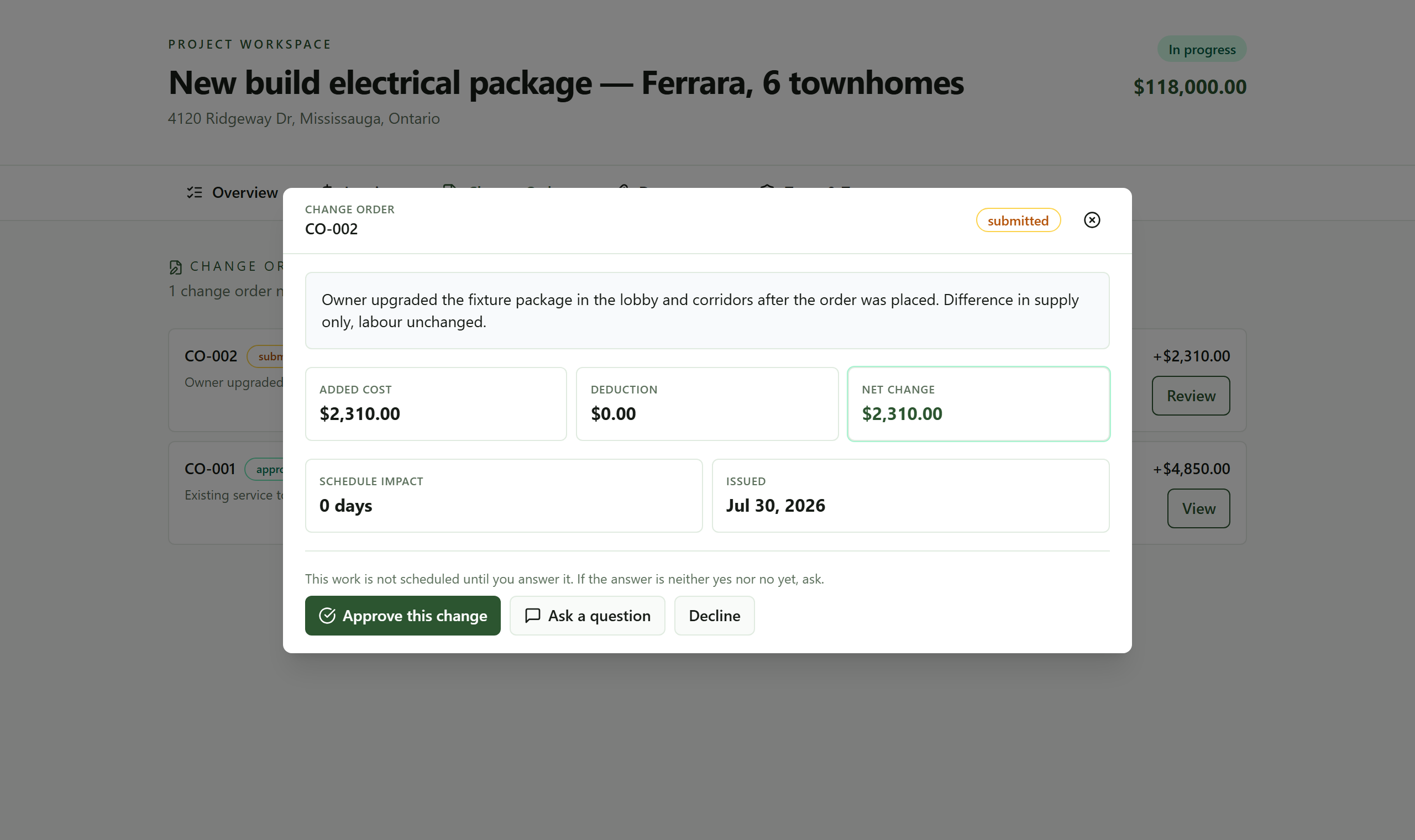 Three answers, not two. The middle one keeps the question on the record instead of in an email.
Approve, decline, and the one in the middle that matters most: ask a question.
Nothing on a real job is answered yes or no first time. It is answered with "what is the $2,310 made up of", "can you do it without the schedule hit", "send me the supplier quote". If the only two buttons are yes and no, that question has to leave the page to get asked, and it becomes an email, and then a phone call, and by the time it is settled the record of what was agreed is spread across three inboxes.
A question here changes nothing about the change order. It stays submitted, it is still owed an answer, and the question lands on the same record as everything else.
Approving takes a name and a signature, and the line above the button tells them plainly what they are agreeing to: this adds $2,310.00 to the contract. Declining asks for a reason, which is more useful to you than silence. Either way you find out now, rather than after the fixtures are in.
That signature and the moment it was given are the thing you did not have when the agreement was a hallway yes.
The whole conversation stays on the extra
Open a change order and the trail is on it, including the back and forth.
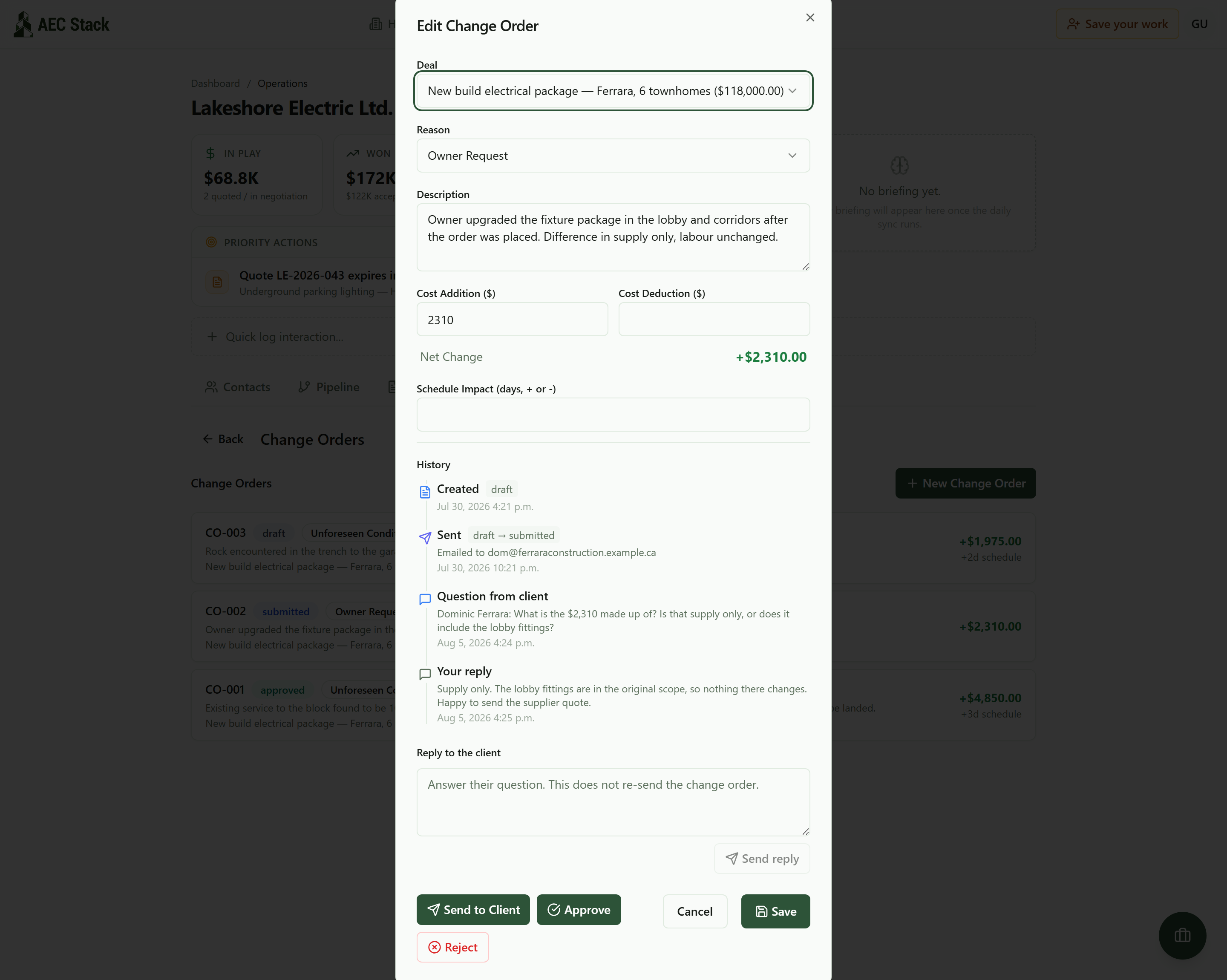 Everything that happened to this extra, on the extra. Including the question the client asked and the answer they got.
Raised on a date. Emailed to a named address on a date. Their question, with the time on it. Your answer, sent from the same box you are reading it in, without re-issuing the change order or starting an email thread. Then approved and signed by a named person on a date.
Answering here rather than by email is the difference between a record and a recollection. When an extra is questioned six weeks later, that list is the answer, and it is the same list whether the person questioning it is the client, a GC's project manager, or your own memory of a job you have half forgotten.
The timing is the whole game
A GC who is going to say "nah dog" will still say it. What you control is when they say it.
An extra raised and sent before the work happens turns a payment fight into a scheduling conversation, and that is a conversation you can win by walking away from two days of unpaid excavation. An extra raised afterwards is a request for a favour, and the electrician in that quote was upside down on the whole project by the time he asked.
Same words, same GC, completely different position. The only variable is what existed in writing before the work was done. That is what raising it here takes off you: not the argument, the disadvantage.
And if it ever does go further than a conversation, the signed record with its date and its approver is the first thing your contract, and any lawyer you bring in, will ask you for.
What it costs
Commercial terms depend on the workflow. Review the relevant AEC Stack product page before you start.
On AEC Stack: an approved change order is work that has to reach an invoice, and that is getting paid on time. If the job carries holdback, the extra is subject to it like everything else: the holdback guide covers the split.
Open your change orders on the job you are on right now, and raise the one you have already agreed to and have not written down. That is usually the one that was going to cost you.
Take this guide with you
The full write-up, every screenshot and clip, captions, and a machine-readable manifest in one zip. Share it with your office or hand it to whoever runs your socials.
Download the kitContinue reading