Ontario / Practical guides
Write down what the price assumed and excluded, and still have it six weeks later
Every argument about a quote is two people remembering a conversation. Two short paragraphs on the quote itself, scope and exclusions, turn that into a comparison of documents.
Browse all Ontario guidesPut this into practice
Build the offer
Connect the scope, price, assumptions, and client response in one working proposal.
Every argument about a quote is the same argument. The client believes the price included something. You believe it obviously did not. Both of you are remembering a conversation from six weeks ago, and the only document either of you can produce is a number.
The fix is not longer quotes. It is putting two short paragraphs in the place where the number lives, so they travel with it.
Where it goes wrong
"What do you do in the situation where you realise you have severely underbid a job? ... Do you just eat it or do you talk to the client and try to figure it out?"
"We built a roofed pergola and I think we severely underbid it. The materials were about $1000$ and for the labor and trips out to the job we charged another $1000."
Underbidding is usually blamed on arithmetic. Just as often the price was fine for the job that was quoted and the job that got built was a different one, because nothing written down said where the edge was.
The two paragraphs
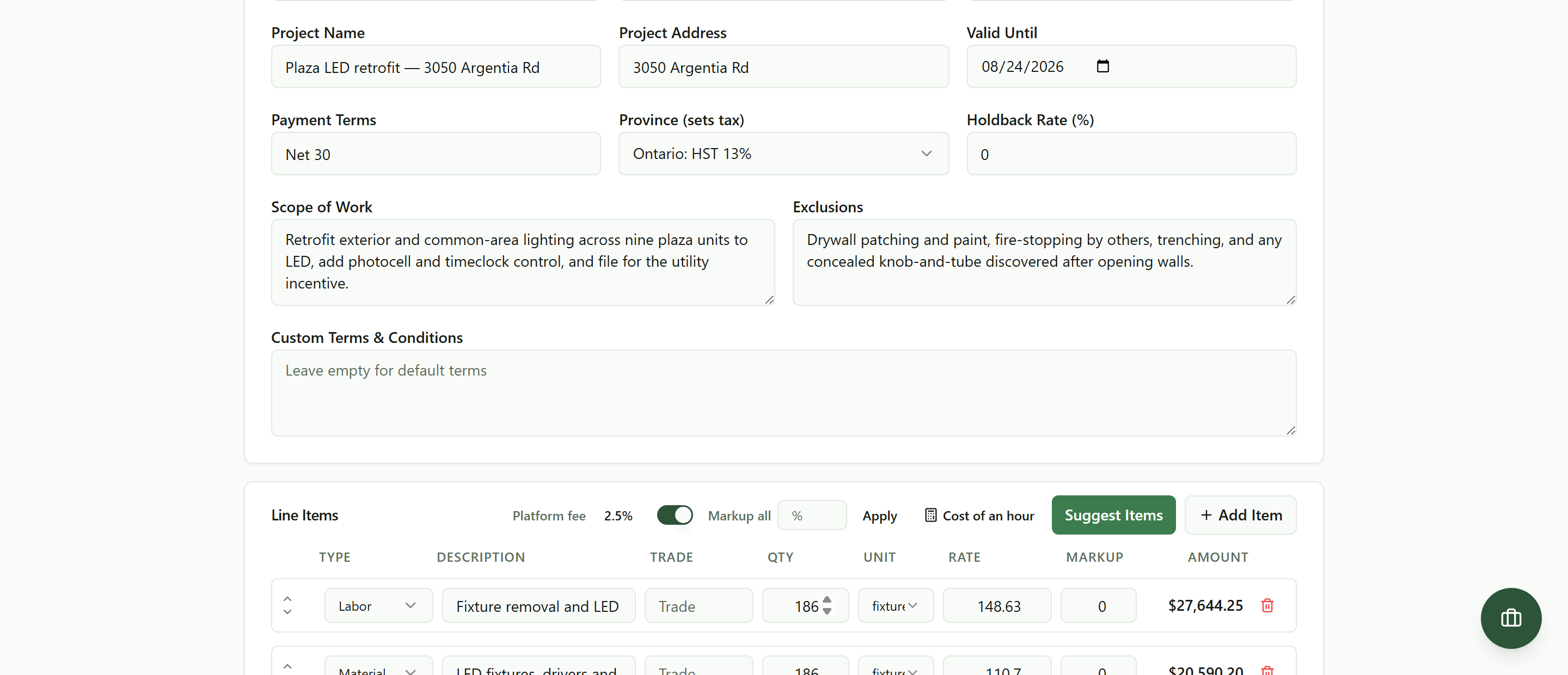 Scope and exclusions sit on the quote itself, not in the covering email. Six weeks later they are still attached to the number.
Scope of work. What the price buys, in the client's language, specific enough that somebody else could tell whether it had been delivered. "Retrofit exterior and common-area lighting across nine plaza units to LED, add photocell and timeclock control, and file for the utility incentive" is a scope. "Lighting works" is not.
Exclusions. What it does not buy. This is the paragraph that pays for itself. "Drywall patching and paint, fire-stopping by others, trenching, and any concealed knob-and-tube discovered after opening walls" is four exclusions that between them cover the four most common fights on that kind of job.
Both live on the quote, not in the covering email, which matters because the covering email is not what gets forwarded to the person who ends up querying the invoice.
What to exclude
Write your list once and reuse it. Start with the things that have cost you money before, and add these:
Anything behind a wall or under the ground. Concealed conditions, rock, rot, knob-and-tube, asbestos. You cannot price what you cannot see, and saying so is not a weakness.
Work by others that you depend on. Fire-stopping, patching, painting, cutting, permits pulled by the GC. Name them, so their absence on the day is not your problem.
Making good. Patching and paint after your work is the single most assumed inclusion in the trades.
Anything the drawings do not show. If you priced from a set, say which set and which revision. "As per drawings dated 12 June, revision 3" turns a later argument into a comparison of two documents.
Time-bound assumptions. Material prices, a working schedule, access hours, whether you can park. The valid-until date on the quote is doing some of this work already; use it.
The rest of the terms that get argued about
The other fields on that screen are the same idea in shorter form.
Payment terms. Net 30 by default; whatever you agree, it is on the quote rather than assumed. If it is not written, the payer will pick.
Holdback rate. On a job where the Construction Act holdback applies, showing it on the quote means the client is not surprised by the split when the invoice arrives. The holdback guide covers what it is.
Valid until. A quote without an expiry is an open offer against material prices you do not control. Twenty-one or thirty days is normal, and it also creates the follow-up reason.
Custom terms. Leave it empty and your defaults apply, which is usually right. Use it when the job needs something specific: access, storage, working hours, a deposit condition.
When it changes anyway
It will. Somebody asks for something not in the scope, and the answer is not to eat it and not to argue about what was meant. The answer is a change order raised before the work, which is a different guide and the most money-direct one in this library: change orders that get paid.
The exclusions paragraph is what makes that conversation easy. "That is one of the exclusions, here is what it would cost" is a normal sentence. "I did not think that was included" is a negotiation.
What it costs
Commercial terms depend on the workflow. Review the relevant AEC Stack product page before you start.
On AEC Stack: the arithmetic under the number is pricing a job and what an hour costs. Getting the package opened is the proposal package.
Open a quote you are writing now and add the exclusions paragraph before you send it. Then save that list somewhere and paste it into every quote after this one.
Take this guide with you
The full write-up, every screenshot and clip, captions, and a machine-readable manifest in one zip. Share it with your office or hand it to whoever runs your socials.
Download the kitContinue reading