Ontario / Practical guides
See every job you are chasing on one board and stop playing catch up
Ask a contractor what they are chasing and you get three jobs and a pause. The pause is where a quote sits for five weeks. One board with the money on each column, and a fifteen minute weekly habit.
Browse all Ontario guidesPut this into practice
Explore a working business
Put the people, records and day-to-day work together in a sample business.
Ask a contractor what they are chasing and you get a good answer for the three biggest jobs and a pause. The pause is the problem. The pause is where a quote sits unanswered for five weeks, a client who asked for a price in April never gets called back, and a job you would have won goes to somebody who followed up.
Nobody loses those on purpose. They lose them because the list lives in a phone, a notebook, a truck and a memory, and no single place shows all of it.
What it sounds like
"But all our work has come from word of mouth referrals, and is pretty feast or famine. I'd like to expand our client base to give us a more consistent flow of work, (which I also know is wishful thinking.)"
"Now the pipeline has slowed right down, I've got staff relying on me, and I honestly feel like I've let everyone down. I know what I should be doing—following up leads, getting quotes out, contacting past clients—but the pressure has made me freeze, and it's become a vicious cycle."
That second one is worth sitting with, because he knows exactly what to do. The list is right there in his sentence. What he does not have is a place where the list looks finite.
One board, with the money on it
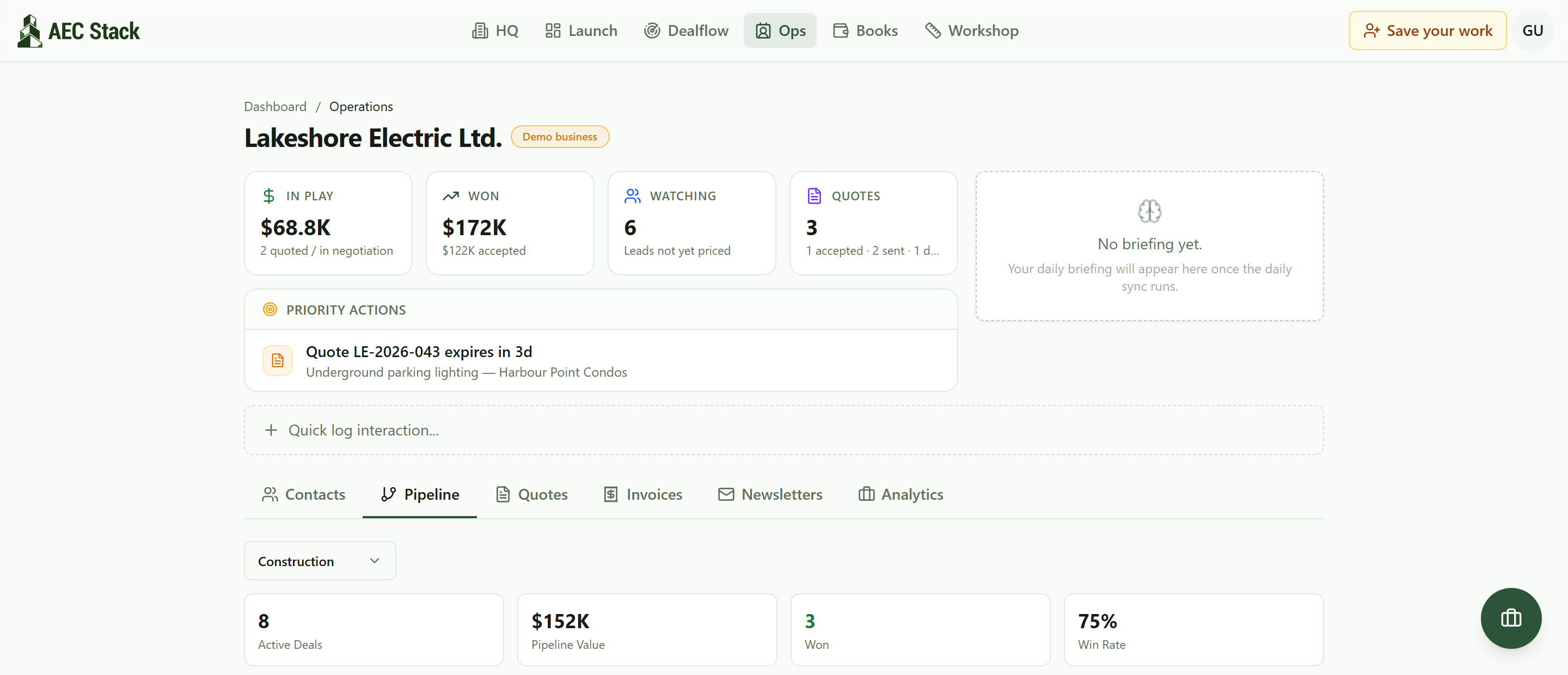 Everything you are chasing in one place, with the money on each column. The empty column tells you what belongs in it rather than just sitting blank.
Eight things in play, $152K of pipeline, and a 75% win rate that is calculated rather than felt.
The column totals are the useful part. $27.1K sitting in Lead and $48.6K in Estimating tells you where the work is stuck. A pipeline that is all Lead is a marketing problem. A pipeline that is all Estimating is a you problem, and the fix is a day of pricing rather than a day of worrying.
The stages are the actual job, not sales theatre. Lead, qualified, site visit, estimating, quoted, negotiation, won. That is what happens to a construction enquiry, and naming the step a job is on is most of deciding what to do about it.
An empty column tells you what belongs in it. Site Visit above is empty and says so, with what the step is for. That is more useful than a blank space you have to interpret.
Getting things onto it without data entry
The board is only worth having if everything is on it, which means the cost of adding something has to be near zero.
Jobs you find get tracked in one click. Anything in the permit and award feed or the tender feed goes onto this board with a button, so a lead you spotted at 7am is on the board at 7:01 rather than in a screenshot.
A phone call is one line. The quick log box at the top of the page takes a sentence and files it against the contact, which is what makes "when did I last speak to them" answerable later.
Quotes and invoices attach themselves. A quote raised against a deal moves with it, so the board is not a separate thing to maintain alongside the real work.
The weekly habit that does the work
Fifteen minutes, once a week, in the same order every time.
Anything in Lead older than two weeks. Call or kill. A lead you will not call is not a lead, and deleting it is better than carrying it.
Anything in Quoted past its valid-until date. That is your follow-up list, and the expiry gives you the reason to phone. The board flags these for you before they go stale.
Anything in Estimating. This is the column that quietly becomes a bottleneck, because pricing is the job that waits until 8pm.
Anything won that has not been invoiced. The board and the money are the same system, so this one is visible rather than discovered at month end.
That is the whole method. The point is not the software, it is that the pause when somebody asks what you are chasing goes away.
What it costs
Commercial terms depend on the workflow. Review the relevant AEC Stack product page before you start.
On AEC Stack: filling the board is where work is starting and projects before they go to tender. Turning what is on it into money is pricing a job.
Open your pipeline and put on it the three things you are chasing that are not written down anywhere. That is usually where the next job was hiding.
Take this guide with you
The full write-up, every screenshot and clip, captions, and a machine-readable manifest in one zip. Share it with your office or hand it to whoever runs your socials.
Download the kitContinue reading