Ontario / Practical guides
Get the right insurance and understand it before you call a broker
Twenty minutes of vocabulary before the call beats shopping three brokers with the wrong question. What each coverage actually does, what additional insured means, and the five questions that find the gap.
Browse all Ontario guidesPut this into practice
Start with your business
Organize formation, standing, and the records that let the business operate.
You buy insurance the way you buy a phone plan: someone quotes a number, it sounds like a lot, you take the cheapest one that lets you start work. Then a GC asks for a five million dollar certificate naming them as additional insured and the policy does not do that.
Twenty minutes of vocabulary before the call is worth more than shopping three brokers with the wrong question.
What you are actually buying
Commercial general liability. The one everybody means by "insurance". It covers damage you cause to other people and their property. Builders ask for it, limits are usually quoted in millions, and two million is the common floor with five million asked for on larger sites.
Additional insured. Not a coverage, an endorsement. It puts the GC or owner on your policy for the work you do for them. This is the thing that makes a certificate acceptable to them, and the reason a perfectly good policy gets rejected.
Certificate of insurance. The one page proof, issued by your broker, that says what you hold and until when. It is what gets asked for, not the policy itself.
Commercial auto. Your personal auto policy very likely excludes business use. If your truck carries tools and gets to site, ask the question directly.
Tools and equipment. Usually separate, usually cheap relative to what a stolen trailer costs.
Professional liability, sometimes called errors and omissions. For design work, engineering input, or anything where your advice rather than your workmanship is the exposure. Design-build outfits get asked for this.
Builder's risk or course of construction. Covers the project under construction, not your liability. Who buys it is a contract question and it is worth asking before you assume it is the owner.
Two things that decide your premium
What you actually do. Not your trade name, the operations. Roofing above two storeys, hot work, excavation, and anything structural move a premium far more than revenue does. Describe the real work; a policy bought on a wrong description is a claim denied later.
Your revenue and payroll. Which is why the number changes when you grow, and why a policy taken out in year one wants revisiting in year two.
Nobody can quote you from a page and no page should try. Ask a broker who writes construction, and ask more than one.
Questions worth asking on the call
- What are my limits, per occurrence and aggregate, and what is my deductible?
- Can you add additional insured for a specific GC, and how fast can you issue that certificate?
- Does this cover subcontractors I hire, or do I need to collect their certificates?
- Is my truck covered for business use?
- What is excluded that a contractor in my trade typically does?
That last one is the question that finds the gap. Ask it plainly.
Then record it, because you will be asked
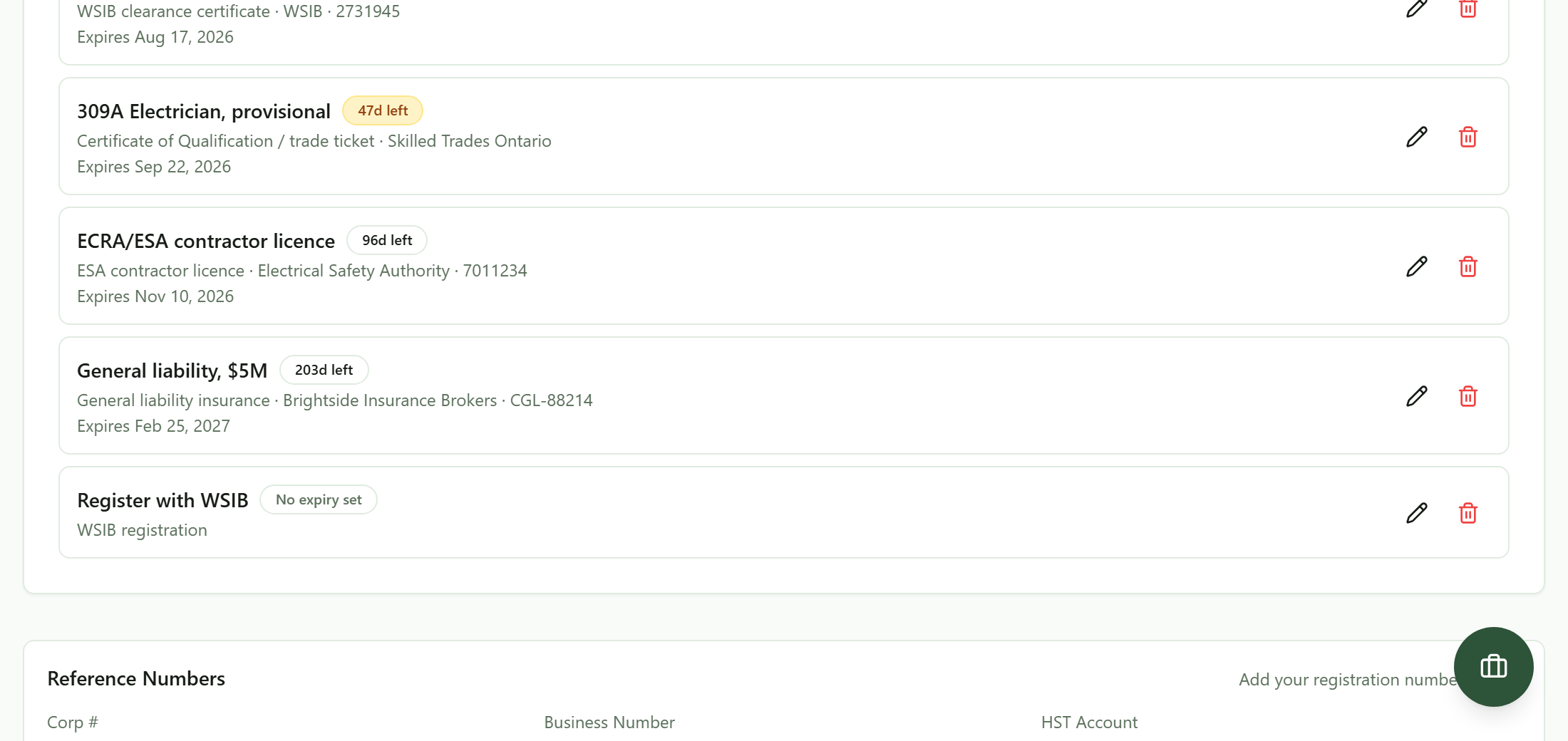 The policy, the broker, the number and the renewal date. What a GC's coordinator asks for is on this row.
Policy, broker, number, renewal date, and a warning window before it lapses. Mark it visible and it shows in your client portal, so a coordinator can check rather than emailing you on a Friday.
Getting the certificate to whoever asked, on time, every time, is clearances and certificates.
Do not confuse insurance with WSIB
They are different things and both get asked for. Insurance covers what you do to other people and their property. WSIB covers injury to workers and is a provincial scheme with its own registration. Neither one substitutes for the other, and a builder asking for "insurance" usually means both. That side is the WSIB guide.
What it costs
Commercial terms depend on the workflow. Review the relevant AEC Stack product page before you start.
The vocabulary above exists so the broker's answers mean something to you, and so you can tell a good quote from a cheap one. Placing the policy is your broker's job; knowing what to ask them is yours.
On AEC Stack: what the whole setup costs, including the first policy, is what going out on your own costs.
Before you call anybody, write down what you actually do, the largest job you expect this year, and whether your truck is on a personal policy. Those three answers shape every quote you are about to be given. When the certificate comes back, put it somewhere it cannot expire quietly: the demo business keeps the expiry dates and sends the renewal before a builder asks.
Take this guide with you
The full write-up, every screenshot and clip, captions, and a machine-readable manifest in one zip. Share it with your office or hand it to whoever runs your socials.
Download the kitContinue reading