Ontario / Practical guides
Put your first employee on the books without payroll breaking you
The first hire is three jobs: registrations that make it legal, paper that makes the deal clear, and a price you should know before the ad goes up. The payroll deductions account is a checklist item, the employment agreement is generated, and the WSIB card prices the hire with your own rate.
Browse all Ontario guidesPut this into practice
Explore a working business
Put the people, records and day-to-day work together in a sample business.
The first hire is the biggest jump a contracting business makes. Not the tenth employee, the first: that is the day your business stops being a person with a truck and acquires a payroll, and a stack of obligations arrives that nobody mentioned in the interview. Most of the fear around it comes from not knowing how many pieces there are.
There are three. Registrations that make the hire legal, paper that makes the deal clear, and a price you should know before the job ad goes up. This page walks all three where they already live in AEC Stack.
How contractors describe it
The questions, exactly as they get asked:
"Do I need to get WSIB, if so what is cost. I need to incorporate can I just upgrade my sole prop/HST number. Can a software like Quickbooks make payroll seamless? What kind of profit would make the added responsibility worth it? What have I totally not considered? I have a lot of questions but we'll start there"
And where it lands for the ones who grew:
"The moment it's not just you and your tool case the paperwork becomes a lot, and even managing 5-6 people can get complicated really quick."
"Wow I couldn’t do that. It’s a lot of work. We have an account that handles our books, taxes and payroll. We spend a pretty penny with her but it takes off so much stress."
The registrations, as checklist items instead of folklore
An employer in Ontario needs a payroll deductions account with CRA, the one that receives the CPP, EI and income tax you withhold from every cheque. It sits on your launch checklist beside the HST and corporate tax registrations, each with its link and its status:
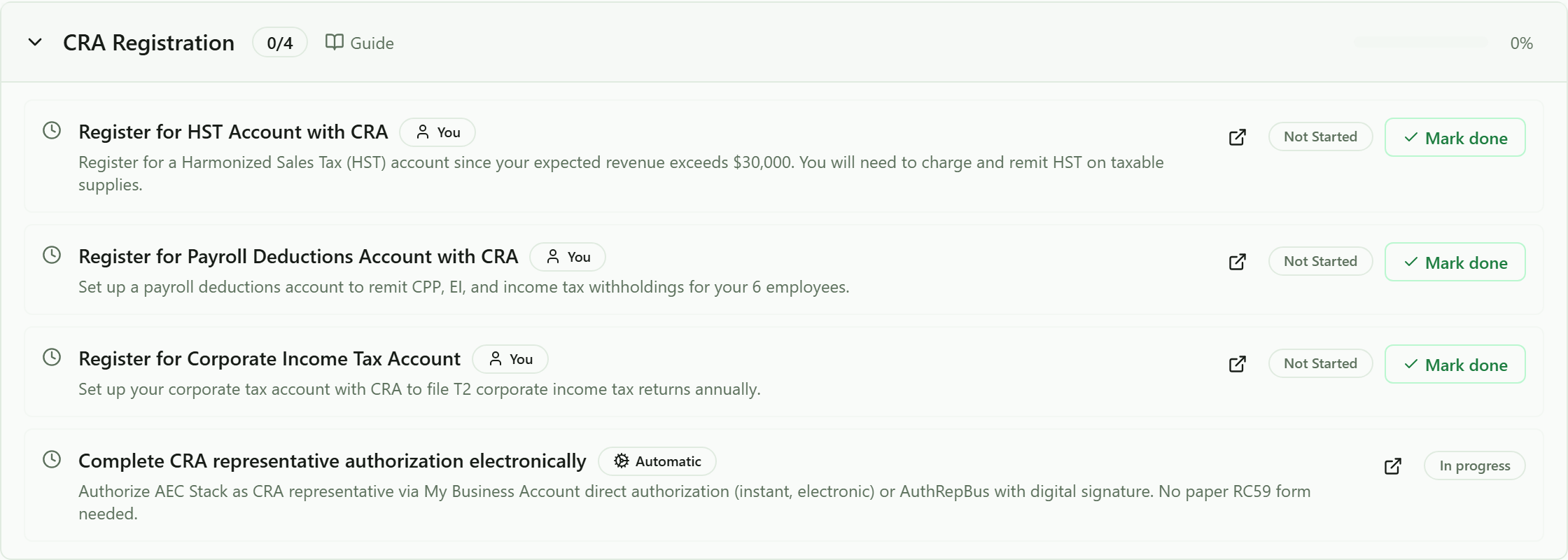 The registrations that make a hire legal sit on the same checklist as the rest of the launch. The payroll deductions account is one item with a link, not a mystery, and the CRA authorization step runs electronically.
The other registration a first hire triggers is WSIB, if you are not already registered: covering workers is what the account is for. The WSIB guide walks that whole surface, from registration to the clearance certificates GCs demand.
The contractor in the first quote asked what they have totally not considered. Usually it is this section, discovered one agency at a time. On a checklist it is an afternoon.
Know the price before you write the ad
A wage is not the cost of an employee, and the gap is the most common first-hire surprise. Two screens put real numbers on it before you commit to anything.
The WSIB estimate lives in your launch settings. It asks for the rate off your own WSIB statement, because the rate belongs to your class and guessing it would be lying to you, and then it prices the hire:
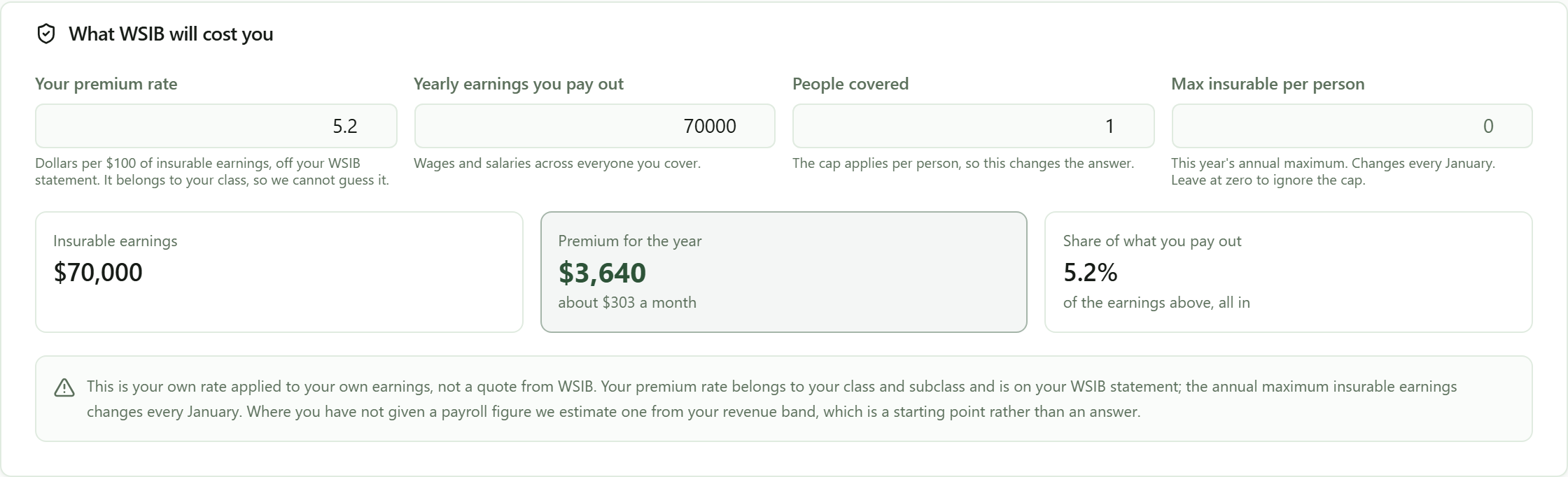 The demo's rate, not yours. Put in the rate from your own WSIB statement and the first hire's premium stops being a rumour and becomes a monthly number.
At the demo's rate, one person on $70,000 of earnings is $3,640 a year, about $303 a month. Your rate will differ, which is exactly why the card refuses to guess it.
WSIB is one line of several. The employer half of CPP, the employer share of EI, vacation pay and the hours you pay for but cannot bill all stack on top of the wage. The cost-of-an-hour calculator adds the whole thing up and turns it into the rate you need to charge for that person's time, which is the number that decides whether the hire pays for itself.
The offer, on paper
The Employment Agreement is already generated in your Document Center. Search for it:
 Already in your document set as TPL-008: edit it to the hire, preview it, and make the offer on paper instead of a handshake.
Edit it to the actual hire, preview it, and the offer goes out as a document instead of a conversation both of you will remember differently. If the person you are about to put on the books is really a contractor, or you are being told to treat an employee as one, read the misclassification guide first: the same facts that decide the tests decide who pays what here.
The honest answer to the Quickbooks question
Can software make payroll seamless? After the accounts exist, mostly. The run itself, calculating each cheque, remitting the withholdings on CRA's schedule, issuing T4s, belongs to a payroll tool or the accountant in the third quote, and that is money well spent. What no payroll tool does is the part before and around it: knowing which registrations you need, having the agreement ready, pricing the hire, and keeping books that absorb wages as a cost you can see per job. That part is this platform, and the wages already flow through your books alongside everything else the business spends.
What it costs
Commercial terms depend on the workflow. Review the relevant AEC Stack product page before you start.
If the ad is written in your head already, do the arithmetic first: what the hour really costs, then the WSIB card in your launch settings with your own rate. If the numbers still say hire, the registrations are a checklist section and the agreement is TPL-008. That is the whole mystery.
Take this guide with you
The full write-up, every screenshot and clip, captions, and a machine-readable manifest in one zip. Share it with your office or hand it to whoever runs your socials.
Download the kitContinue reading