Ontario / Practical guides
Stop paying for five tools that each miss the construction part
Contractors build their own spreadsheets because every app was missing the thing that makes construction different, and because a monthly bill for something that still needs a workaround is infuriating. Holdback, per-job profit and the T5018, in one place, with no monthly bill.
Browse all Ontario guidesPut this into practice
Explore a working business
Put the people, records and day-to-day work together in a sample business.
Contractors do not build their own spreadsheets because they enjoy spreadsheets. They build them because every app they tried was missing the one thing that makes construction different, and because paying a monthly bill for something that still needs a workaround is infuriating.
So they duct-tape a stack, or they spend thirty hours in Excel, and then they spend every month after that maintaining it.
The complaint underneath all of them
"The ones I've tried have always been missing something I wanted, which is what drove me to do my own books in the first place."
"Bookkeeping feels like digital whack a mole no matter what app you use."
"I'm finally going to start managing my business like an adult and am curious about what y'all use to manage your book."
Three people, one problem: the generic tool does generic business, and construction is not generic business.
The three things generic software gets wrong
Holdback. Ten percent of a job is invoiced, earned, and not collectible for months. Generic software puts it in "money owed to you" and your cash picture is a lie from that moment on. Here it is its own receivable, and it becomes real money on the day it is released.
Per-job profit. Not overall profit. This job, against this contract, with this spend.
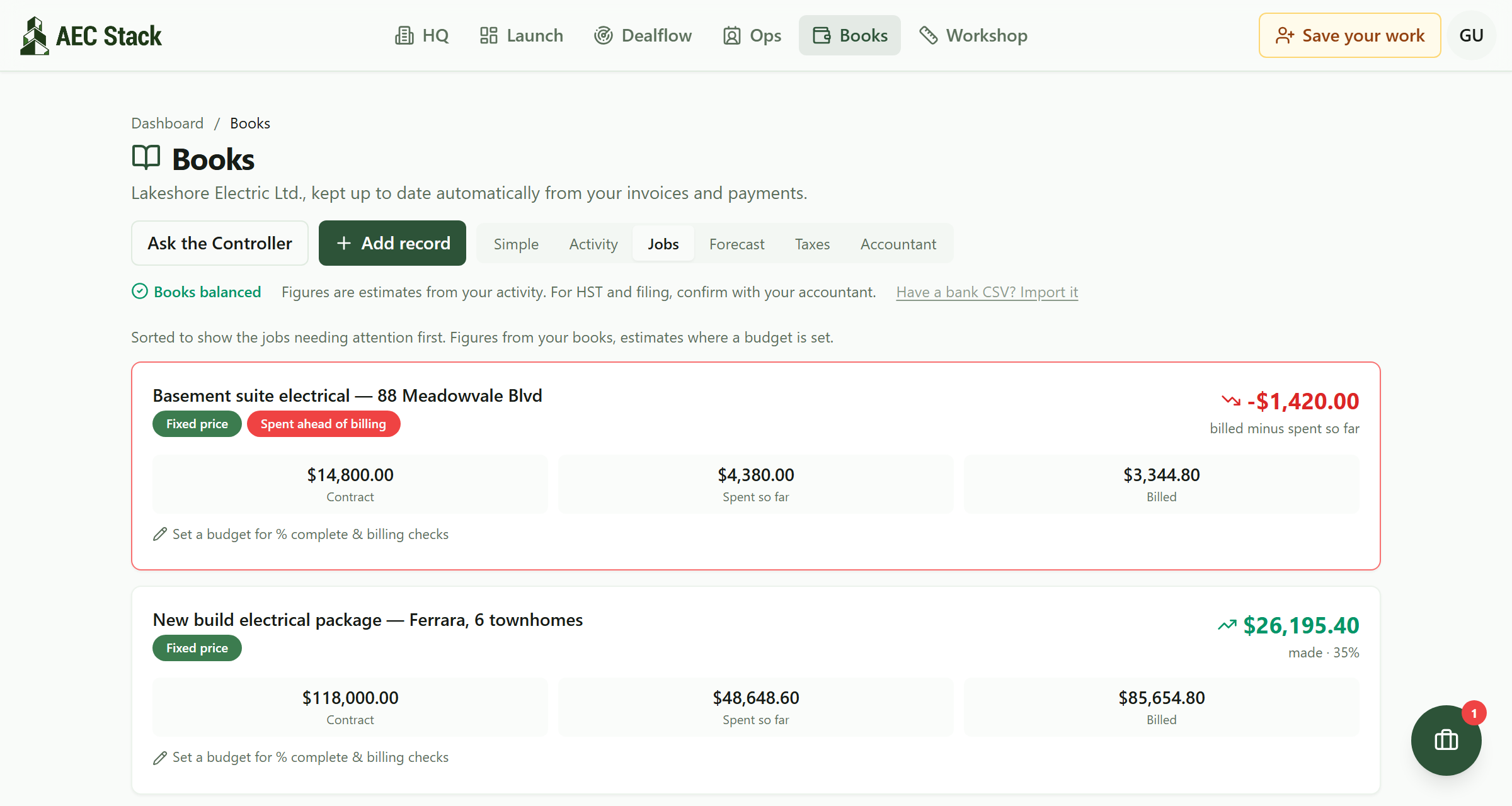 The job that needs you is at the top, in red. The two that are fine are underneath, where they belong.
The one that needs you is at the top. That is the number contractors most often cannot get at, and the reason a busy year can end with no money in it.
The construction tax return. T5018 is a CRA return for subcontractor payments, specific to construction, and it is built in here rather than left for you to assemble at year end.
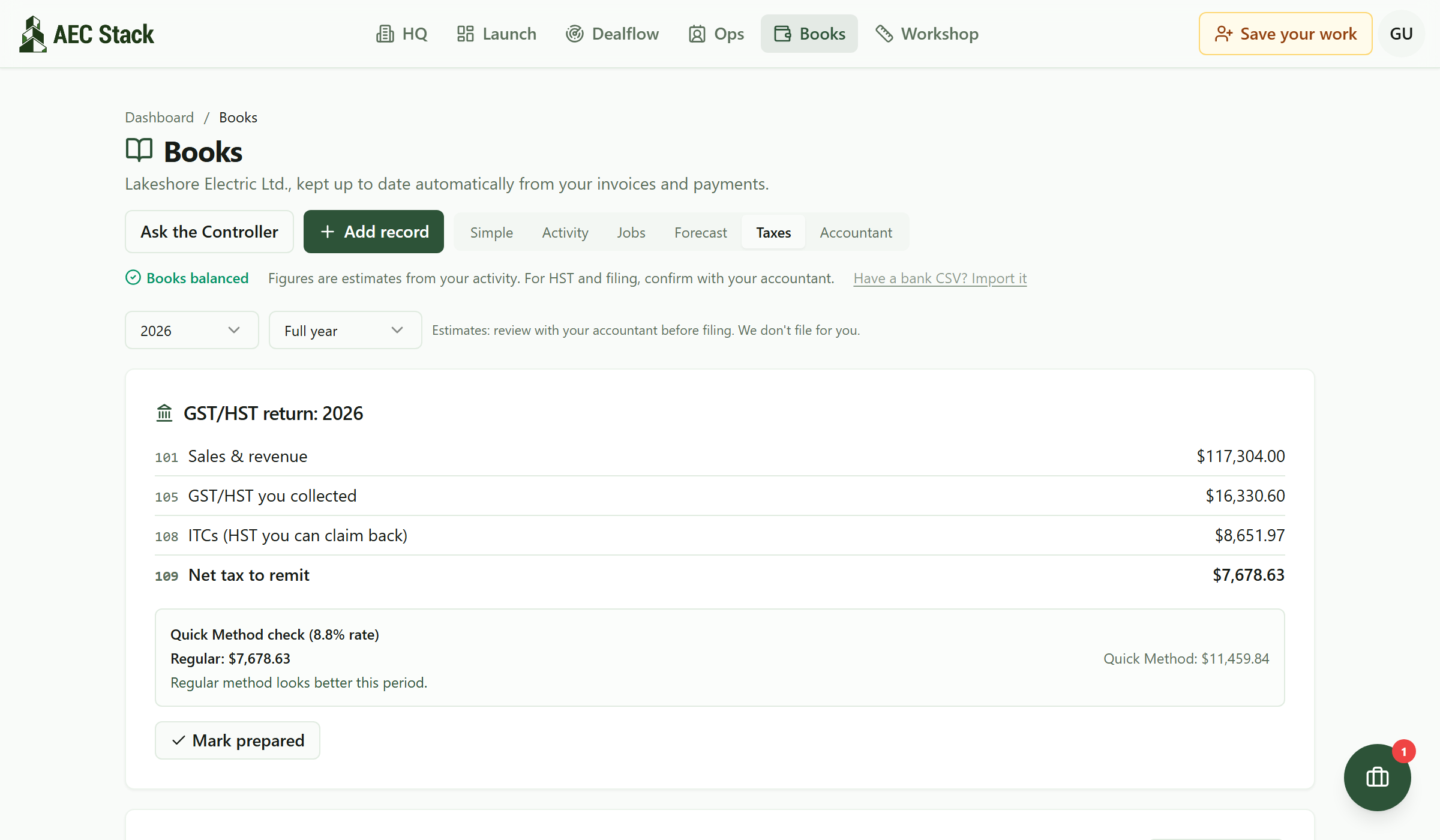 HST by CRA line number, the Quick Method compared for you, and the T5018 with the missing business number already flagged.
Look at two details there. The Quick Method is compared against the regular calculation and tells you which one is cheaper this period. On the screen above that gap is $3,781.21. And the T5018 has already noticed a vendor with no business number, which is the thing that bounces the return.
What it replaces
One place holds the quotes, the invoices, the holdback, the expenses, the per-job profit, the HST, the T5018, the client portal and the documents. The pipeline that produced the invoice and the books that record it are the same system, so nothing is re-typed and nothing disagrees.
That is what kills the spreadsheet: not that the spreadsheet was bad, but that it was the only thing joining tools that would not talk to each other.
And the bill is the real reason
Commercial terms depend on the workflow. Review the relevant AEC Stack product page before you start.
Commercial terms depend on the workflow. Review the relevant AEC Stack product page before you start.
Invoices you raised before you arrived come in as drafts and are never charged a fee, so moving across does not cost you retroactively.
Try it on a business that already has a year behind it
You do not have to incorporate, sign up or enter a single invoice to see whether this holds. Open a demo business in your trade and it arrives mid-year with posted activity in it: real invoices, real holdback, jobs that made money and one that did not.
Go straight to Books and press Jobs. If the number you have been unable to get at all year is sitting there, you have your answer in about ninety seconds.
On AEC Stack: the per-job number in detail is did I make money this month, the holdback mechanics are the holdback guide, and what an auditor would ask for is books that survive.
Open a demo business as your trade and look at the Jobs tab first. It is the fastest way to find out whether your current stack has been hiding something from you.
Take this guide with you
The full write-up, every screenshot and clip, captions, and a machine-readable manifest in one zip. Share it with your office or hand it to whoever runs your socials.
Download the kitContinue reading