Ontario / Practical guides
What to charge when you go independent in Ontario
WSIB, CPP at both halves, income tax, HST after $30,000, insurance and plates all arrive together. Add up your real monthly overhead, run it through a six-month cash forecast, and get the number that has to go on top of your rate.
Browse all Ontario guidesPut this into practice
Build the offer
Connect the scope, price, assumptions, and client response in one working proposal.
The day you stop being an employee, a stack of costs that used to belong to somebody else lands on you. WSIB, CPP at both halves, income tax with nothing withheld, HST once you pass $30,000, commercial general liability, commercial auto, plates, licence fees. They do not arrive politely one at a time. They arrive together, and the client asking for your certificate of insurance does not care that it costs you anything.
So people go independent at roughly their old hourly rate and find out later.
The number is bigger than it looks
"Found this out the hard way. Got switched to a subcontractor with a 5 dollar raise. I had to up my rate by 70 dollars just to clear overhead."
Five dollars offered. Seventy dollars needed. That is not a rounding error, it is a different job.
And the question underneath it, asked properly by somebody about to make the jump:
"I know I will have to pay my own WSIB, CPP, income tax, and HST after $30,000. I also know I will be able to write some things off. Will the new expenses be balanced out by the write-offs or will be making less money if I charge at the same rate?"
That is exactly the right question and it has an arithmetic answer, not an opinion. You just need somewhere to do the arithmetic.
Start from cash, not from a rate
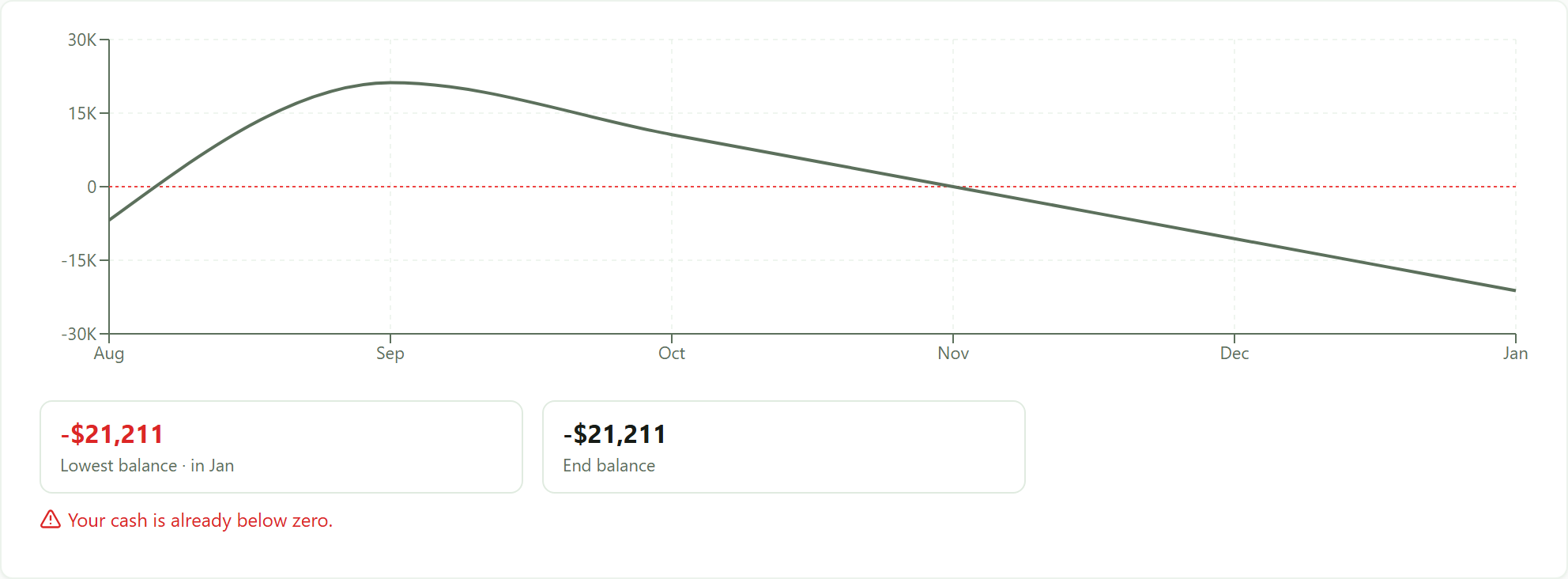 Six months of cash, projected from invoices you have actually raised and bills you have actually entered. The low point is called out with the month it lands in.
This is a six-month cash projection built from real receivables, real bills and real overhead. Not a budget you typed in, and not a rate calculator. The invoices you have raised, when they are due, the bills you owe, and what goes out every month regardless.
The value is the shape. The curve here climbs to about $20K in September and then falls all the way through to January, and the low point is called out with the month attached. You would find that out in August rather than in December, which is the entire difference between a decision and a scramble.
Then test the decision before you make it
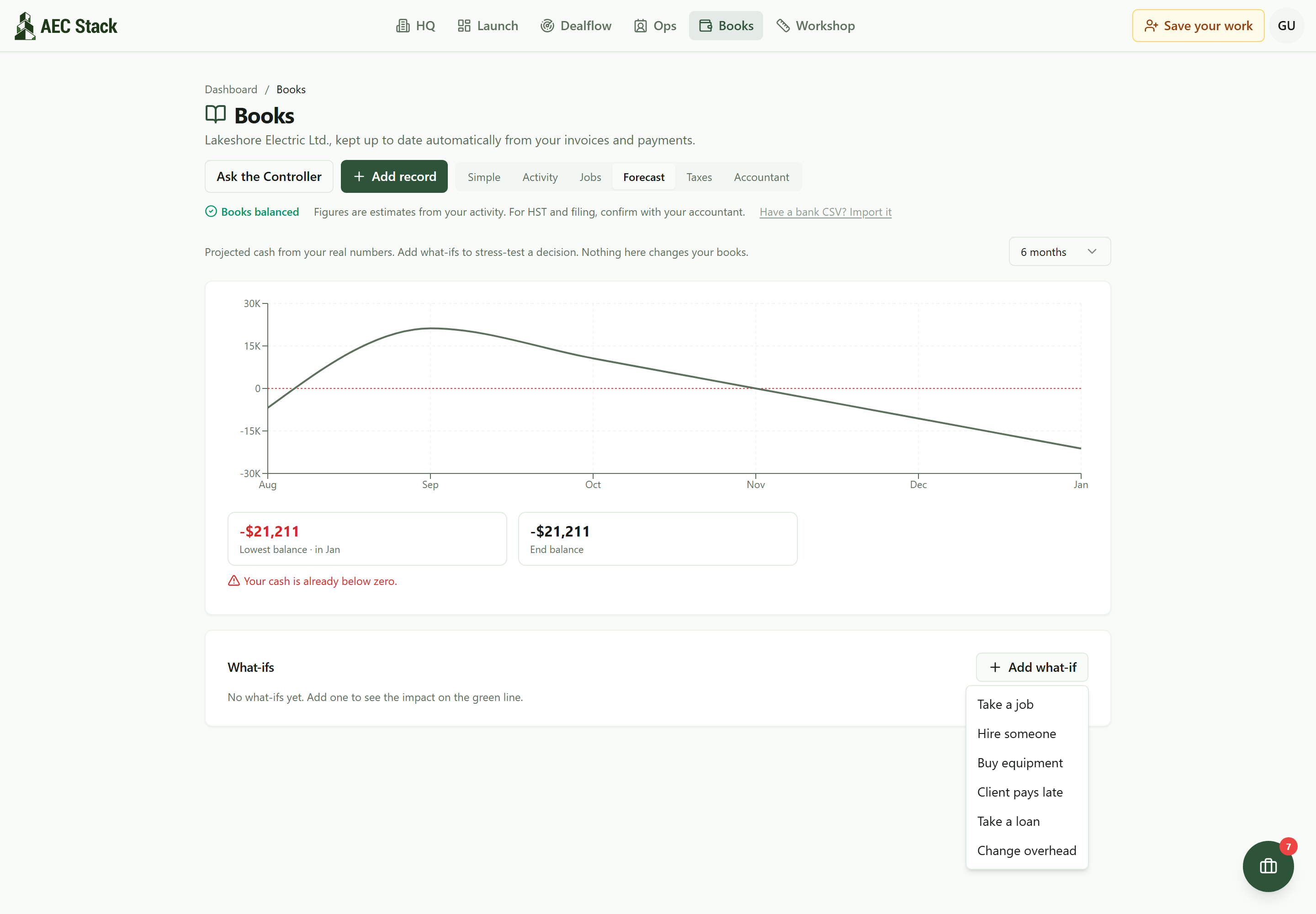 Six decisions you can run against your real numbers before you make them. Nothing here changes your books.
Six things you can lay over that curve: take a job, hire someone, buy the truck, a client pays sixty days late, take a loan, change your overhead. They are the six decisions of a first year on your own, and none of them changes your books. It is a projection, not an entry.
The one that answers this guide is the last one.
What a thousand a month actually costs you
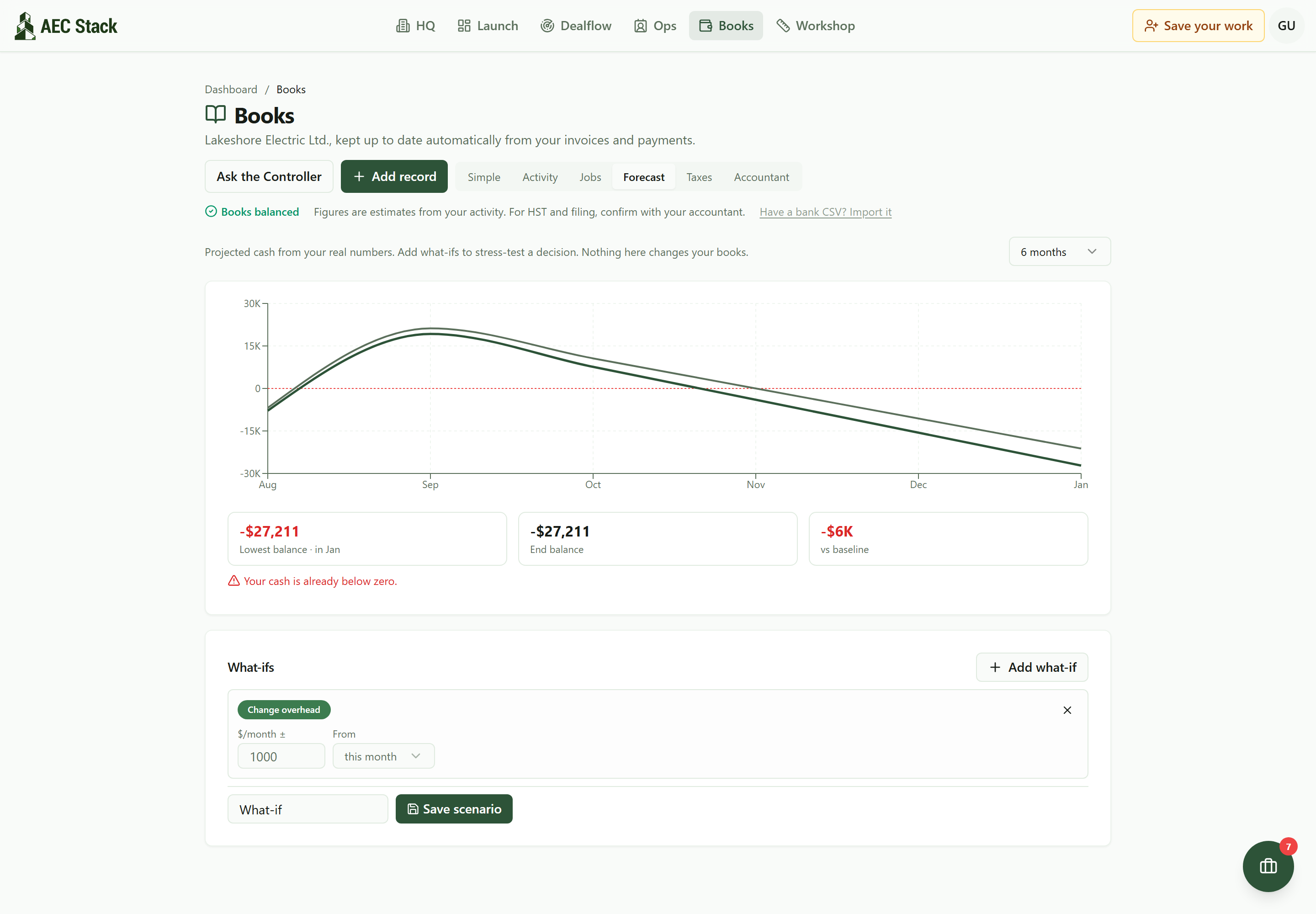 A thousand a month of overhead, tested. Six thousand dollars off the bottom line by January, and a second line on the chart showing exactly where it separates from the plan.
Add up what going independent actually costs you every month. Insurance, WSIB premiums, the phone, the truck payment, plates, accounting, licence renewals. Put that number in as a change in overhead and watch what it does.
A thousand a month here takes the January position from minus $21,211 to minus $27,211. Six thousand dollars, and a second line on the chart showing you exactly which month the two paths separate.
Now you can work backwards, which is the whole point. Six thousand over six months, across the billable hours you actually expect to work, is the number that has to go on top of your rate before you have earned a cent. Do it against your real overhead rather than a guess and the answer stops being a feeling about whether you are charging enough.
Then name the scenario and save it, so next January you can reload the version of this you believed in August and see how close you were.
The parts people get caught by
HST is not yours. You start charging once you pass $30,000, measured either across the four calendar quarters before this one or inside any single calendar quarter, and on the single-quarter path the invoice that takes you over is taxable itself. The money you collect belongs to the CRA. Holding it in the same account you spend from is how a good year turns into a bad remittance.
CPP is both halves now. An employer used to pay half. That half is yours.
Write-offs reduce tax, they do not reduce cost. A $1,000 expense you can deduct still leaves your bank account. It comes back at your marginal rate, not at a hundred cents on the dollar. This is the single most common miscalculation behind the question in that second quote.
Insurance is a gate, not an expense. Commercial general liability and commercial auto are what let you on the site at all. Price them in as the cost of being allowed to work.
Bill for the paperwork you now do. Quoting, invoicing, chasing payment, certificates, clearances. Nobody paid you for those as an employee because somebody else did them.
And the fee only lands after you are paid
Commercial terms depend on the workflow. Review the relevant AEC Stack product page before you start.
On AEC Stack: the hourly version of this arithmetic is what an hour costs you. The costs you meet on the way in are named up front in what it costs to start, and the HST side is in HST right and clean books.
Before you hand in your notice, add up your monthly overhead honestly and put it through the forecast once. It takes ten minutes and it will tell you whether the rate you had in mind is a business or a pay cut. Open the business workspace to explore the connected records before you use your own numbers.
Take this guide with you
The full write-up, every screenshot and clip, captions, and a machine-readable manifest in one zip. Share it with your office or hand it to whoever runs your socials.
Download the kitContinue reading