Ontario / Practical guides
Walk through a working contractor business before giving anyone your name
An empty trial account tells you nothing. Pick your trade and land in a business partway through its year: money in play, an invoice fourteen days overdue, change orders on a live job, books that balance.
Browse all Ontario guidesPut this into practice
Explore a working business
Put the people, records and day-to-day work together in a sample business.
Software for contractors is usually sold the same way: a demo video where everything is already set up, then a signup form, then an empty account and a month of your evenings before you find out whether it fits.
The problem with that order is that the empty account tells you nothing. A quoting screen with no jobs in it looks fine. What you need to know is what it looks like on a Tuesday when there are eight things in play, an invoice is late, and a client has asked for an extra.
Pick your trade
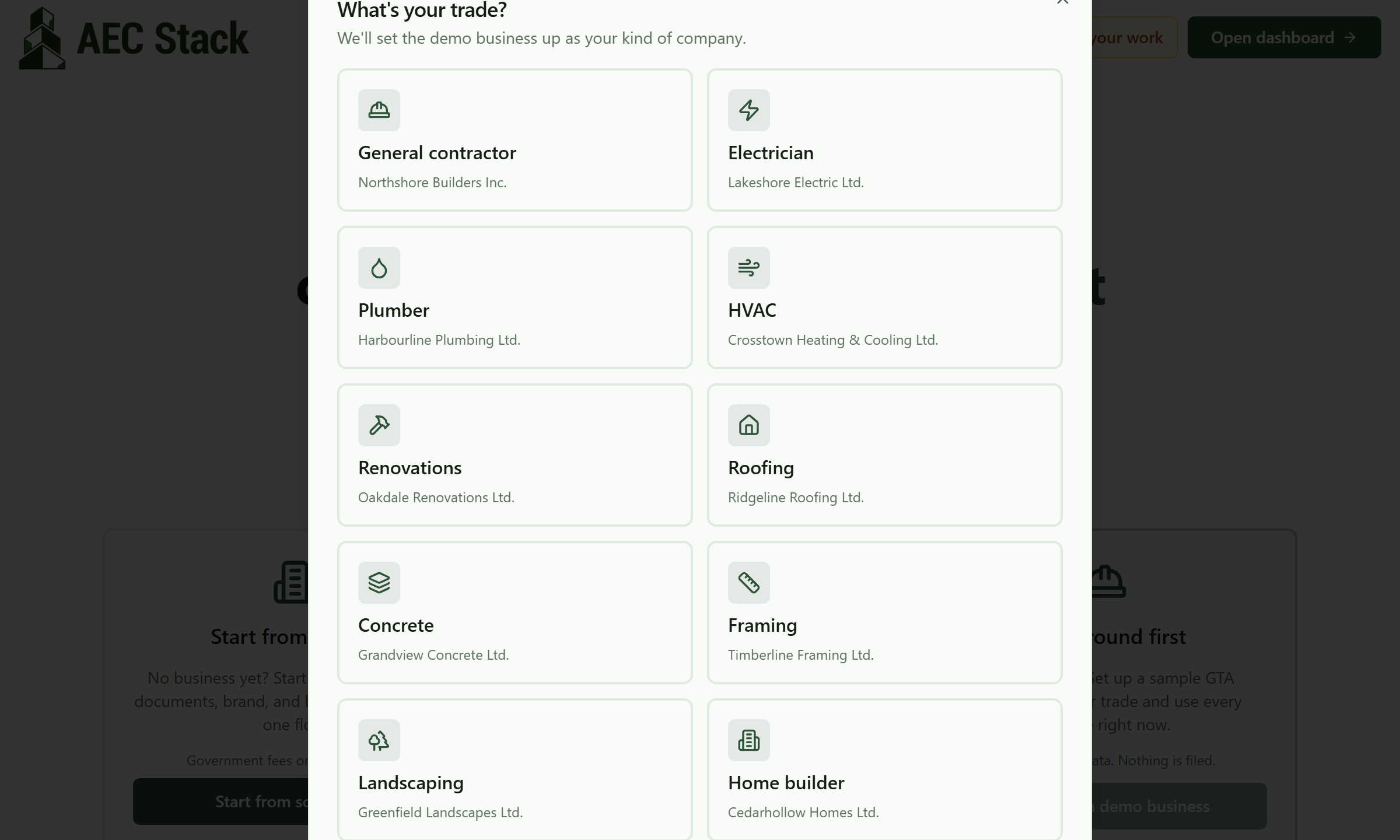 Pick your trade. No email, no card, no form. The business it builds is in your trade, not a generic one.
Ten trades, and the one you pick decides what gets built. An electrician gets ESA licensing rows on the setup checklist, panel upgrades and fixture packages in the jobs, and suppliers an electrician would actually use. A landscaper gets a different company entirely.
There is no email box on that screen. Nothing is asked for, because asking is the thing that stops people looking.
What you land in
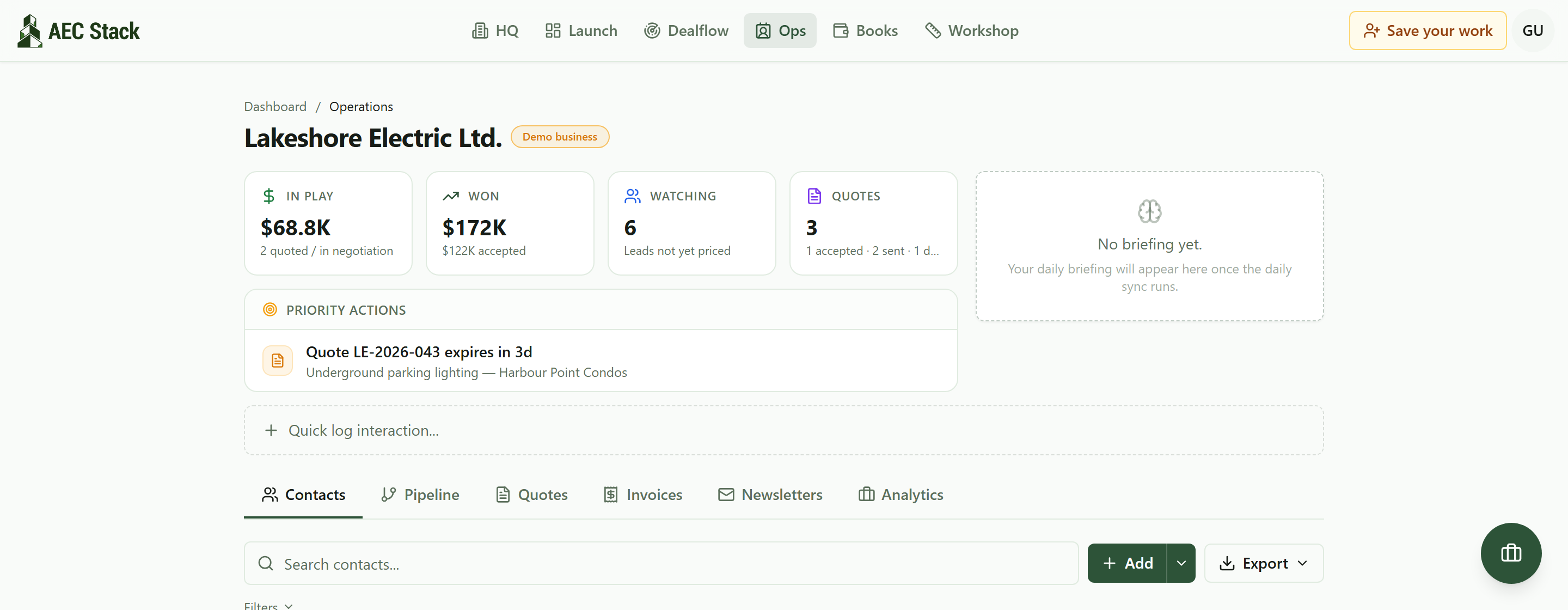 What lands is a business mid-year: money in play, jobs won, quotes about to expire. Not an empty shell with sample data in it.
A business partway through its year. Money in play, jobs won, quotes with expiry dates approaching, an invoice fourteen days overdue, change orders on a live job, a set of books that balances.
That is deliberate. You cannot judge an invoicing screen with no invoices, and you certainly cannot judge whether the thing would survive your worst week.
What is worth actually trying
Poke at the things that decide it for you rather than the tour.
Open the overdue invoice and look at its history: sent, opened by the client, reminded. Then find Send Payment Reminder in the row menu. That is the loop that decides whether you get paid.
Open a change order and look at what happened to it, and at what the client sees when it reaches them. Extras are where the money leaks.
Open the books and switch to Jobs. One job will be flagged as spent ahead of billing. That is the figure that tells you which job to ask a question about, while there is still time to ask it.
Price something. The quote builder has a cost-of-an-hour calculator in it. Put your own wage and WSIB rate in and see what your real floor is.
Look at the feed. Real Ontario permits and awards, thousands of live rows, filtered to your trade.
What is real and what is not
The company is invented. Lakeshore Electric does not exist and neither do its clients, and the invoices are seeded so there is something to look at.
Everything else is the actual product. The same screens, the same arithmetic, the same emails, the same Construction Act date calculations. The dealflow feed is live public data rather than fixtures. Nothing you press files anything with anybody, and nothing is sent to a real person.
When you want your own, the same on-ramp starts a real business and the demo stays out of the way.
What it costs
Commercial terms depend on the workflow. Review the relevant AEC Stack product page before you start.
That is also why the demo is a whole working business rather than a locked tour. There is no trial to convert; there is only whether this is useful on a Tuesday.
On AEC Stack: if you already run a business, the more interesting version is bringing the one you have. If you are starting from nothing, it is starting a construction business in Ontario.
Open a demo business as your trade, then go straight to the overdue invoice. Five minutes there tells you more than any tour.
Take this guide with you
The full write-up, every screenshot and clip, captions, and a machine-readable manifest in one zip. Share it with your office or hand it to whoever runs your socials.
Download the kitContinue reading