Ontario / Practical guides
Preserve and perfect a lien before the deadline, or decide not to
Sixty days to preserve, ninety more to perfect, and the clock starts on your last day on site rather than on your invoice. Get your date first, then decide whether a lien is the right instrument at all.
Browse all Ontario guidesPut this into practice
Create the invoice
Follow the work into billing, payment status, and the next collection step.
Ask any room of contractors what to do about a client who will not pay and someone will say lien the property. They are not wrong. It is the strongest thing in the toolbox, because it attaches to the land rather than chasing a person who has stopped answering.
Ask the same room what the deadline is and the room goes quiet, or gives you a number that stopped being right in 2018.
This page is the two dates, what actually starts them, and how to decide whether a lien is worth it. It is written against the Act as it stands after the changes that took effect on 1 January 2026, and it names the section behind every number so you can check it.
How contractors describe the problem
On how common the underlying situation is:
"There is talk of extending the lien rights time to greater than 45 days which would be a very welcome option to anyone in the construction industry who has been screwed by a GC or home owner. (which is pretty much everybody)"
That wish was granted, and then the Act moved again. The 2018 amendments took the preservation period from 45 days to 60, and a further package took effect on 1 January 2026. The post is worth quoting because it is still there, still readable, still says 45, and posts like it are where a lot of contractors get their numbers.
And the thread where the whole ladder gets skipped in three words:
"A client I did a lot of work for already owes me $1100 and has claimed she doesn't want to pay because she doesn't like how the vinyl tile she chose looks. I installed it, she told me she thinks it doesn't look good so I go back pull it all out and reinstall it and now she is just ghosting me."
Top reply, 379 upvotes: put a lien on the house. For $1,100, that advice is probably wrong, and the last section of this page is about why.
Two deadlines, not one
This is the distinction that costs people their rights, because both steps get called "filing a lien".
Preserving is registering the claim for lien on title. You get 60 days. Section 31.
Perfecting is starting a court action on it and registering a certificate of action. You get a further 90 days, counted from the last day you could have preserved rather than from the day you actually registered. Section 36. Registering early does not buy you time at the far end.
Preserve and then do nothing and the lien expires. It does not convert, it does not extend, and nobody writes to remind you. The registered claim simply stops being worth anything, and you are back to being an unsecured creditor with a worse relationship than you started with.
What starts the clock depends on which end of the job you are on
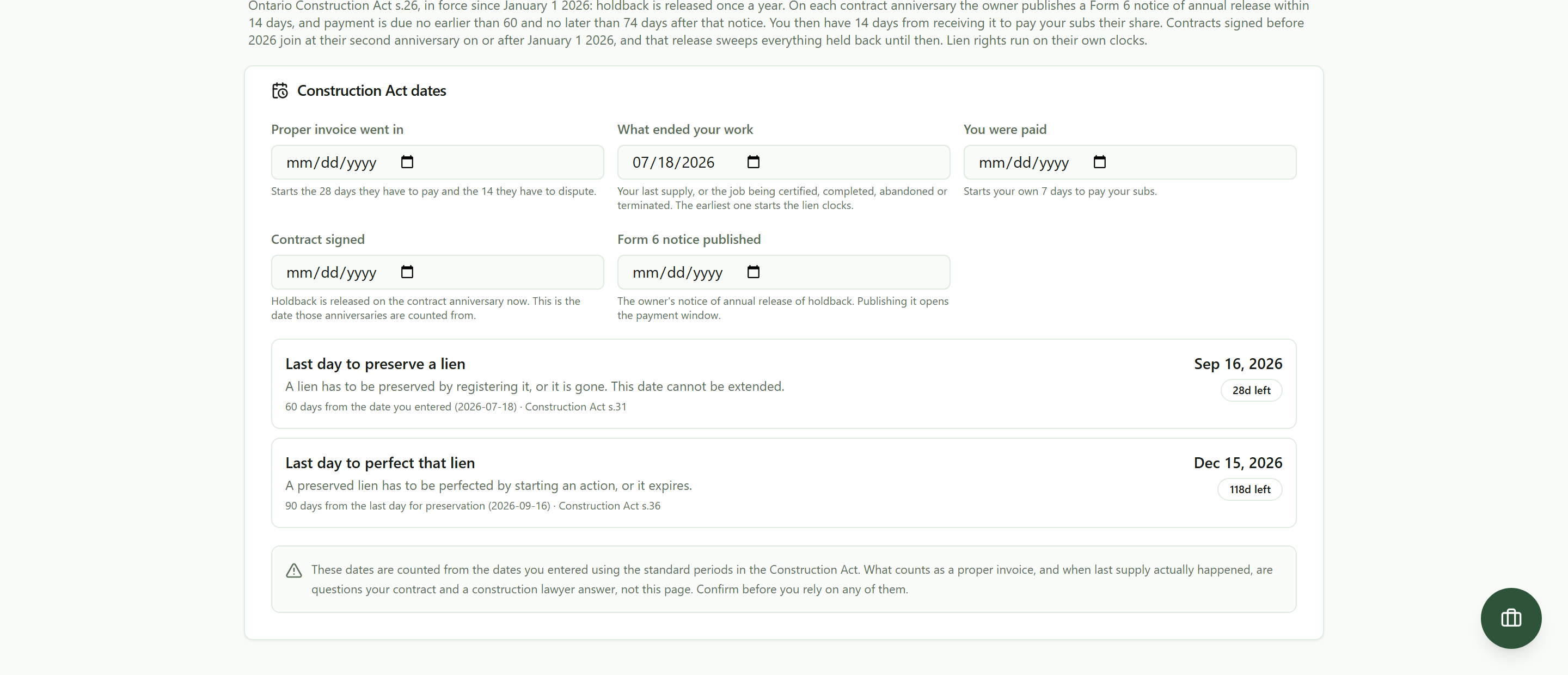 One date in, both dates out, each naming its section of the Act. Neither can be extended once it has passed.
One date in, both dates out, with the section each comes from and the days left on each.
If you hold the contract with the owner, your 60 days does not run from the day you personally last worked. Section 31(2) counts from a project milestone: publication of the certificate or declaration of substantial performance, or the contract being completed, abandoned or terminated, whichever comes first.
If you are a subcontractor or a supplier, four things can start it and the earliest one wins. Section 31(3): substantial performance being published, your own last supply to the improvement, the head contract being completed, abandoned or terminated, or your subcontract being certified complete.
So "last day on site" is the most expensive shorthand in this trade. It is one of four triggers if you are a sub, and it is not a trigger at all if you hold the head contract. Even for a sub it is last supply rather than attendance: a warranty call back six weeks later is usually not last supply, and dropping off the final materials often is.
New since 1 January 2026: where a contract is terminated, a notice of termination has to be published within seven days, and where one is published, that publication date is what your clock runs from. Section 31(6) and (7). Do not count from the day you heard the job was killed. Do not wait for a notice either, because if nobody publishes one the clock runs from the actual termination.
Which day it was on your job is a question of fact that gets argued about, and it is the thing the panel says plainly it cannot answer for you. If your date is anywhere near the edge, that is the phone call.
Everything here is counted, not stored. The dates are candidates so you are not doing arithmetic on the worst day of the job, and where you have your own date, yours wins.
The holdback clock is not the lien clock
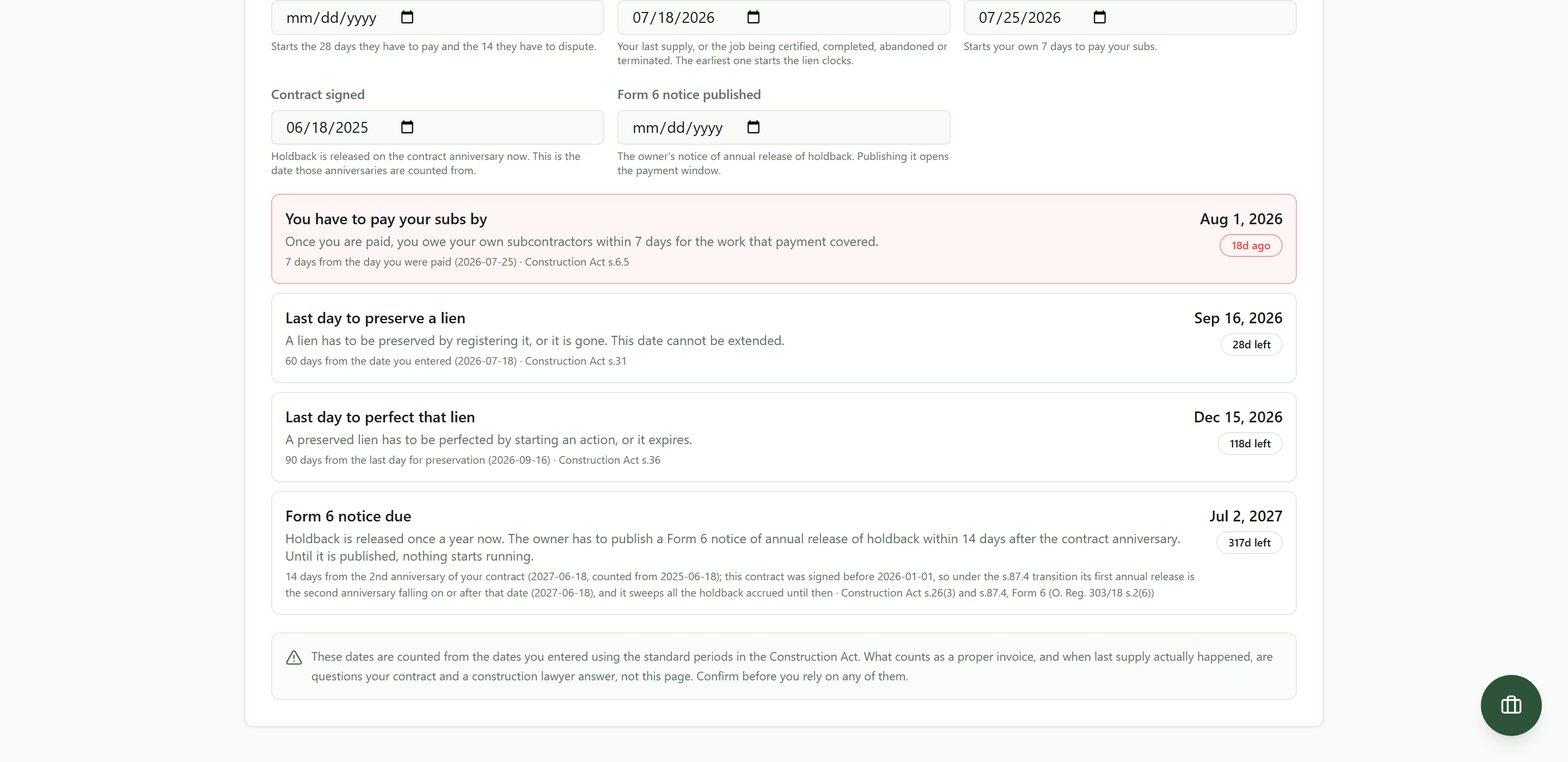 Holdback and lien dates on one timeline. They run on different triggers, which is exactly why they get confused.
These are different schemes with different triggers, and since 1 January 2026 they have moved further apart. Publication of substantial performance starts a lien clock under section 31. It no longer starts a holdback clock.
On a job that finishes inside a year, holdback still becomes payable after lien rights have run out: section 26(8) gives 14 days from the point every lien has expired or been satisfied, discharged or otherwise provided for. On a contract that runs past an anniversary of the day it was signed, the basic holdback moves onto an annual cycle instead, which the holdback guide covers properly.
Worth knowing either way: Ontario briefly legislated liens expiring 60 days after a holdback release notice, then repealed it before it ever came into force. Taking your holdback does not burn your lien rights.
Deciding whether it is worth it
A lien is leverage, and leverage has a price.
What it costs. Preserving one properly means a lawyer who does construction work, title searching to get the right owner and the right property description, and registration. Anyone quoting you a flat number without seeing the job is guessing. Get a real quote, because the fee against a $1,100 balance is the whole decision.
What it risks. A lien registered on the wrong title, for the wrong amount, or after the deadline can be expunged, and there is exposure if it was registered improperly. This is the specific reason the answer to "should I lien it" is not "yes" by default.
What it does well. It stops a sale or a refinance and it gets attention from people who were not answering the phone, particularly on a project with a lender behind it. On a real balance owed by a solvent owner, it works.
When something else fits better. Under a few thousand dollars, Small Claims Court is usually the better instrument and you do not need a lawyer for it. For a live dispute mid-project, adjudication under the Act is faster and cheaper than either. Both are in what to do when a client will not pay. One trap there: starting an adjudication used to buy extra time to register, and since 1 January 2026 it does not. Register on the section 31 timetable whatever else is running.
The decision that is never wrong: find out your preservation date today. Whether you use it is a separate question you can take your time over, and you cannot take your time over the date.
What you get here, and where the lawyer starts
AEC Stack counts the dates from the dates you give it and shows the section of the Act behind each one, so the arithmetic is already done before the worst day of the job rather than during it. Whether you have lien rights on a particular project, and which event actually started your clock, are facts about your job, and they belong to a construction lawyer who can see it.
If you are inside 60 days of the event that started your clock on a job that has gone bad, the useful next action is that lawyer, not more software. Bring the invoice, the contract, the dates panel, and the date you think it started.
Commercial terms depend on the workflow. Review the relevant AEC Stack product page before you start.
On AEC Stack: the clocks that run before this one, and the 14 days a payer had to dispute anything, are in prompt payment. Most jobs that get here started with an extra nobody wrote down: change orders.
Open the Ontario lien deadline calculator, free and with no account, and put in the date your clock started on the job you are worried about. If the number that comes back is small, make the call today.
Take this guide with you
The full write-up, every screenshot and clip, captions, and a machine-readable manifest in one zip. Share it with your office or hand it to whoever runs your socials.
Download the kitContinue reading