Ontario / Practical guides
Survive net 60 without an 11% loan or a factoring company
Materials and payroll go out weeks before the money comes in. Bill against a schedule of values as the work happens, see what is outstanding against what is genuinely late, and keep the holdback out of the number you think you have.
Browse all Ontario guidesPut this into practice
Create the invoice
Follow the work into billing, payment status, and the next collection step.
The materials go out on your card in week one. Payroll goes out every second Friday from week one. The invoice goes out at the end, the terms say net 60, and net 60 means the client starts counting when it suits them. In between, the job is financed by you.
This page is about the part of that you can move. Not the client's terms, which are usually not negotiable, but when the invoice leaves, what it covers, and whether you can see the whole position on one screen instead of in your head at 11pm.
Nothing here lends you money. AEC Stack is not a lender and does not advance or factor anything. It shortens the gap you control and makes the rest visible, which is what turns a liquidity problem back into a scheduling problem.
How contractors describe the problem
The clearest statement of it, from a sub who did the arithmetic:
"So I am a subcontractor and we are currently dealing with some serious liquidity issues right now. Majority of our invoices are net 60 and like 95% of them are taking the full 60 days, with some even going beyond 60 days, and we just can't continue waiting."
That poster was weighing a bank loan at 11.3% against invoice factoring at 3.22%. Both of those prices are set by how badly you need the money this week.
From the other side of the chain, where the delay starts:
"as G.C working for public sector, we often don't get paid for 2~3 months because, well, fucking government worker doesn't give a shit. imagine being supplier/sub and 2nd tier sub working for us? often we front the money for small outfit who can't float for too long, but it sucks."
And the advice given to anyone starting out in Ontario, which is really a description of the same gap:
"Plan on not having any income for minimum 6 months to start"
Stop lending the client the whole job
The single biggest lever is not the terms. It is how often you bill.
A four month job invoiced at the end is a four month loan at 0%, and then net 60 on top of it. The same job billed monthly against a schedule of values is four loans of one month each, and the last one is the only one still outstanding when you finish.
That is what progress billing is for, and it is the screen contractors skip because the first one takes twenty minutes to set up.
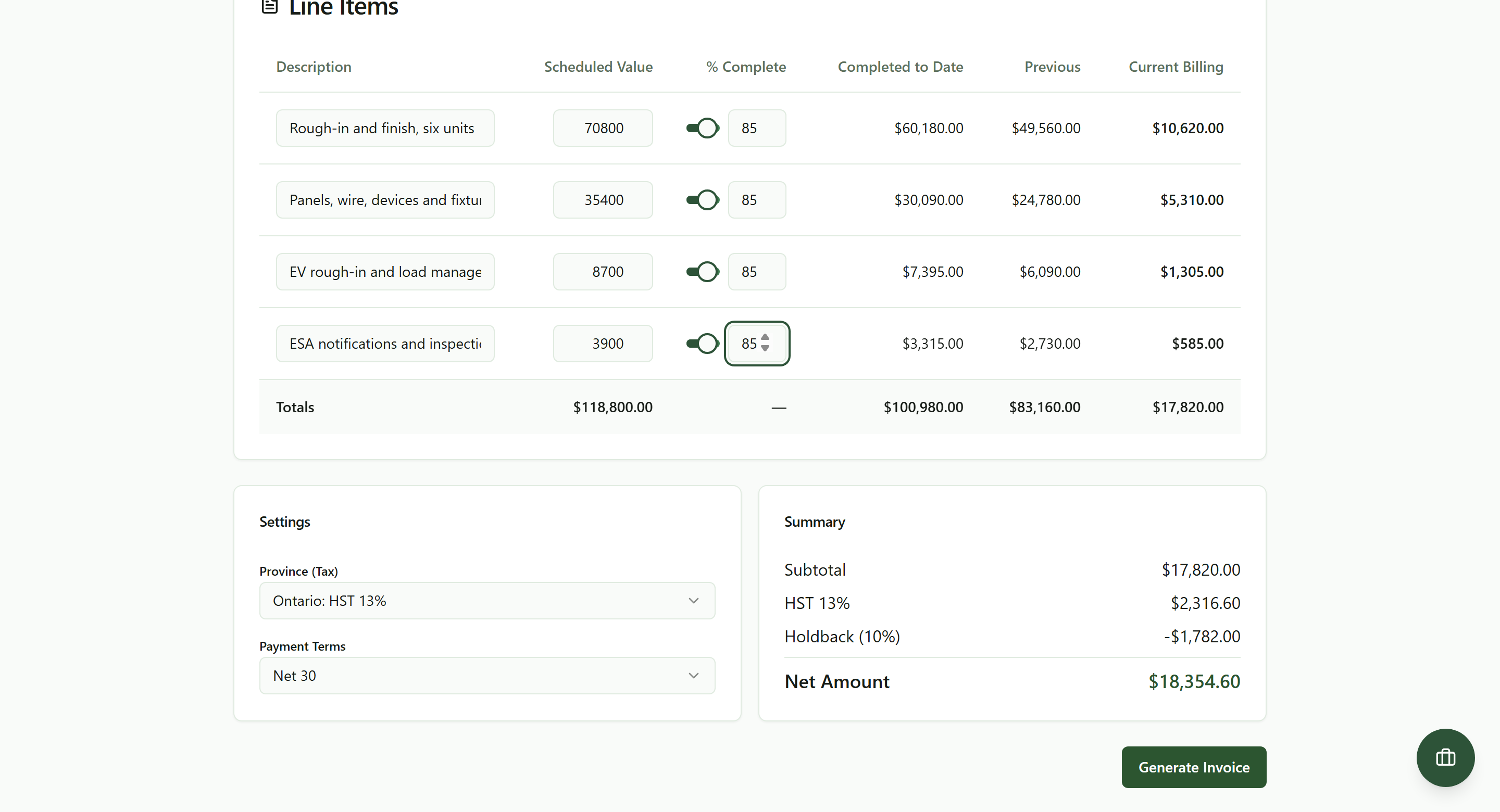 Move each line to where the work actually is and it bills the difference. Everything already invoiced sits in the Previous column so it cannot go out twice.
Each line carries what it is worth for the whole job. You move the percentage to where the work actually is, and the current billing is the difference between that and everything already invoiced. HST goes on, the holdback comes off, and the net is what you are asking for this month.
The Previous column is the part that makes it safe. Double billing a line is the thing everyone is afraid of when they bill in pieces, and it is the reason people go back to invoicing once at the end. Here the previous billings are read off the last invoice you raised, so a line that has been billed to 70% cannot be billed from zero again.
Two honest caveats. Your contract has to allow progress billing, and on a GC job that usually means their form and their cut-off date, so the useful move is to ask before the first invoice rather than after the third. And billing monthly does not make the client faster. It makes the first payment arrive months earlier than it otherwise would have, which is a different thing and the one that matters.
Know what is out and what is late without adding it up
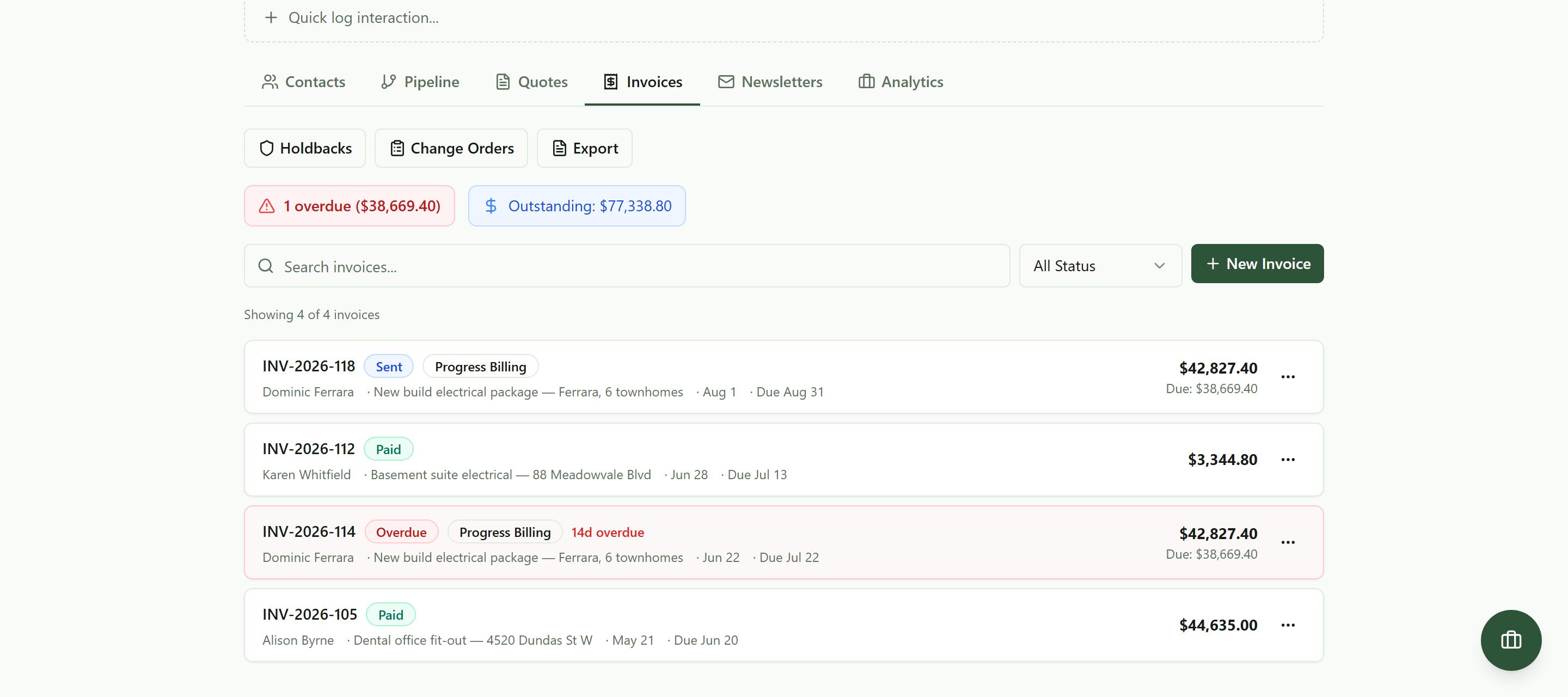 What is out there and what is late, on the same screen. The two numbers a contractor on net 60 is actually tracking.
Two numbers, and they answer different questions.
Outstanding is what has been invoiced and not yet paid. That is the balance of your float, and on net 60 it is normal for it to be large. It is not a problem by itself.
Overdue is the part that has gone past its own due date. That is the number to act on, and every day it sits there it is a day of somebody else's working capital that you are supplying for free. Chasing it is the next guide in this series.
The invoice that is fourteen days late in that list is worth $38,669.40. At the 11.3% the poster above was quoted, borrowing that amount for those fourteen days costs about $170. Which is roughly what it costs to not send an email.
Count the holdback separately, because it is not yours yet
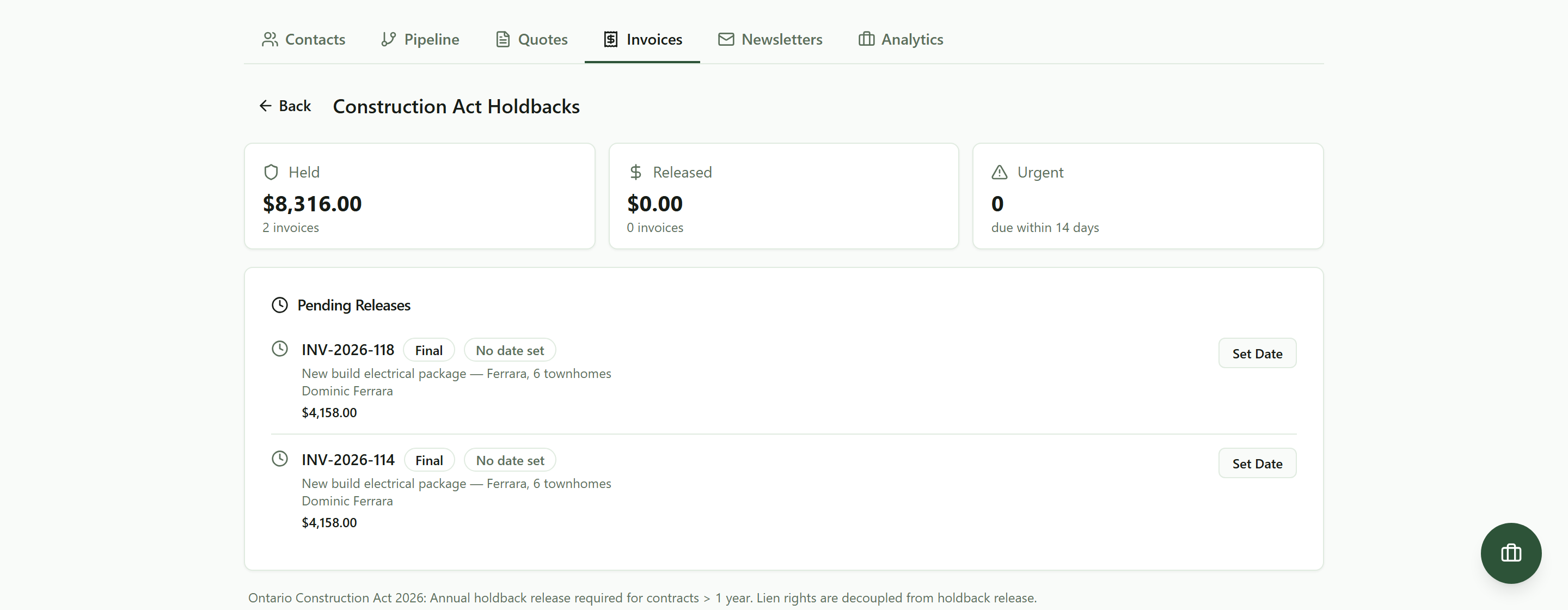 The 10% that was never yours to spend, counted separately from the money you are waiting on.
Ten percent of every progress billing on a job with statutory holdback is held back by the client under the Construction Act. It is on your invoice, it is in your revenue, and it is not coming for months.
The reason it belongs on its own screen is that contractors who count it as cash in the bank get caught twice: once when the money does not arrive, and again at the end of the job when they have already spent the only cushion they had. $8,316 is a payroll run.
What the holdback is, when it is released and how the HST on it works is the holdback guide.
The three things that actually shorten the gap
None of them is clever, which is why they get skipped.
Bill the moment the milestone is real, not at month end. Payment terms start when the invoice is issued. An invoice sitting in your drafts folder for nine days is nine days of net 60 you gave away.
Ask for a deposit on anything with material in it. Nobody in the quotes above was refused a deposit. They never asked, because the last person who asked did not get the job, which is a different problem.
Send the invoice from a system that records it going. When a payer says they never received it, the argument is over a date, and having the date is the difference between resending and starting again at day one. Every invoice here carries when it was created, sent, opened and reminded.
What it costs
Commercial terms depend on the workflow. Review the relevant AEC Stack product page before you start.
None of this is a loan, an advance or a factoring line, and that is the point of it. Every dollar it frees up is your own money arriving earlier, at full value, from a client who already owes it. An 11.3% loan and 3.22% factoring are both ways of renting money you have already earned. Billing in progress, on terms that start when you send rather than when you finish, is how you stop turning up at that decision.
On AEC Stack: the invoice side of this, terms, HST and getting the thing out the door the same day, is getting paid on time. The statutory clocks that decide how late a payer actually is are prompt payment.
Open your invoices and look at the job you are furthest into. If the only invoice on it is the one you are planning to send at the end, that is the loan to convert first.
Take this guide with you
The full write-up, every screenshot and clip, captions, and a machine-readable manifest in one zip. Share it with your office or hand it to whoever runs your socials.
Download the kitContinue reading