Ontario / Practical guides
Keep books you could hand to an auditor without dread
The fear is being asked a question about your own business and not being able to answer it. The way out is records made as the work happens, by the system that raised the invoice, so there is nothing to reconstruct in March.
Browse all Ontario guidesPut this into practice
Open Books
See the receipt, transaction, job, and tax record in the same financial picture.
The fear is not really of an audit. It is of being asked a question about your own business and not being able to answer it, in a room, with somebody official waiting.
The way out is not heroic bookkeeping. It is that the records get made as the work happens, by the same system that raised the invoice, so there is nothing to reconstruct in March.
What bad looks like from inside
"Haven't paid taxes. Ran out of extensions. Just bought Xero software. Bringing in money. Lots of expenses. Specialty construction company. Maybe 100k gross receipts per year. Need to rectify accounts and pay back taxes, future taxes, etc."
"I never really paid much attention to how I was tracking my expenses, receipts, and such. I know now that's a big mistake, but I've never created a separate business account. All my earnings go into my personal account, and I just spend as needed."
Neither of those people is lazy. They are both running a business where the recording was a separate job from the working, and the separate job lost.
What good looks like
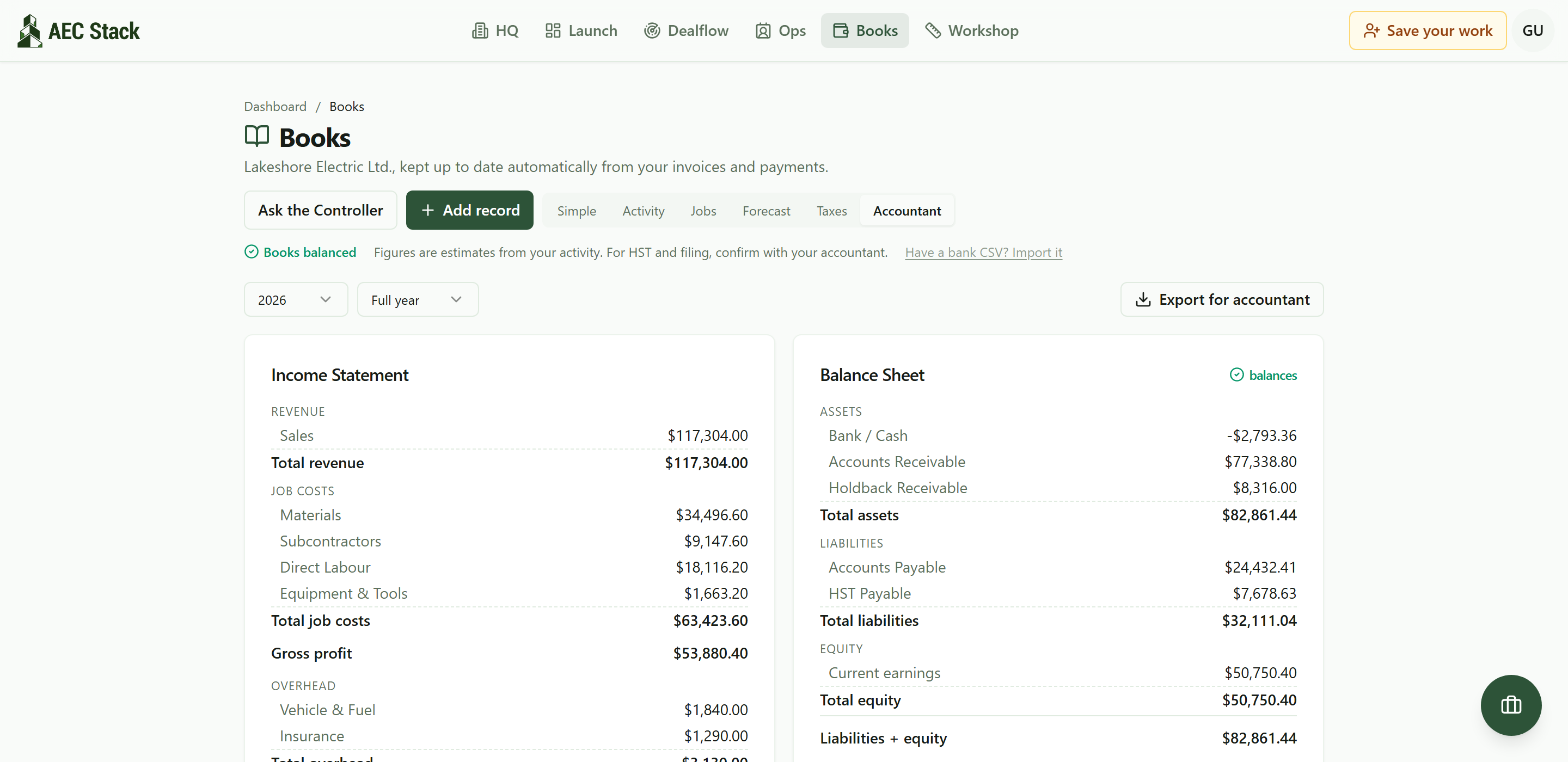 Statements, from the invoices and expenses already entered. The balance sheet says whether it balances, and the export is one button.
Three things on that screen matter more than the numbers.
It is derived, not typed. Every figure traces back to an invoice you raised, a payment you recorded or an expense you entered. Nobody keyed a journal. That is what makes it defensible: the trail from the statement to the document exists because it is the same record.
The balance sheet says whether it balances. A set of books that does not balance is a set of books with something missing, and knowing that today rather than in April is the whole point. Holdback receivable appearing as its own asset line is the construction-specific version of this: money earned, invoiced, and not collectible yet.
The export is one button. Your accountant gets the period rather than a shoebox and an apology, which is the difference between a bill for tidying up and a bill for advice.
The four habits that do it
One account for the business. This is the one that fixes the second quote above, and nothing else works without it. Personal and business money in one account means there are no books to keep, only a forensic exercise later.
Enter the cost when it happens, not at year end. Photograph the receipt in the parking lot: receipts out of the shoebox. Every one you skip is a deduction lost and a hole in the trail.
Tag costs to jobs. It is what makes per-job profit real, and in an audit it is what makes a cost obviously business rather than arguably personal. Did I make money this month is the payoff.
Keep the HST separate in your head and ideally in an account. It is on the balance sheet above as a liability because that is what it is. HST without the surprise.
What an auditor is actually looking for
Not elegance. Consistency and traceability.
Can you show the invoice behind a revenue line, the receipt behind a cost, and the payment behind both? Do the numbers you filed match the numbers in the books? Are personal and business separated? Is the treatment the same in January as in November?
The system holds the first three because they are the same records that ran the job. The fourth is a habit.
If you are already behind
The posters above are not unusual and the hole is not as deep as it feels. The order matters more than the effort:
Open a business account. Nothing else works until personal and business money are separate, and everything else gets easier the moment they are.
Enter the last period's costs. Not all of them, the last period. The statements start balancing and you can see where you actually are.
Take the export to an accountant. They price the advice, not the excavation. An accountant handed a clean period bills for a clean period.
These statements are derived from your own activity and are what your accountant will work from. They are good enough to run the business on and to answer questions from, and filing the return is still your accountant's signature.
What it costs
Commercial terms depend on the workflow. Review the relevant AEC Stack product page before you start.
On AEC Stack: the input side is receipts out of the shoebox and the tax side is HST without the surprise.
Open your books, switch to Accountant, and check whether the balance sheet balances. If it does not, that is today's job and it is a much smaller one now than in April.
Take this guide with you
The full write-up, every screenshot and clip, captions, and a machine-readable manifest in one zip. Share it with your office or hand it to whoever runs your socials.
Download the kitContinue reading