Ontario / Practical guides
What your win rate actually says about your price
A win rate is a score, not a diagnosis. Put the size of what you lose next to the size of what you win, read the reasons you lost, and check what the wins actually made before you come down on price.
Browse all Ontario guidesPut this into practice
Build the offer
Connect the scope, price, assumptions, and client response in one working proposal.
You put in a number that reflects what the work is worth, you lose, and the job goes to somebody at two thirds of it. Do that a few times and you stop testing the theory. You just quietly come down.
The thing worth knowing is that a win rate on its own cannot tell you whether your price is the problem. It is a score, not a diagnosis.
The frustration is not subtle
"Electrical is licensed, dangerous, skilled work. Have some respect for yourselves and stop racing to the bottom. How are you guys pricing jobs and actually making real profit?"
And on the other side of the same coin, the second-guessing that follows a lost bid:
"is this a reasonable price or am I underbidding I'm in Southern California? Owner said she found someone cheaper that they can do it for 2500 and it's a crew of only 3 you think I overbidded?"
Overbid or underbid, in the same sentence, about the same quote. That is what it feels like to price a job with no feedback loop.
Start with the score
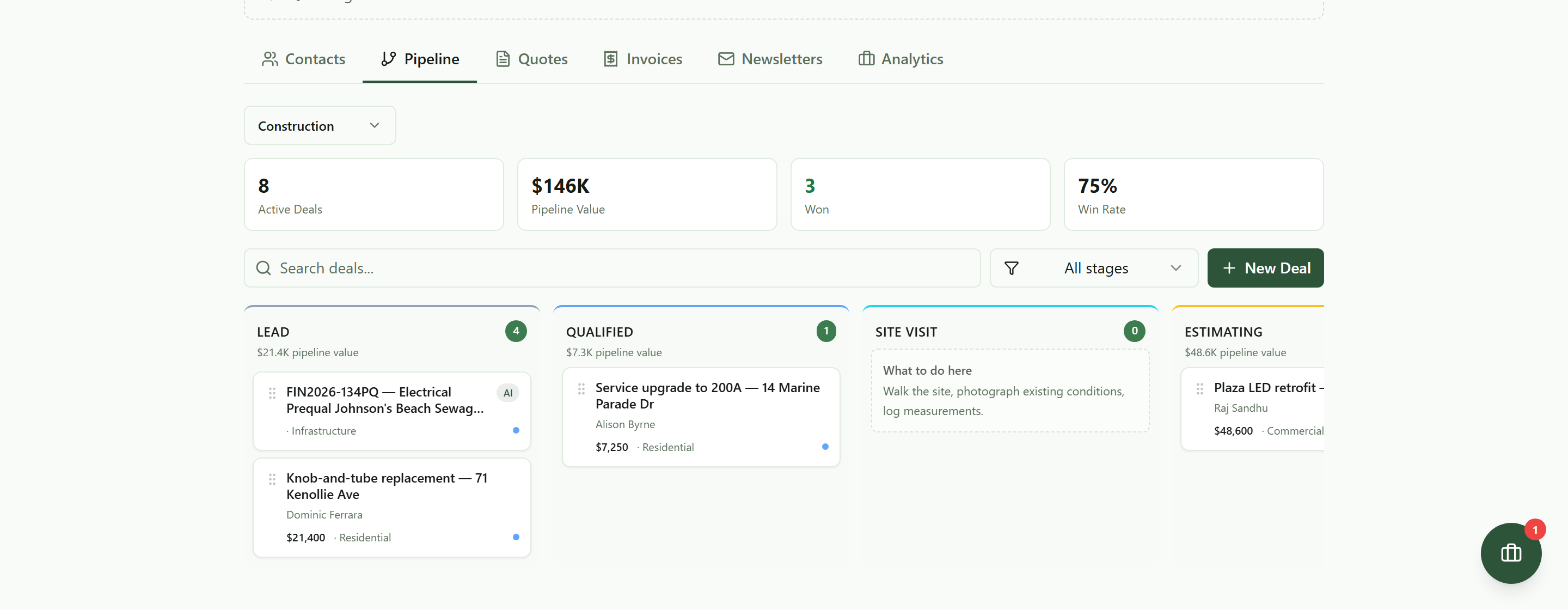 The score, on the board you already work from. A 75% win rate, sitting above the jobs it was calculated from.
Eight live deals, $146K in the pipeline, three won, a 75% win rate. It updates as you move cards, so it is always current without anybody keeping a spreadsheet.
Now, is 75% good? Nobody can answer that. A 75% win rate could mean you are priced well, or it could mean you are cheap and busy. That question needs the other half.
The other half is what you lose, and why
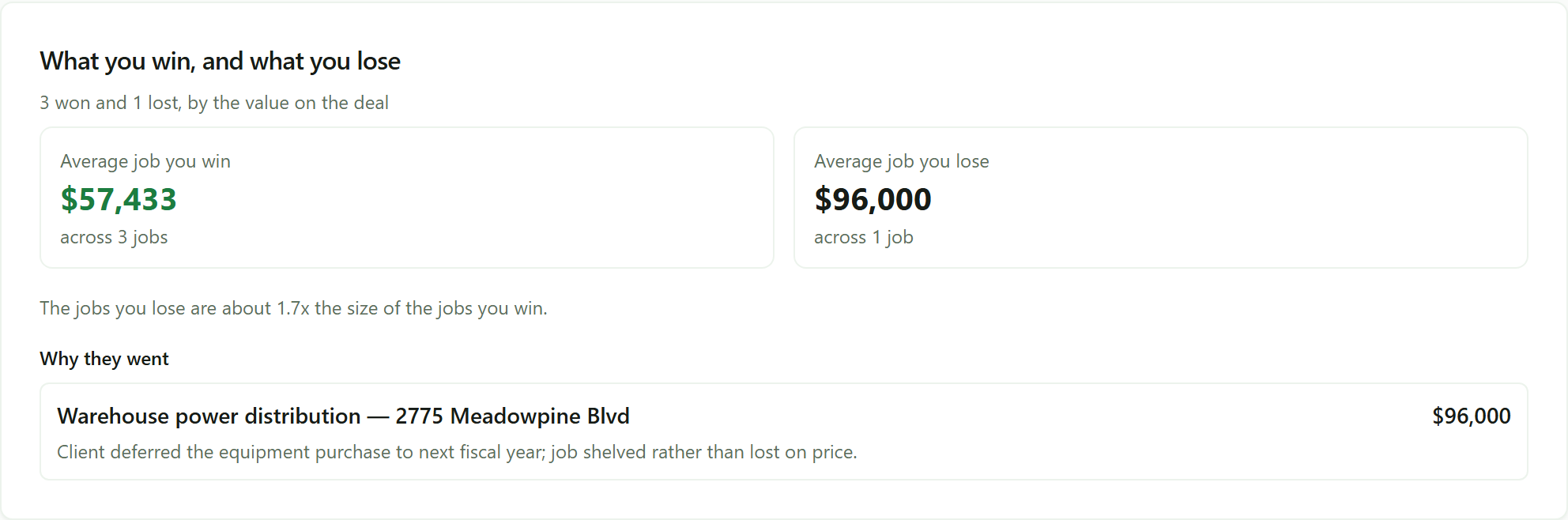 The same win rate with the other half attached. The gap says you lose the big ones. The reason says this one was never about price.
The average job here wins at $57,433 and loses at $96,000. The jobs going elsewhere are nearly twice the size of the ones being won. That is the shape of a contractor who is competitive on small work and getting beaten on the big stuff, and it is invisible in a win rate.
Then read the reason. Client deferred the equipment purchase to next fiscal year; job shelved rather than lost on price.
That job was not lost. It was postponed. Come down five points across the board because of it and you have given away margin on every job you win to fix a problem that was never yours.
This is the whole argument in one panel. Two numbers to tell you where the pressure is, and the reasons underneath to tell you whether the pressure is really about money. Both were sitting on your deals already; nothing extra to fill in.
Then check what the wins were actually worth
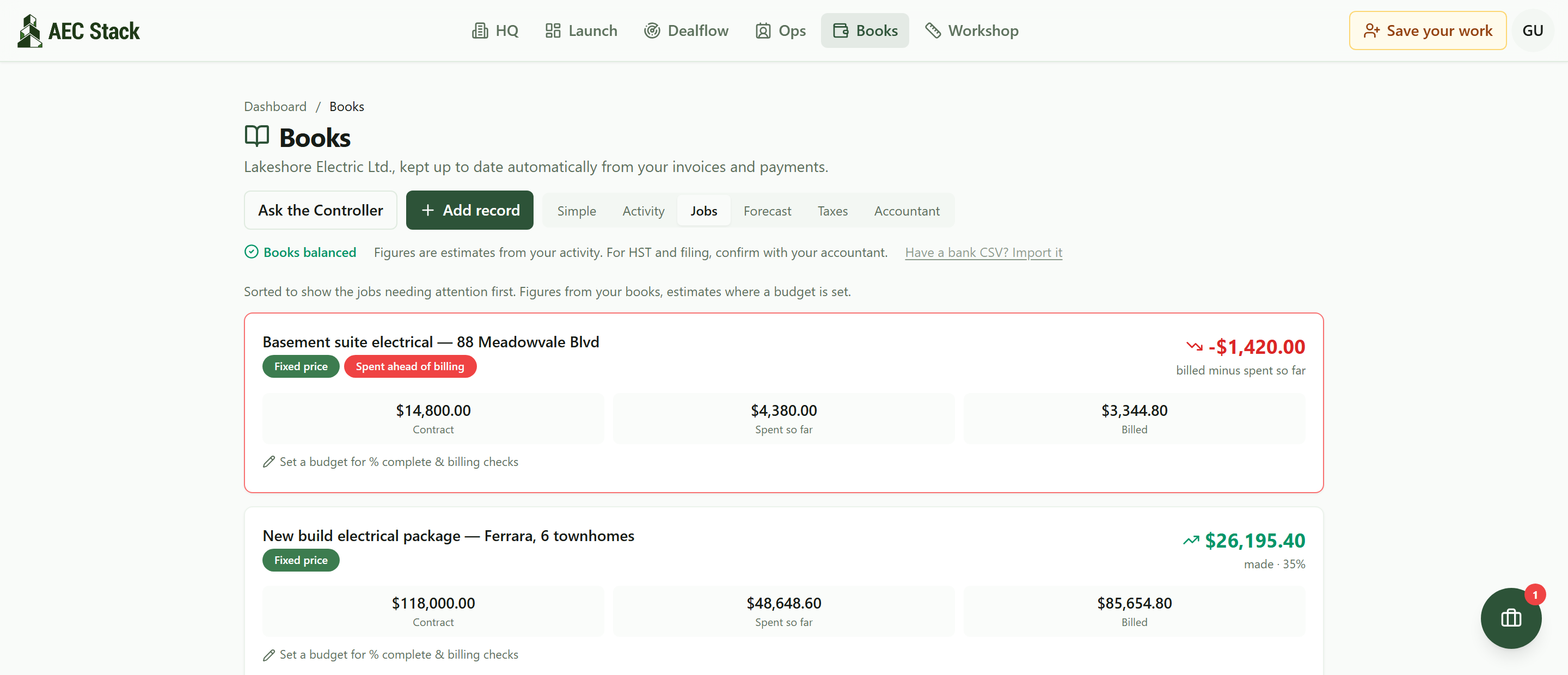 What the wins actually made. The smallest job on the list is the one underwater, and the margins on the other two are nowhere near each other.
A win rate counts jobs. This counts money, from the invoices and costs already in your books.
Three jobs, three completely different stories. The $39,500 fit-out returned 77.9%. The $118,000 new build returned 35%, which is still a good job, but it is not the same business. And the smallest one, at $14,800, is $1,420 underwater and flagged as spent ahead of billing while it is still running.
Put that beside the win rate and the picture inverts. The jobs won most easily are the ones worth the least, and one of them is costing money right now. A higher price that loses that job is not a loss.
What to do with all this
Do not move your price off a feeling. Move it off the reasons. If most of your losses say budget, timing or scope, price was not the deciding factor and cutting it will not raise your win rate.
Look at where the losses cluster by size. Losing the big ones and winning the small ones is a different problem from losing evenly, and it usually has more to do with how you present the company than with the number.
Aim for a win rate you can defend, not a high one. Winning everything means you left money on every job. The number that matters is what those wins made you.
Kill the jobs that lose money before you price the next one like them. A job flagged as spent ahead of billing is telling you something about that kind of work, that client, or that estimate. It is the cheapest lesson you will get.
Write down why you lost, while you remember. One line on the deal. It costs a few seconds and it is the only thing that turns a run of losses into an answer.
And the fee only lands after you are paid
Commercial terms depend on the workflow. Review the relevant AEC Stack product page before you start.
On AEC Stack: what belongs in the number is what an hour costs you and pricing a job. To stop competing on price at all, there is the proposal package that gets opened and charging for the estimate.
Open your last ten quotes and write one line on each of the ones you lost. By the tenth you will know whether you have a pricing problem or a completely different one. The demo business shows what that panel looks like once the reasons are in it.
Take this guide with you
The full write-up, every screenshot and clip, captions, and a machine-readable manifest in one zip. Share it with your office or hand it to whoever runs your socials.
Download the kitContinue reading