Ontario / Practical guides
Hear about the work months before it goes to tender
Transmission lines, environmental filings, rezonings and agency capital plans are projects announcing themselves years ahead. Get them filtered to your trade and region, grouped by how far in front of the bid each one sits.
Browse all Ontario guidesPut this into practice
Find relevant work
Explore opportunities and carry the right one into a pursuit.
By the time a job is a tender, the decisions that matter have already been made. The scope is set, the consultants are appointed, and somebody has been talking to the buyer for a year. You get four weeks to price something other people have been thinking about since the last budget cycle.
This page is about the part before that. Ontario publishes an enormous amount of warning: transmission line applications, environmental filings, rezonings, agency capital plans. Each one is a project announcing itself long before anyone asks for a price. By the end of this page you will have that stream open, filtered to your trade and region, sorted by how far ahead of the bid each signal sits.
How contractors describe the problem
They do not describe it as a data problem. They describe it as a who-you-know problem:
"Everything is about connections. You know the right people, you can know the inside scoop."
a contractor on r/Construction, in a thread about staying ahead of upcoming projects
"In most cities, the town board's nephew(s) are the biggest contractors. It's corrupt, but absolutely nearly always the case."
And the cost of being on the wrong side of that lands later, as a pipeline that empties with no warning and no way to refill it quickly:
"Now the pipeline has slowed right down, I’ve got staff relying on me, and I honestly feel like I’ve let everyone down. I know what I should be doing—following up leads, getting quotes out, contacting past clients—but the pressure has made me freeze, and it’s become a vicious cycle."
The inside scoop is real. What is also real is that most of it was published. It is just published where you would have to go looking for it: a regulator's docket, an environmental registry, an agency's capital plan.
Open the radar
Open Dealflow in the example workspace and pick the Radar tab. It is a different thing from the tender list next to it. Tenders are work you can bid this month. The radar is work that has not become a tender yet.
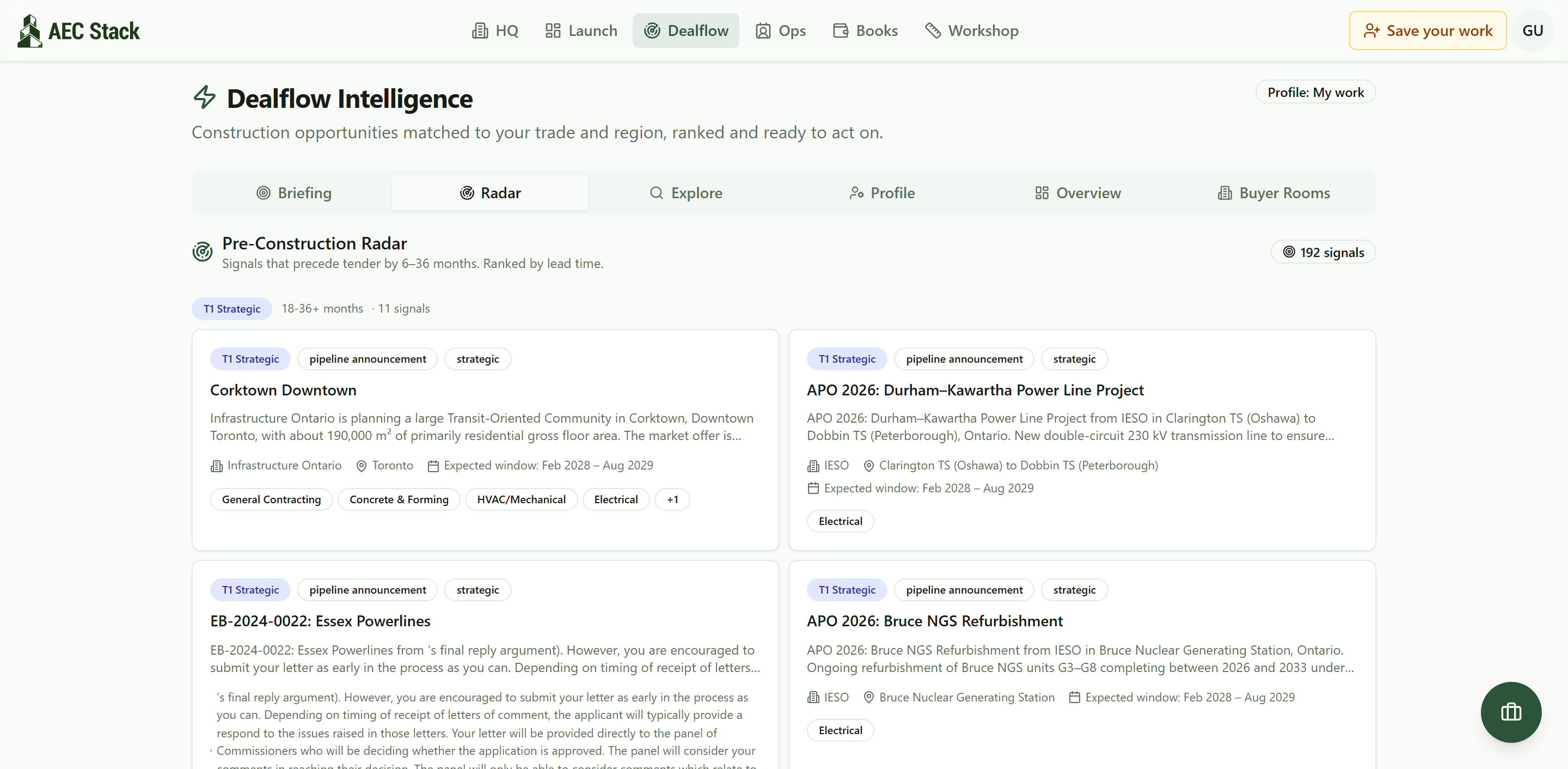 Work that has not reached a tender yet, sorted by how far ahead of the bid it sits.
The header says what the tab is for: signals that precede tender by 6 to 36 months, ranked by lead time. The count in the corner is how many are live for this business right now.
Look at what the first two cards are. Infrastructure Ontario planning a transit-oriented community in Corktown with roughly 190,000 square metres of residential floor area. IESO's new double-circuit 230 kV line from Clarington to Peterborough. Both name the organisation, the location, and an expected construction window. Neither is a tender. Both are going to need trades.
The tiers are lead time, not importance
Signals are grouped by how far ahead of the work they sit, because that decides what you do about them.
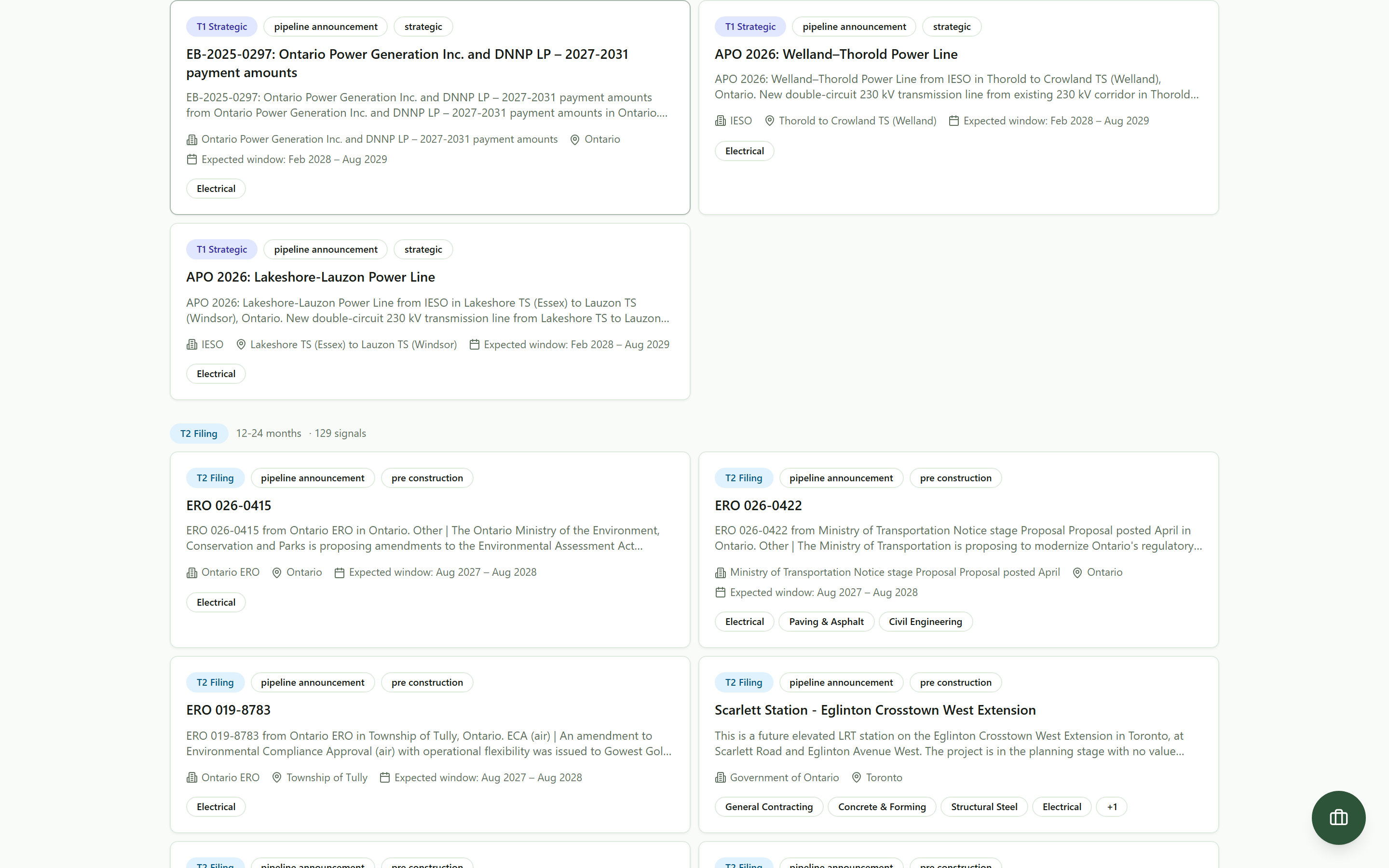 The tiers are lead time. T1 is 18 months out and further, T2 is a filing that means someone is now serious.
T1 Strategic, 18 to 36 months and beyond, is a plan or an announcement. Nobody is buying anything yet. This is the tier that tells you which way your regional market is moving, and which general contractors are about to get very busy.
T2 Filing, 12 to 24 months out, is somebody spending money on process: an environmental approval, a regulatory application, a planning submission. A future Eglinton Crosstown West Extension station sits in this tier, described as being in the planning stage. A filing costs real money, so it is the point where a project stops being an idea.
T3 is closer still. The nearer the tier, the more it is worth a phone call rather than a note in a calendar.
Tell it what you build, once
The radar is not a firehose you have to read. It filters against the same company profile the rest of Dealflow uses.
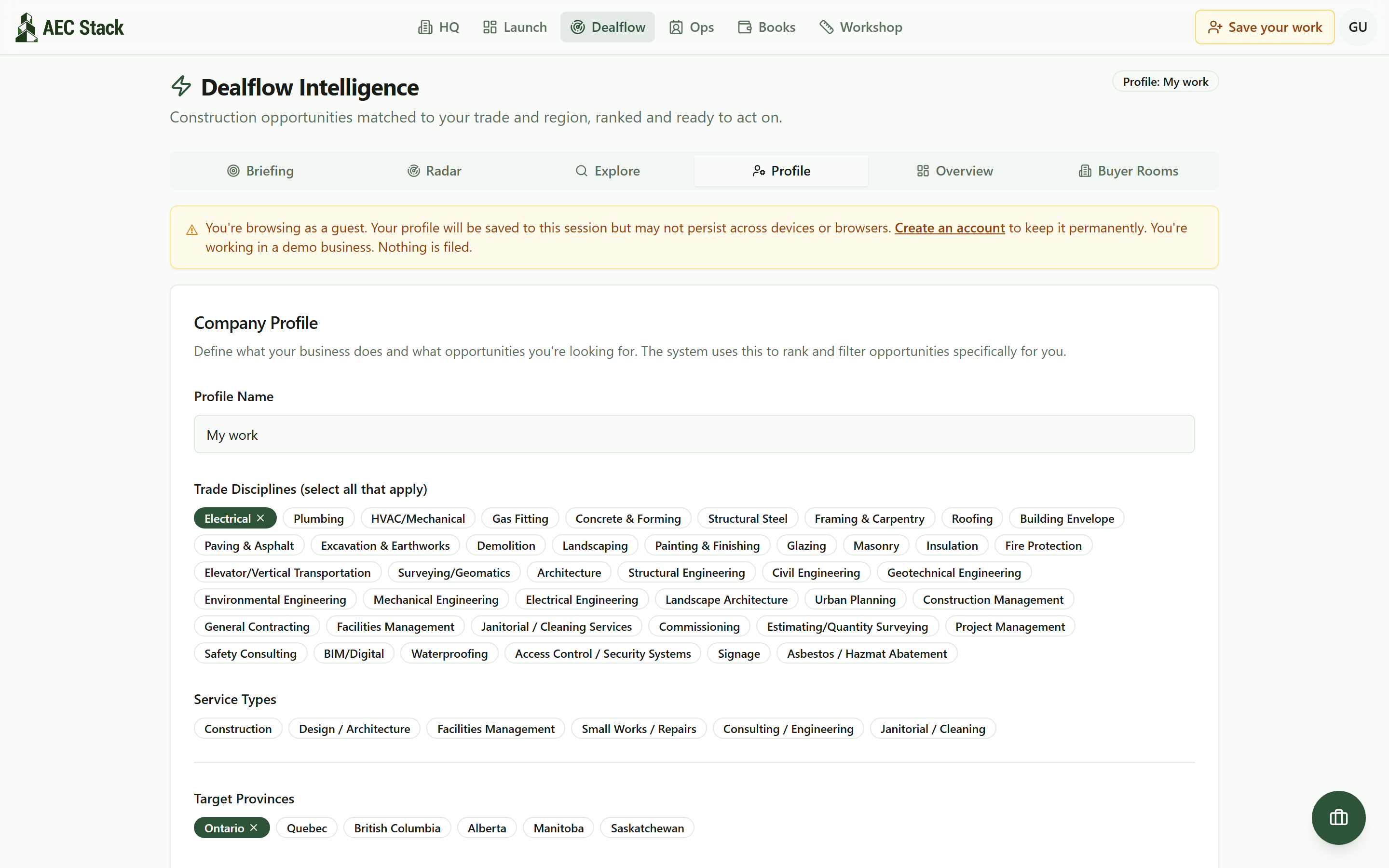 The radar reads this once. Trades, regions and job size decide which early signals reach you.
Set your trades, your provinces and the cities you will actually travel to, and the radar narrows to signals whose likely scope includes work like yours. An electrical contractor sees the transmission lines and the LRT station. A drywall contractor does not.
It reads the same on a phone, which is where you will be when you have five minutes between jobs:
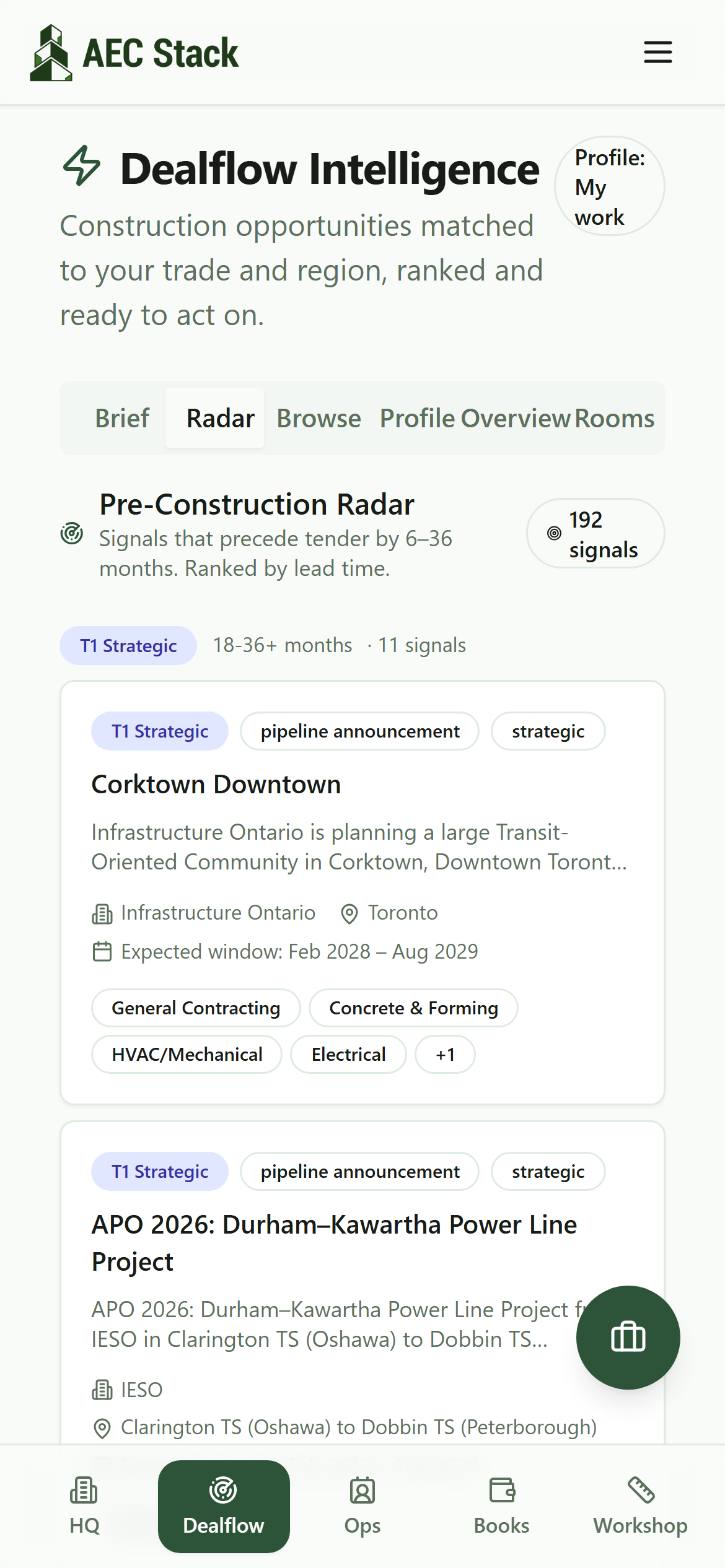 Same radar from the truck.
What to actually do with an early signal
A signal 24 months out is not a lead. Treating it like one is how people waste an afternoon. What it is good for is narrower and more useful:
- Knowing who to know. A T1 signal names the organisation behind it. That is the buyer or the agency whose bid list you want to be on well before the tender exists, which is the honest answer to the "everything is about connections" problem. You are not skipping the relationship, you are finding out who to build one with, a year before the people who wait for tenders.
- Reading the direction of your market. Nine transmission projects in your region means something specific about the next two years of electrical work, whether or not you ever bid one of them.
- Timing your capacity. Knowing that a large job in your city is expected to break ground in a given window is the difference between hiring in advance and scrambling.
What it costs
Commercial terms depend on the workflow. Review the relevant AEC Stack product page before you start.
Be clear on what these are. They are public filings, announcements and planning documents, collected and sorted, not private intelligence and not a tip from someone on the inside. The expected windows are estimates derived from the type of signal and its date, not commitments by the buyer. A plan can be cancelled, deferred, or rescoped, and some of these will be. The scope tags are inferred from the project type, so a signal tagged for your trade is a reason to look, not proof there is work in it for you.
And a signal is not a tender. When these projects do reach the market they go out through the same public channels as everything else, which is the tender list next door.
On AEC Stack: the radar, the tender list and the permit feed are three distances from the same thing. Permits and awards are work starting now, on the placements feed. Tenders are work you can price this month. The radar is the year before either.
Open Dealflow in the example workspace, set your profile, and look at the T1 group. If you recognise a buyer's name on a project you had never heard of, that is the whole point: it was published, and until now nobody was reading it for you.
Take this guide with you
The full write-up, every screenshot and clip, captions, and a machine-readable manifest in one zip. Share it with your office or hand it to whoever runs your socials.
Download the kitContinue reading