Ontario / Practical guides
Pay your subs without the paperwork eating you
Paying a sub is three jobs: pay them, prove everyone under you is paid, and report it to CRA. The statutory declaration that releases holdback is already generated, the subcontractor agreement starts the paper trail on day one, and the T5018 totals itself from your books.
Browse all Ontario guidesPut this into practice
Explore a working business
Put the people, records and day-to-day work together in a sample business.
Paying a subcontractor is never just paying a subcontractor. It is three jobs wearing one name: getting money to them, being able to prove that everyone under you has been paid, and reporting the year's payments to CRA on a form most contractors meet for the first time the week it is due. Each job makes its own paper, and the paper arrives whether or not you have a system for it.
This page shows where each piece already exists in AEC Stack: the sworn declaration that unlocks holdback, the agreement that starts the paper trail on day one, and the T5018 that totals itself from your books instead of from a January shoebox.
How contractors describe it
The day-to-day, as most crews actually run it:
"They have their subs submit hours via text message and does their own time and bookkeeping with a mix of pen and paper, and excel spreadsheets."
What it grows into:
"The moment it's not just you and your tool case the paperwork becomes a lot, and even managing 5-6 people can get complicated really quick. In construction you have to coordinate with a bunch of other contractors and you're at each other's throats constantly. It's really about the size of the business, you can get buried in papers and phone calls really quick."
And the view from the other side of the ledger, which is why the proof part matters. This is an owner checking up on their general contractor:
"We are doing our due diligence and contacting all the subcontractors. We have found majority of them have not been paid in full. ... The contract we have is very minimal on details, so we are following the Ontario Construction Act."
When subs under a contractor turn out not to have been paid, everyone above that contractor starts demanding proof on paper. That is the world your paperwork lives in.
The one page that releases holdback
Before releasing holdback, the payer above you will usually ask for a Statutory Declaration: a sworn statement that you have paid your subs, suppliers and workers for the project, so no lien can surface behind you. The night someone first asks for one is a bad night to learn what it is.
Yours is already written. Search the Document Center for it:
 Already written before you knew you needed it: the sworn statement a payer asks for before releasing holdback, generated with your company's details as document TPL-012.
It is generated with your company's details, editable before it goes anywhere, and it lives beside the lien and holdback templates in the same set. What makes it easy to swear honestly is everything below: knowing, from your own records, that the subs really have been paid.
Start the trail where the work starts
The cheapest time to solve subcontractor paperwork is before the subcontractor starts. The generated Subcontractor Agreement carries the machinery for later:
 The paper trail starts on day one: the generated Subcontractor Agreement, including the clause that obliges your subs to provide statutory declarations that their own people are paid.
Inside it is the clause that mirrors the one above you: the subcontractor shall, upon request, provide statutory declarations confirming that all workers and suppliers have been paid. The declaration you give your payer is only as solid as the ones you can collect from the layer below, and this is the sentence that lets you collect them.
Two habits at signing time save the most grief later. Get the sub's business number now, while they want the job, because you will need it in January and they answer email slower in January. And make a current WSIB clearance certificate a condition of payment, the same way the people above you treat yours: your own clearance and certificates work identically in the other direction.
The January form that fills itself in August
If you paid subcontractors more than $500 for construction services in a year, CRA expects a T5018 information return. Contractors who keep sub payments in texts and spreadsheets rebuild the year every January. If the payments went through your books, there is nothing to rebuild:
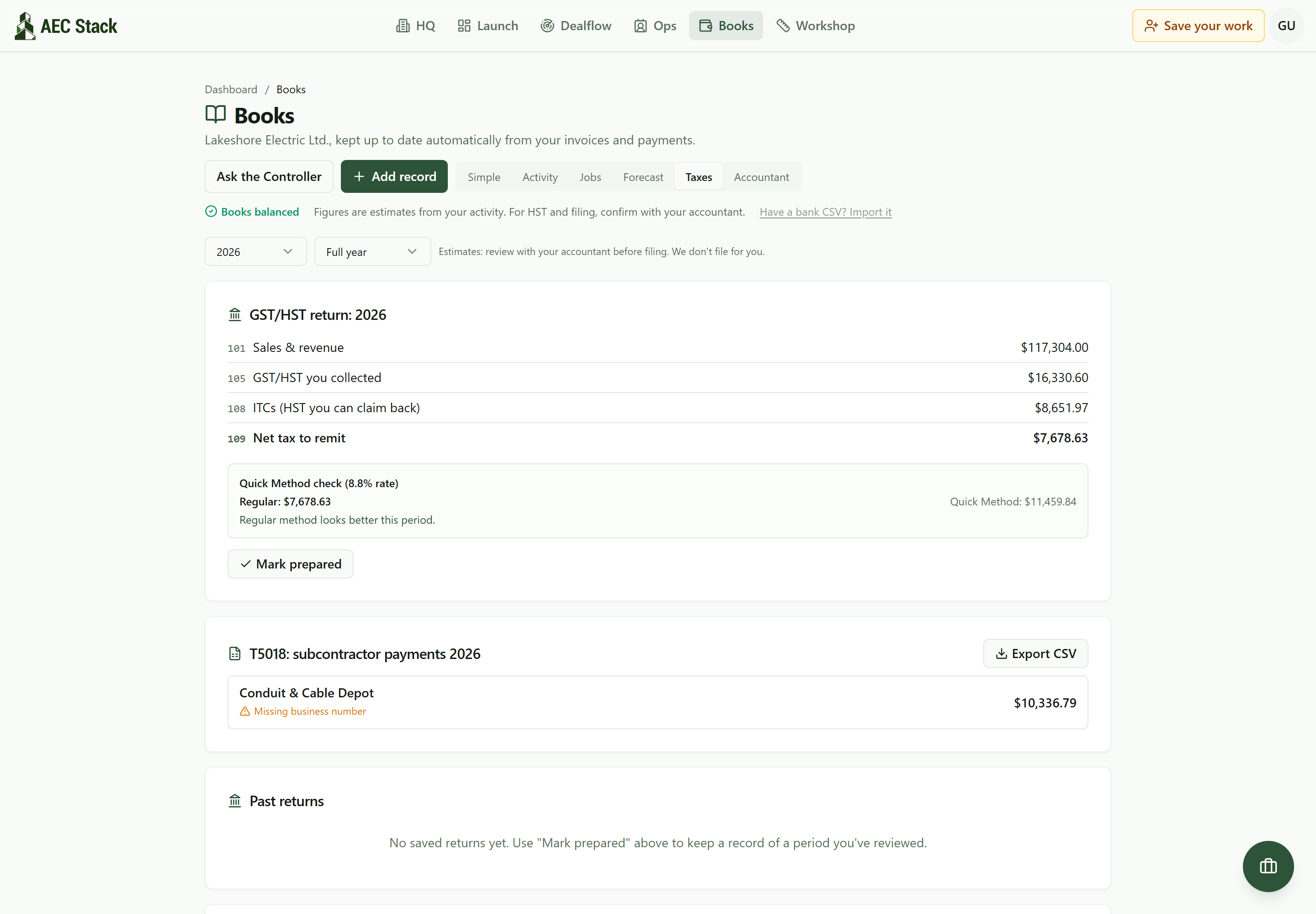 The T5018 totals itself from what you actually paid each sub, and flags a missing business number months before the deadline instead of the night of it.
The panel sits in the Taxes view of Books, under the same screen that assembles your HST return. It totals what you actually paid each subcontractor, and the row in the demo is doing the most useful thing on this page: warning, in August, that a vendor has no business number on file. That warning in August is an email. The same discovery in January is a deadline problem. Export CSV hands the totals to whoever files for you.
The figures are estimates from your activity, as the screen itself says, and filing is between you and your accountant. What the panel removes is the archaeology.
What it costs
Commercial terms depend on the workflow. Review the relevant AEC Stack product page before you start.
If subs are part of how you build, open the Document Center and search for the two documents in this guide; they are already in your set. Then run the next sub payment through your books, and January's T5018 becomes a printout instead of a project.
Take this guide with you
The full write-up, every screenshot and clip, captions, and a machine-readable manifest in one zip. Share it with your office or hand it to whoever runs your socials.
Download the kitContinue reading