Ontario / Practical guides
Use the 28 day, 14 day and 7 day clocks the Construction Act gives you
Ontario gives the payer 28 days to pay a proper invoice and 14 to dispute it, and gives you 7 to pay your own subs once you are paid. Put in one date and every deadline it sets is counted, with the section it comes from.
Browse all Ontario guidesPut this into practice
Create the invoice
Follow the work into billing, payment status, and the next collection step.
Ontario gives you deadlines that run whether or not anyone is watching them. Most of them are the payer's, which is the part contractors miss: the Act does not just tell you when you get paid, it tells you when the other side ran out of ways to argue about it.
This page is what each clock is, what starts it, and what it means when one goes by. Then it counts them, because the whole problem with statutory periods is that they are arithmetic done on a bad day.
It is not legal advice. Every number below carries the section it comes from so you can check it, and the two facts everything hangs on are ones the software cannot know.
How contractors describe the problem
Counting on a calendar, in public, on a forum:
"The GC is entitled to hold back 10% for 45 days to wait for the lien rights to clear. However if the GC does not pay me anything by day 31, I'm putting a lien on the property. At that point in time I don't care who pays what is owed as long as I get paid."
Read that carefully, because it is doing something important and something out of date at the same time. He knows exactly which day he acts on. He is also working from 45 days, which was the lien preservation period before the 2018 amendments. It is 60 now. Most of the advice you will find in forums predates that change, and nearly all of it predates the package that took effect on 1 January 2026, which is the one this page is written against.
And from the paying side, quoting the clocks back at the people waiting:
"We are doing our due diligence and contacting all the subcontractors. We have found majority of them have not been paid in full. ... The contract we have is very minimal on details, so we are following the Ontario Construction Act. This also states we can take 28 days to pay, with 14 days for file a dispute"
The five dates everything comes off
Five fields, under the holdback tracker in your invoices. Nothing is saved: these are working questions rather than a record, and a stored legal date that later turns out to be wrong is worse than no stored date at all.
The 28 days
Under prompt payment, an owner has 28 days from a proper invoice to pay it. Section 6.4.
The weight is all in "proper". A proper invoice is a written bill for services or materials that meets what the Act requires and whatever your contract adds, and if your contract sets out what an invoice has to contain, that is the bar. This is the most argued about phrase in the whole scheme, and the panel says plainly that what counts as a proper invoice is a question for your contract rather than for a screen.
Since 1 January 2026 that argument has a deadline on it, and the deadline is theirs. Under section 6.1(2), an invoice that does not meet the requirements is deemed to be a proper invoice unless the owner tells you in writing, within seven days of receiving it, what is wrong with it and what would fix it. Silence for a week now starts your 28 days instead of quietly suspending them.
Down the chain the period changes. A contractor who has been paid by the owner has 7 days to pay their subcontractors for the work that payment covered, unless they have given that sub a notice of non-payment. Section 6.5. That one is yours, and it is the clock most people do not know is running.
The 14 days
If an owner is not paying your proper invoice, they have to deliver a notice of non-payment within 14 days, specifying the amount and detailing all their reasons. Section 6.4(2), and the prescribed form is Form 1.1.
Down the chain the form changes and so does the job it does. If the owner did not pay and you are passing that down to your subs, that is Form 1.2 under section 6.5(5), and it has to carry an undertaking to refer the matter to adjudication within 21 days. If you are the one disputing your sub’s invoice, that is Form 1.3 under section 6.5(6). Section 6.5(7) gives you seven days from receiving the owner’s notice, or the expiry of the 35 days in section 6.5(4), whichever comes first. Forms 1.1 to 1.5 have not changed since October 2019, which makes them the one part of this scheme you can recognise on sight.
This is the clock worth knowing cold, because it is the one that works in your favour. Silence is not a dispute. A payer who says nothing for 14 days and then does not pay within 28 has not raised a defence; they have simply not paid. When you finally write the letter, that distinction is the letter.
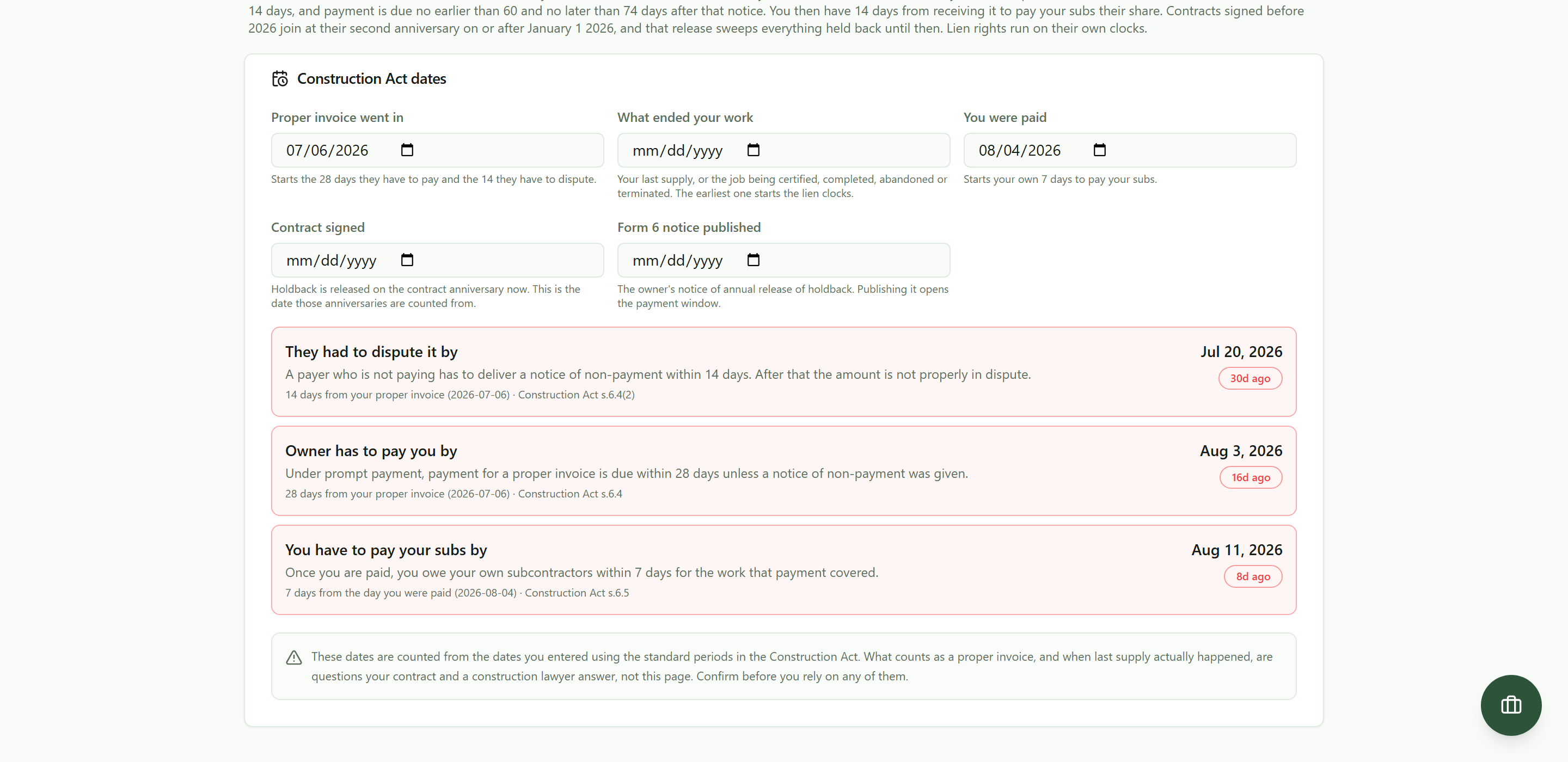 One invoice date and one payment date, and every deadline they set is counted, including the one that is now yours.
One invoice date produces both of their deadlines. Adding the date you were paid on a different job produces yours: seven days to pay your own subs, six days left on it.
Each row carries what it was counted from and the section it comes from, so nothing here is a number you have to take on faith. The periods are the standard ones; where your contract sets different terms, your contract wins.
When a clock has run out
Nothing happens automatically. The Act does not send anybody a cheque on day 29. What passing a deadline does is change which moves are available to you.
Interest. Late payment attracts interest under the Act, at your contract's rate if it sets one. Worth naming in writing before you start adding it to invoices, and worth a call to a lawyer if the amount is real.
Adjudication. Ontario's Construction Act created interim adjudication for exactly this: a decision inside about a month, on one dispute, binding on an interim basis until a court or arbitration says otherwise. It is a genuine option for a mid-size unpaid invoice and much faster than court. The date to put in the diary is the door closing: since 1 January 2026 a notice of adjudication generally cannot be given more than 90 days after the contract is completed, abandoned or terminated. Section 13.5(3). Process and fees come from the Ontario Dispute Adjudication for Construction Contracts, whose rules were also remade on that date.
A lien. Separate scheme, separate clocks, and the ones that cannot be extended. Covered in when and how a lien works.
Two dates worth getting right
The clocks are counted for you. These are the two inputs that decide what they count from, and they are what people argue about.
Whether your invoice was a proper invoice. This used to be the argument that could unwind the whole thing months later. Since 1 January 2026 an owner who wants to run it has seven days to put the deficiency in writing, and if they do not, the invoice is deemed proper and your 28 days have been running all along. Section 6.1(2).
When last supply actually happened. The lien clocks run from the last day you supplied services or materials to the improvement, and people are wrong about this in both directions. A punch list visit is often not last supply. Delivering the final materials often is.
Both facts are exactly what gets argued about, which is why the dates are counted for you and never stored as though they were settled.
What it costs
Commercial terms depend on the workflow. Review the relevant AEC Stack product page before you start.
On AEC Stack: the reason most people open this panel is an invoice that has gone quiet, and the order to work through that in is what to do when a client will not pay. The 10% the Act lets your client hold, and when it comes back, is the holdback guide.
Open the dates panel, put in the date your oldest unpaid invoice went in, and see how long ago their 14 days went by.
Take this guide with you
The full write-up, every screenshot and clip, captions, and a machine-readable manifest in one zip. Share it with your office or hand it to whoever runs your socials.
Download the kitContinue reading