Ontario / Practical guides
You have the ticket. Where does the business start?
Your ticket lets you do the work. Something else entirely lets you sell it. Read the Last Mile guide for your code to the end, find out whether your trade needs a contractor licence, and look around a working business before you file anything.
Browse all Ontario guidesPut this into practice
Start with your business
Organize formation, standing, and the records that let the business operate.
The Certificate of Qualification is the only thing standing between the same person doing the same work and a completely different number on the cheque. But what nobody hands you with the certificate is the next page, the one that explains that the ticket lets you do the work and something else entirely lets you sell it.
"Hey folks, I'm a Red Seal Pipefitter, I've always worked non-union but now getting ready to go back to work I've been leaning towards joining a union, OR getting incorporated and start contracting as a direct service provider."
Ticket in hand, standing at a fork, asking strangers. And the version of it that comes up again and again:
"Ive heard that i can write these off in my taxes, and put myself in a much lower tax bracket but incorporating myself but I'm not entirely sure if its worth it, or even where to start."
Or even where to start. That is the actual problem. Not the work, not the ticket, not the ambition.
First, the guide for your code does not stop at the exam
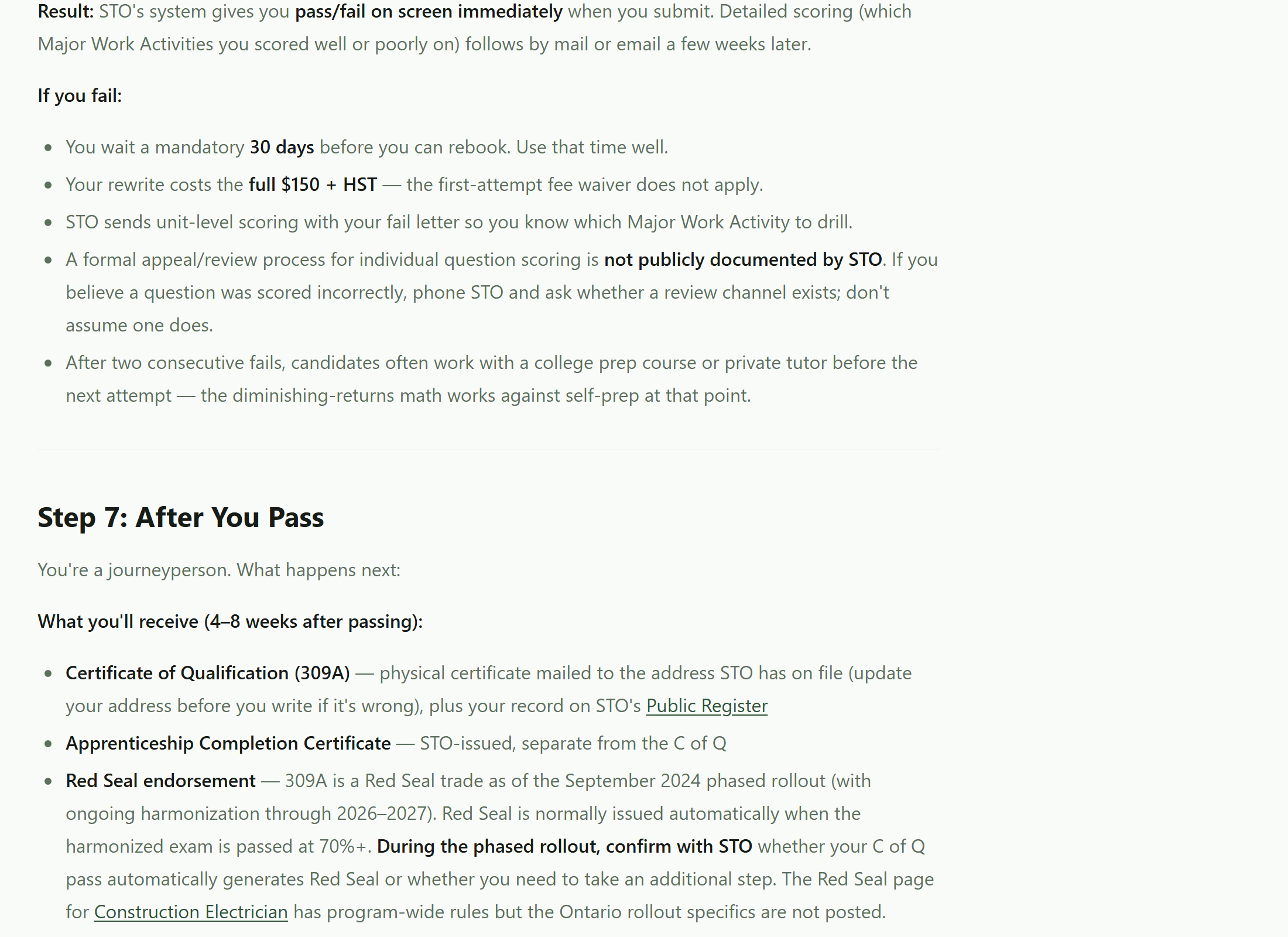 Every trade code has one of these, and it does not stop at the exam. The fail path and what lands in the post after you pass are both written down.
There is a Last Mile guide for 41 trade codes, free and with no signup. It covers logbook close-out, how booking actually runs, the Authorization to Test letter, the $150 plus HST, exam-day check-in and what happens if you fail: the mandatory 30-day wait, the full rewrite fee, and the unit-level scoring that tells you which Major Work Activity to drill rather than leaving you to guess.
Then it keeps going. Step 7 is After You Pass, written out rather than left to word of mouth: what arrives in the post four to eight weeks later, the Red Seal endorsement and its phased-rollout wrinkle, the journeyperson scale, the right to sponsor apprentices, and the payroll date that catches people out.
Each one carries Skilled Trades Ontario's own phone numbers and hours, so the answer to a booking question is a call rather than a thread.
Then the layer that decides whether you can sell the work
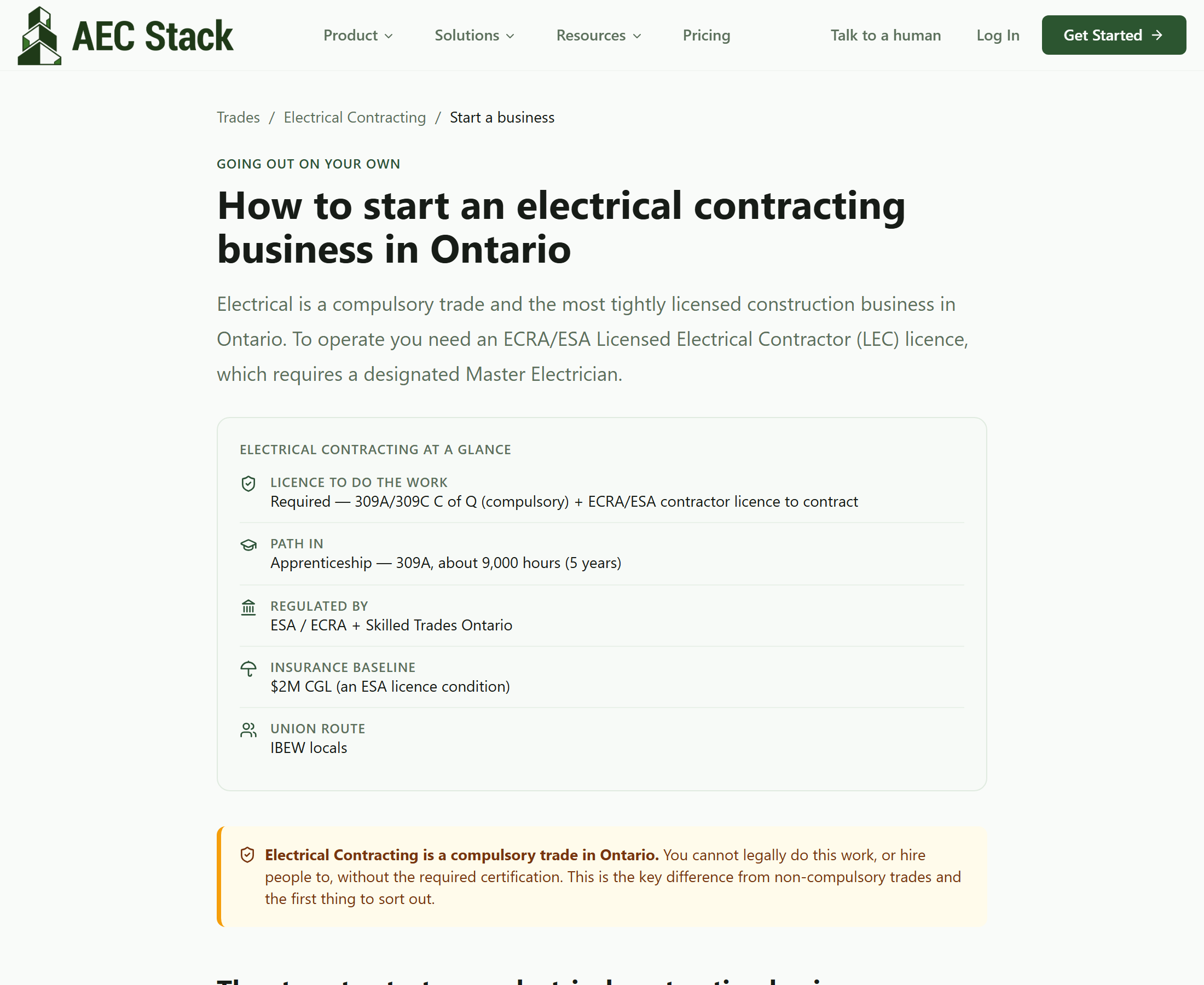 The layer nobody mentions at the exam. Your ticket lets you do the work; a contractor licence is what lets you sell it.
This is the page that answers "where does the business start", and it is per trade rather than generic.
Read the at-a-glance panel on an electrical one and the shape is immediate. Licence to do the work: a 309A or 309C C of Q. Licence to contract: ECRA/ESA, which requires a designated Master Electrician. Two different things, and the second one is a separate exam, a separate application and an eligibility clock. Insurance baseline $2M commercial general liability, not because it is prudent but because it is a condition of the ESA licence.
Your trade will have its own version. Gas fitting answers to TSSA. New home building answers to HCRA and Tarion. Plenty of trades are voluntary and need none of it, which is equally worth knowing before you assume you are blocked.
The steps underneath are the ordinary ones in the right order: incorporate, CRA accounts, WSIB, the trade licence, insurance, first contract.
And you can look at the whole thing before you file anything
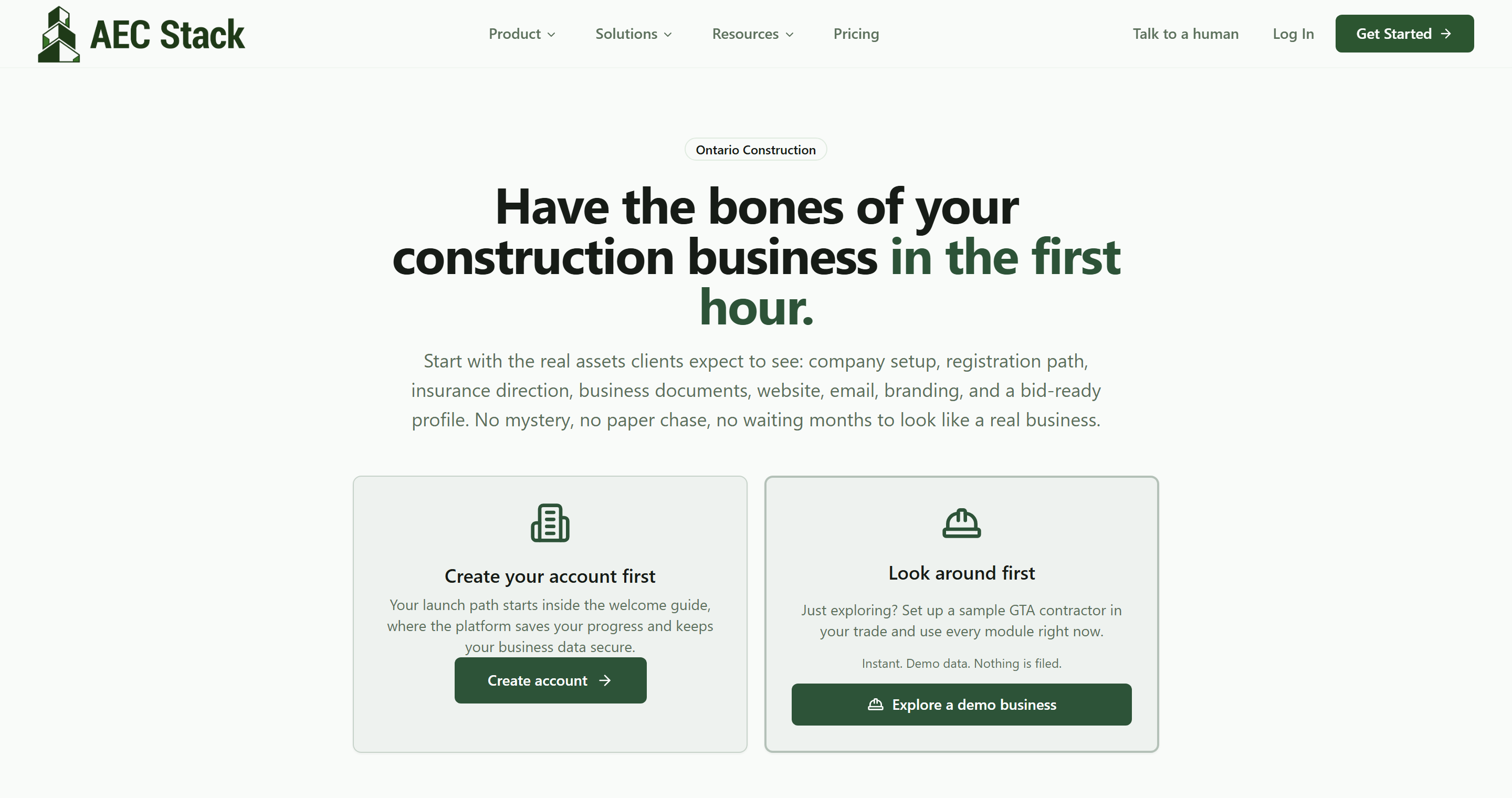 Two doors, and the second one files nothing. A worked contracting business in your own trade, to look around before you commit to anything.
The honest answer to "is it worth it" is that you cannot tell from the outside, so the second door exists.
Explore a demo business builds a fully stocked contractor in your trade and lets you use every part of it. Jobs, quotes, invoices, documents, branding, books, dealflow. Real screens with worked numbers in them rather than a slideshow. Nothing is filed and no account is created.
Spend twenty minutes in it and the question stops being philosophical. You are looking at what an invoice, a change order and a set of books actually involve, and you will know whether that is a life you want before you have spent a dollar on an incorporation.
The order that works
Finish the ticket first, properly. Everything downstream is easier from a journeyperson rate, and the sponsor right matters the moment you want a second pair of hands.
Find out whether your trade needs a contractor licence, before you incorporate. For electrical, gas, and new home building the business licence is the real gate and it has its own clock. Incorporating first and discovering that afterwards is the expensive order.
Do not incorporate for the tax story alone. The write-offs are real and they are smaller than they sound, because a deductible expense still leaves your bank account. Incorporate for liability, for the clients who will not hire an individual, and because you intend to keep going.
Price the overhead before you quote anything. The ticket changed what you are worth per hour; going independent changes what an hour costs you.
Then get one job through the whole loop. Quote, contract, invoice, paid. One complete circuit teaches more than any amount of planning.
And the fee only lands after you are paid
Commercial terms depend on the workflow. Review the relevant AEC Stack product page before you start.
On AEC Stack: the pricing side is what to charge when you go independent and what an hour costs you. If you are still deciding on the structure, there is sole proprietor or incorporate, and the whole setup is in starting a construction business in Ontario.
Read the Last Mile guide for your own code to the end, then open the start-a-business page for your trade. Fifteen minutes, and you will know whether there is a licence between you and working for yourself.
Take this guide with you
The full write-up, every screenshot and clip, captions, and a machine-readable manifest in one zip. Share it with your office or hand it to whoever runs your socials.
Download the kitContinue reading