Ontario / Practical guides
Being pushed to incorporate by your boss: what the deal really pays before you sign
Open a company, keep the same hourly rate, add HST. It sounds like a favour and it is a transfer: everything your boss pays on top of your wage becomes yours. Run the arithmetic on what moves, see the tests CRA and WSIB actually rule on, and price the real version if you go anyway.
Browse all Ontario guidesPut this into practice
Explore a working business
Put the people, records and day-to-day work together in a sample business.
The offer usually arrives sounding like a favour. Open a company in your name. You will be paid by the hour, same as now, plus HST. It cuts out the middleman, the bookkeeper says it works better this way.
What is actually on the table is a transfer. Every cost your employer pays on top of your wage moves from their side of the ledger to yours, and the price you are offered for taking it rarely moves with it. This page does the arithmetic on what transfers, shows you the tests that decide whether the arrangement is even what it claims to be, and prices what you would be signing up for if you decide the answer is yes anyway.
How tradespeople describe it
The offer, as it lands:
"However today he came to me and said that his book keeper suggested I open a company in my name, for electrical, data communication, and automation. He will still pay me per hr + hst. He said it works better this way and will cut out the middle man, we are in Ontario, Canada if that helps any. I'm very sketched out by this and feel like I'm being screwed."
What the arrangement usually is, named plainly:
"I'm paid like a subcontractor (rate less WSIB + HST), but I'm an employee. That's a quirk we have in Ontario/Canada. You are not paid like a subcontractor if you're paid hourly. You're an employee. So you're misclassified under the ESA."
And the arithmetic, from someone who did it after signing instead of before:
"Found this out the hard way. Got switched to a subcontractor with a 5 dollar raise. I had to up my rate by 70 dollars just to clear overhead."
A five dollar raise against seventy dollars of transferred cost. That ratio is not unusual, and you can compute your own version of it before anyone signs anything.
What stops being paid the moment you sign
AEC Stack has a calculator that employers use to learn what a worker really costs them. Read it from the other direction and it is a list of everything your boss stops paying the day you become a contractor.
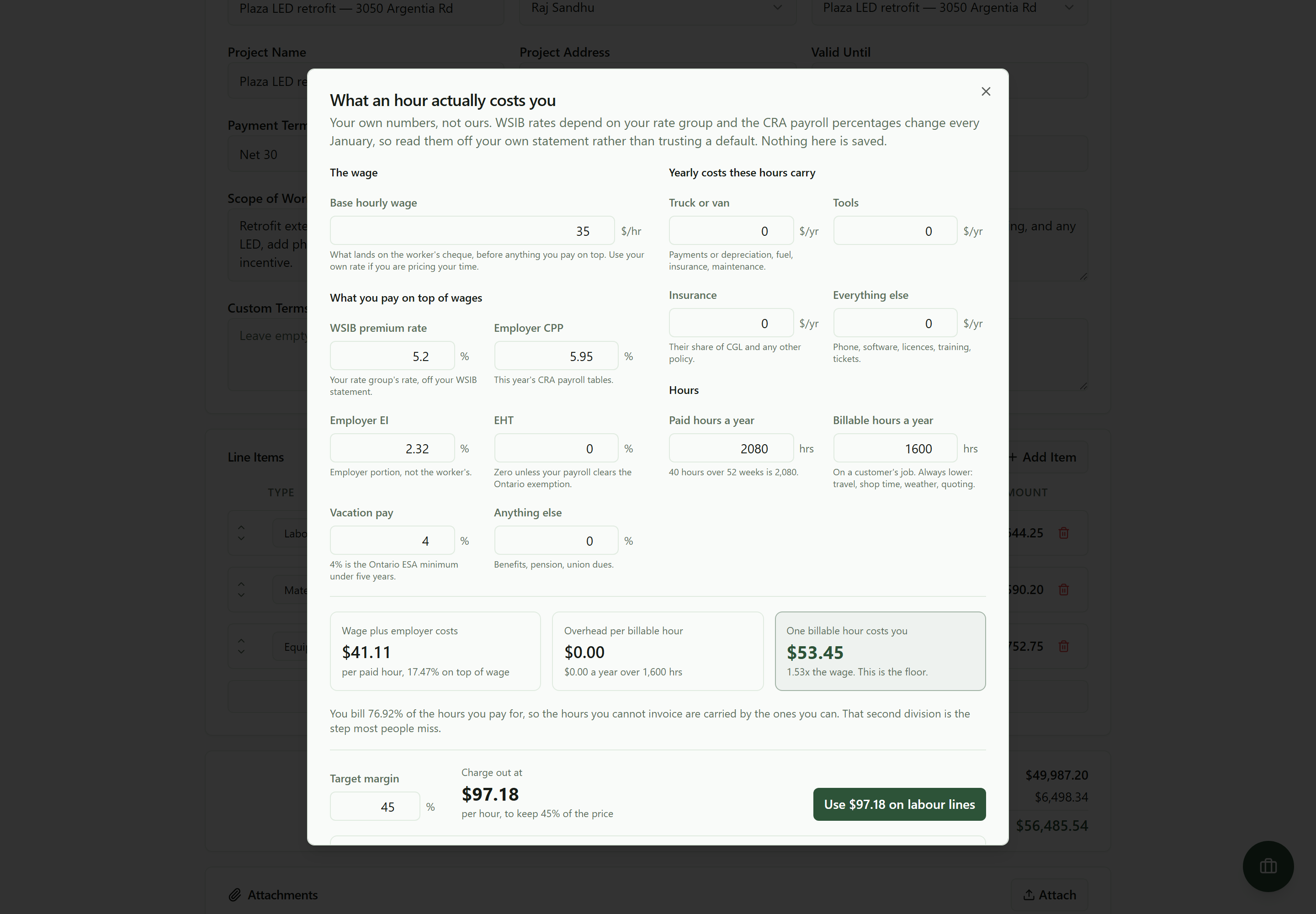 A $35 wage costs an employer $41.11 for every paid hour, and $53.45 for every hour they can bill. The day you sign as a contractor, that gap stops being their problem.
Work through what a $35 wage costs the person paying it. WSIB at the shop's own rate group, the employer half of CPP, the employer share of EI, and vacation pay at 4%, the Ontario ESA minimum, put the paid hour at $41.11. That is 17.47% on top of the wage before a truck or a tool enters the picture.
Then the division nobody mentions in the offer. An employer pays for roughly 2,080 hours a year and bills something like 1,600 of them. Travel, shop time, weather, quoting. The hours that cannot be billed are carried by the ones that can, so the hour your boss actually sells costs them $53.45. As a contractor, those unbillable hours become yours to carry too, along with the HST returns, the invoicing, and the chasing of your own payment.
The rates in the picture are the demo's, not yours. The calculator ships empty on purpose, because a WSIB rate belongs to a rate group and the CRA percentages change every January. Put your own wage in and the number that comes out is the wage you would need just to stand still. It is never your current wage plus five dollars.
Whether the deal is even what it says it is
There is a harder problem underneath the arithmetic: calling someone a contractor does not make them one. CRA and WSIB decide from the facts of the work, not from the paper. Paid by the hour, one client, their tools, their schedule, no chance of profit and no risk of loss: those facts describe an employee, whatever name is on the invoice, and the commenter above was right to call it misclassification.
The rulings run on questionnaires about how the work actually happens, and they land on people who had every reason to believe their setup was fine:
"I completed the questionnaire but now WSIB has deemed me a worker of the staffing agency for WSIB purposes and asking to pay WSIB premiums. I have never had to do this my entire contracting experience"
The corporation the bookkeeper wants you to open has its own version of this. A company whose only customer is your old boss, doing the same work on the same schedule, can be treated by CRA as an incorporated employee. The tax advantages that made the idea sound clever are precisely what that treatment takes away. None of this page is a ruling and no software can make one; the point is that the ruling belongs to CRA and WSIB, and the facts of your week decide it.
If you are going out on your own anyway
Sometimes the answer is yes. Not because a bookkeeper suggested it, but because you want your own customers, your own price, and your own name on the truck. That is a different decision, and it deserves real numbers instead of a hallway pitch.
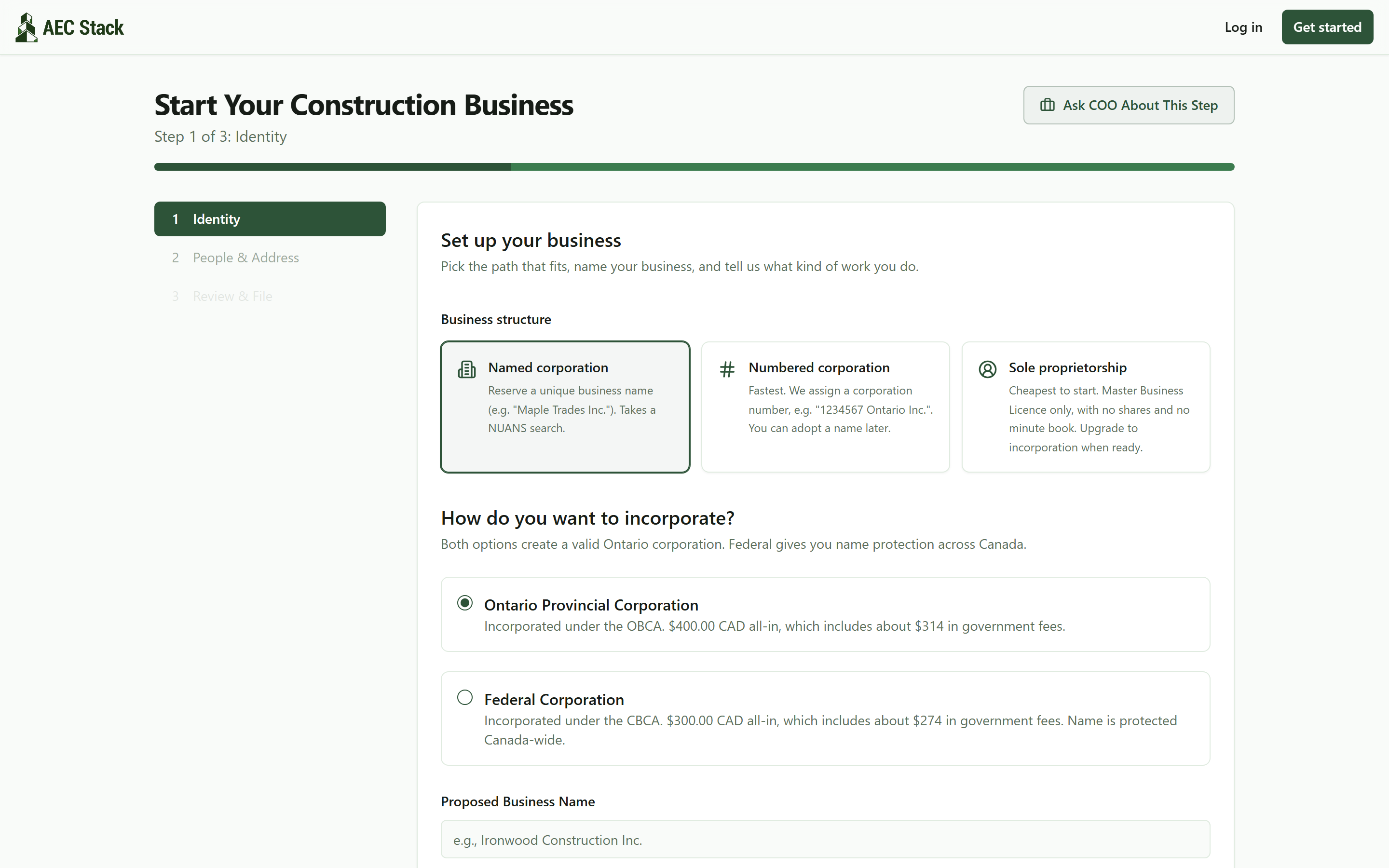 What you are actually being asked to take on, priced plainly: both corporation paths and the sole proprietorship, with the government fees inside the number.
The launch wizard puts the three structures on one screen with the government fees inside the price: a sole proprietorship at $100 all-in, an Ontario corporation at $400, federal at $300. Which one fits is its own question, worked through in the structure guide, and when you decide, the filing is done for you.
Before any of that, set your rate the way the people who survive the first year set it. Work out what your hour costs with your own numbers, then price the whole year, the WSIB premium and the insurance and the slow months included. In the demo above, the same screen that shows a $35 wage costing $53.45 a billable hour also works the rate backwards: at a 45% margin it says charge $97.18. If the number in the offer is your old wage plus a little, you now know exactly whose deal it is.
What it costs
Commercial terms depend on the workflow. Review the relevant AEC Stack product page before you start.
Run your own wage through the cost of an hour before you answer the bookkeeper. If the deal survives your arithmetic, the wizard will price the company honestly. If it does not survive the arithmetic, that is your answer, and it cost you nothing to find out.
Take this guide with you
The full write-up, every screenshot and clip, captions, and a machine-readable manifest in one zip. Share it with your office or hand it to whoever runs your socials.
Download the kitContinue reading